
将基于社区的国家卫生工作者项目纳入卫生系统:一项系统评价,确定从中低收入国家吸取的经验教训。
Integrating national community-based health worker programmes into health systems: a systematic review identifying lessons learned from low-and middle-income countries.
作者信息
Zulu Joseph Mumba, Kinsman John, Michelo Charles, Hurtig Anna-Karin
机构信息
Department of Public Health, School of Medicine, University of Zambia, P,O, Box 50110, Lusaka, Zambia.
出版信息
BMC Public Health. 2014 Sep 22;14:987. doi: 10.1186/1471-2458-14-987.
BACKGROUND
Despite the development of national community-based health worker (CBHW) programmes in several low- and middle-income countries, their integration into health systems has not been optimal. Studies have been conducted to investigate the factors influencing the integration processes, but systematic reviews to provide a more comprehensive understanding are lacking.
METHODS
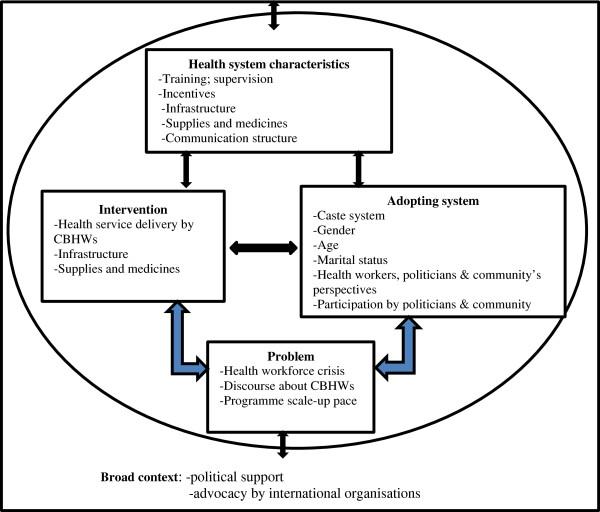
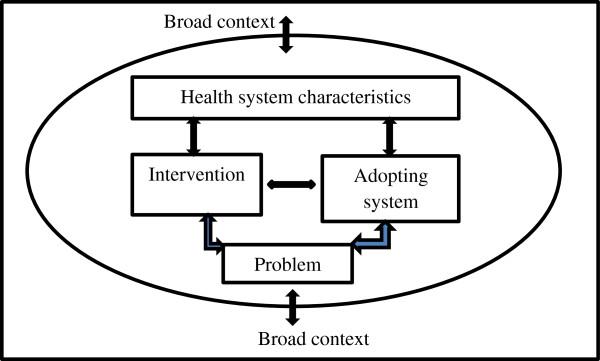
We conducted a systematic review of published research to understand factors that may influence the integration of national CBHW programmes into health systems in low- and middle-income countries. To be included in the study, CBHW programmes should have been developed by the government and have standardised training, supervision and incentive structures. A conceptual framework on the integration of health innovations into health systems guided the review. We identified 3410 records, of which 36 were finally selected, and on which an analysis was conducted concerning the themes and pathways associated with different factors that may influence the integration process.
RESULTS
Four programmes from Brazil, Ethiopia, India and Pakistan met the inclusion criteria. Different aspects of each of these programmes were integrated in different ways into their respective health systems. Factors that facilitated the integration process included the magnitude of countries' human resources for health problems and the associated discourses about how to address these problems; the perceived relative advantage of national CBHWs with regard to delivering health services over training and retaining highly skilled health workers; and the participation of some politicians and community members in programme processes, with the result that they viewed the programmes as legitimate, credible and relevant. Finally, integration of programmes within the existing health systems enhanced programme compatibility with the health systems' governance, financing and training functions. Factors that inhibited the integration process included a rapid scale-up process; resistance from other health workers; discrimination of CBHWs based on social, gender and economic status; ineffective incentive structures; inadequate infrastructure and supplies; and hierarchical and parallel communication structures.
CONCLUSIONS
CBHW programmes should design their scale-up strategy differently based on current contextual factors. Further, adoption of a stepwise approach to the scale-up and integration process may positively shape the integration process of CBHW programmes into health systems.
背景
尽管多个低收入和中等收入国家已开展了基于社区的卫生工作者(CBHW)国家项目,但这些项目融入卫生系统的情况并不理想。已有研究对影响整合过程的因素进行了调查,但缺乏能提供更全面理解的系统评价。
方法
我们对已发表的研究进行了系统评价,以了解可能影响低收入和中等收入国家CBHW国家项目融入卫生系统的因素。纳入研究的CBHW项目应由政府制定,并具备标准化的培训、监督和激励结构。一个关于将卫生创新融入卫生系统的概念框架指导了该评价。我们识别出3410条记录,最终选取了36条,并针对可能影响整合过程的不同因素相关的主题和途径进行了分析。
结果
来自巴西、埃塞俄比亚、印度和巴基斯坦的四个项目符合纳入标准。这些项目的不同方面以不同方式融入了各自的卫生系统。促进整合过程的因素包括各国卫生人力资源应对卫生问题的规模以及关于如何解决这些问题的相关论述;国家CBHW在提供卫生服务方面相对于培训和留住高技能卫生工作者的感知相对优势;一些政治家和社区成员参与项目过程,结果他们认为这些项目是合法、可信且相关的。最后,项目在现有卫生系统内的整合增强了项目与卫生系统治理、融资和培训功能的兼容性。阻碍整合过程的因素包括快速扩大规模的过程;其他卫生工作者的抵制;基于社会、性别和经济地位对CBHW的歧视;无效的激励结构;基础设施和物资不足;以及层级和平行的沟通结构。
结论
CBHW项目应根据当前的背景因素以不同方式设计其扩大规模战略。此外,对扩大规模和整合过程采用逐步推进的方法可能会积极影响CBHW项目融入卫生系统的过程。

 Zotero 插件