Lee Woogul, Kim Sung-il
Department of Education and bMRI (Brain and Motivation Research Institute), Korea University, Seoul, Korea.
PLoS One. 2014 Sep 24;9(9):e107254. doi: 10.1371/journal.pone.0107254. eCollection 2014.
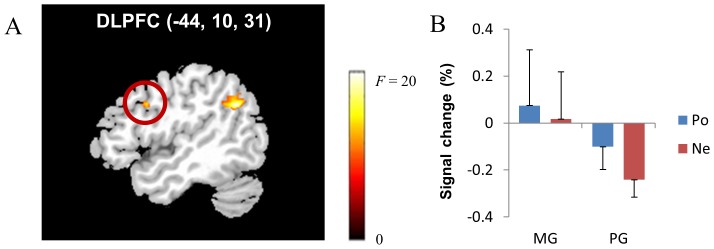
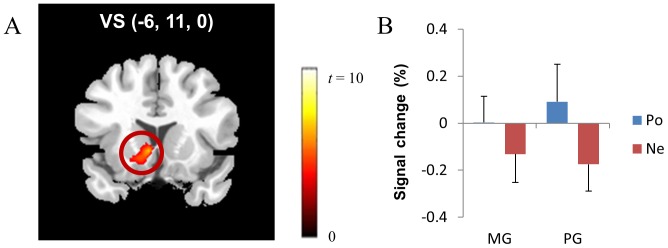
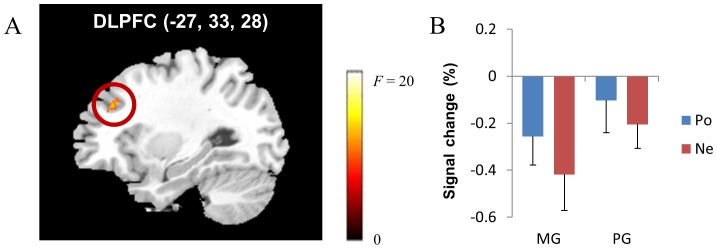
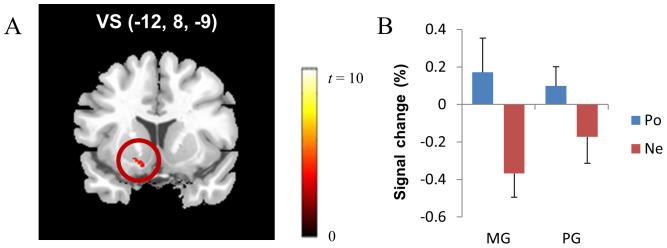
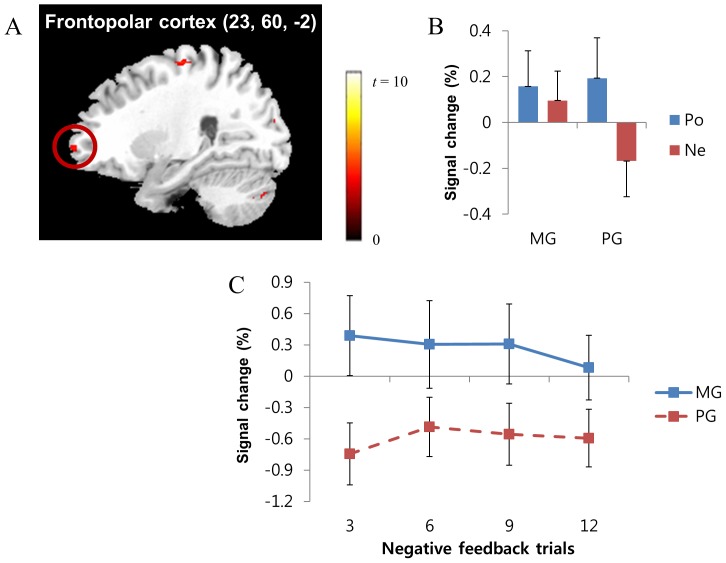
We conducted behavioral and functional magnetic resonance imaging (fMRI) research to investigate the effects of two types of achievement goals--mastery goals and performance-approach goals--on challenge seeking and feedback processing. The results of the behavioral experiment indicated that mastery goals were associated with a tendency to seek challenge, both before and after experiencing difficulty during task performance, whereas performance-approach goals were related to a tendency to avoid challenge after encountering difficulty during task performance. The fMRI experiment uncovered a significant decrease in ventral striatal activity when participants received negative feedback for any task type and both forms of achievement goals. During the processing of negative feedback for the rule-finding task, performance-approach-oriented participants showed a substantial reduction in activity in the dorsolateral prefrontal cortex (DLPFC) and the frontopolar cortex, whereas mastery-oriented participants showed little change. These results suggest that performance-approach-oriented participants are less likely to either recruit control processes in response to negative feedback or focus on task-relevant information provided alongside the negative feedback. In contrast, mastery-oriented participants are more likely to modulate aversive valuations to negative feedback and focus on the constructive elements of feedback in order to attain their task goals. We conclude that performance-approach goals lead to a reluctant stance towards difficulty, while mastery goals encourage a proactive stance.
我们进行了行为学和功能磁共振成像(fMRI)研究,以探究两种成就目标——掌握目标和成绩-趋近目标——对挑战寻求和反馈处理的影响。行为实验结果表明,掌握目标与在任务执行过程中遇到困难之前和之后寻求挑战的倾向相关,而成绩-趋近目标则与在任务执行过程中遇到困难后避免挑战的倾向相关。fMRI实验发现,当参与者对任何任务类型以及两种成就目标形式收到负面反馈时,腹侧纹状体活动显著减少。在对规则发现任务进行负面反馈处理期间,以成绩-趋近为导向的参与者在背外侧前额叶皮层(DLPFC)和额极皮层的活动大幅减少,而以掌握为导向的参与者则变化不大。这些结果表明,以成绩-趋近为导向的参与者不太可能因应负面反馈而调用控制过程,也不太可能关注负面反馈附带的与任务相关的信息。相比之下,以掌握为导向的参与者更有可能调整对负面反馈的厌恶评价,并关注反馈中的建设性元素,以实现其任务目标。我们得出结论,成绩-趋近目标导致对困难采取不情愿的态度,而掌握目标则鼓励积极主动的态度。