van den Bos Wouter, Güroğlu Berna, van den Bulk Bianca G, Rombouts Serge A R B, Crone Eveline A
Institute of Psychology, Leiden University Leiden, The Netherlands.
Front Hum Neurosci. 2009 Dec 1;3:52. doi: 10.3389/neuro.09.052.2009. eCollection 2009.
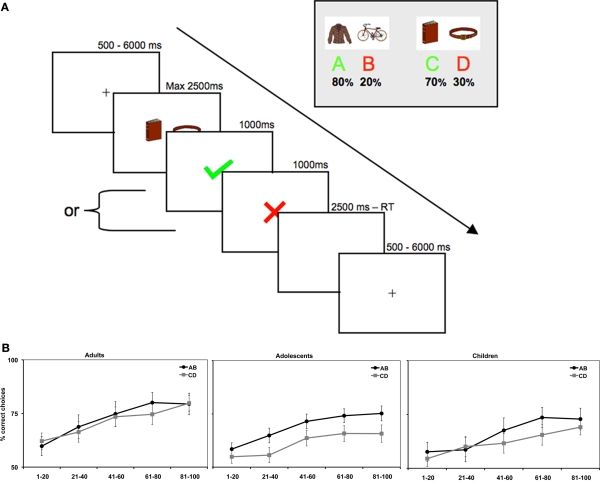
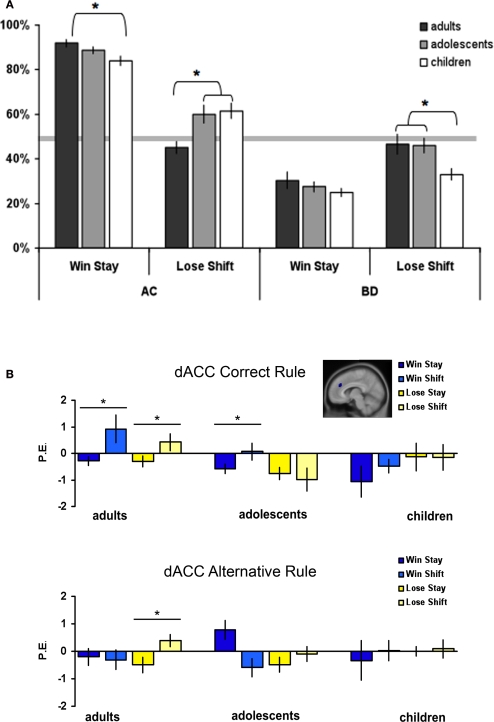
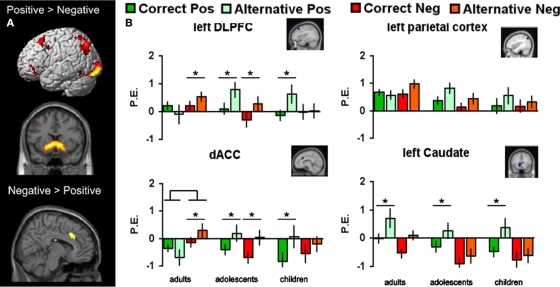
Learning from feedback lies at the foundation of adaptive behavior. Two prior neuroimaging studies have suggested that there are qualitative differences in how children and adults use feedback by demonstrating that dorsolateral prefrontal cortex (DLPFC) and parietal cortex were more active after negative feedback for adults, but after positive feedback for children. In the current study we used functional magnetic resonance imaging (fMRI) to test whether this difference is related to valence or informative value of the feedback by examining neural responses to negative and positive feedback while applying probabilistic rules. In total, 67 healthy volunteers between ages 8 and 22 participated in the study (8-11 years, n = 18; 13-16 years, n = 27; 18-22 years, n = 22). Behavioral comparisons showed that all participants were able to learn probabilistic rules equally well. DLPFC and dorsal anterior cingulate cortex were more active in younger children following positive feedback and in adults following negative feedback, but only when exploring alternative rules, not when applying the most advantageous rules. These findings suggest that developmental differences in neural responses to feedback are not related to valence per se, but that there is an age-related change in processing learning signals with different informative value.
从反馈中学习是适应性行为的基础。之前的两项神经影像学研究表明,儿童和成人在利用反馈方面存在质的差异,研究表明,背外侧前额叶皮层(DLPFC)和顶叶皮层在成人得到负面反馈后更活跃,而在儿童得到正面反馈后更活跃。在本研究中,我们使用功能磁共振成像(fMRI)来测试这种差异是否与反馈的效价或信息价值相关,通过在应用概率规则时检查对负面和正面反馈的神经反应。共有67名8至22岁的健康志愿者参与了该研究(8 - 11岁,n = 18;13 - 16岁,n = 27;18 - 22岁,n = 22)。行为比较表明,所有参与者都能同样好地学习概率规则。在探索替代规则时,年幼的儿童在得到正面反馈后以及成年人在得到负面反馈后,背外侧前额叶皮层和背侧前扣带回皮层更活跃,但在应用最有利的规则时则不然。这些发现表明,对反馈的神经反应的发育差异与效价本身无关,而是在处理具有不同信息价值的学习信号方面存在与年龄相关的变化。