Lo Ernest, Hamel Denis, Jen Yun, Lamontagne Patricia, Martel Sylvie, Steensma Colin, Blouin Chantal, Steele Russell
Institut National de Santé Publique du Québec, 190 blvd Crémazie Est, Montréal, Québec H2P 1E2, Canada.
BMC Public Health. 2014 Sep 25;14:996. doi: 10.1186/1471-2458-14-996.
Projection analyses can provide estimates of the future health burden of increasing BMI and represent a relevant and useful tool for public health planning. Our study presents long-term (2013-2030) projections of the prevalence and numbers of individuals by BMI category for adult men and women in Quebec. Three applications of projections to estimate outcomes more directly pertinent to public health planning, as well as an in-depth discussion of limits, are provided with the aim of encouraging greater use of projection analyses by public health officers.
The weighted compositional regression method is applied to prevalence time series derived from sixteen cross-sectional survey cycles, for scenarios of linear change and deceleration. Estimation of the component of projected change potentially amenable to intervention, future health targets and the projected impact on type 2 diabetes, were done.
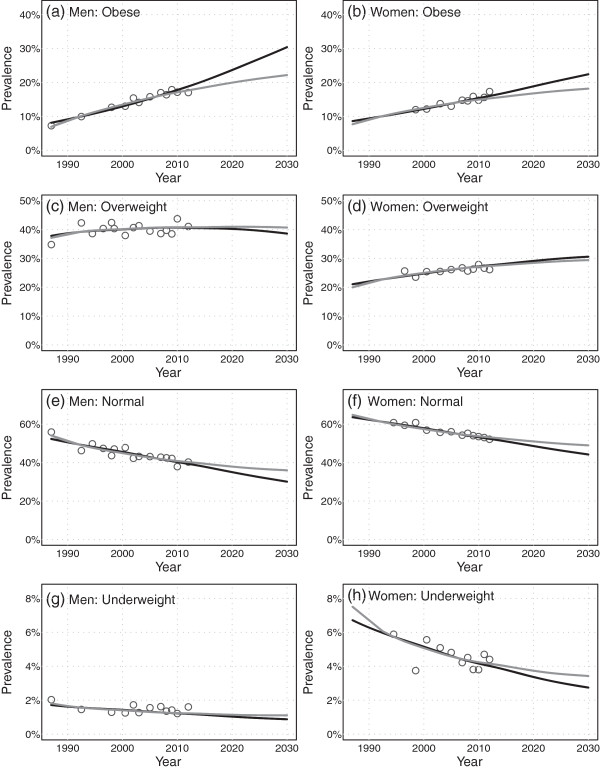
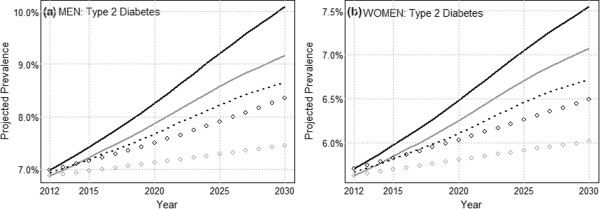
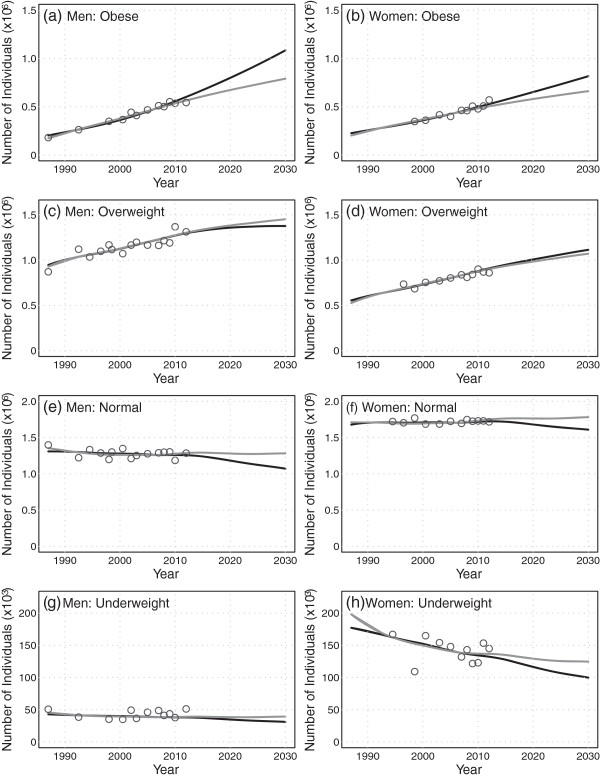
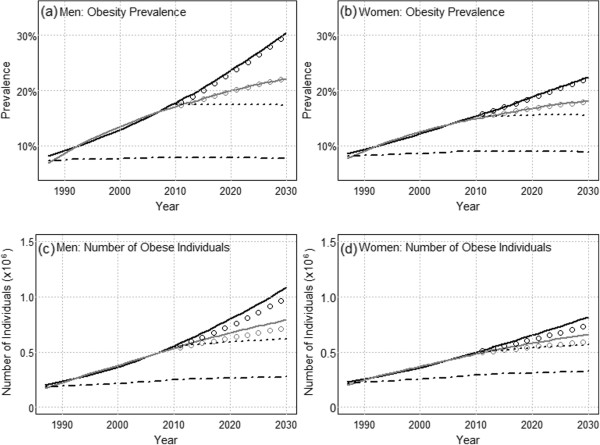
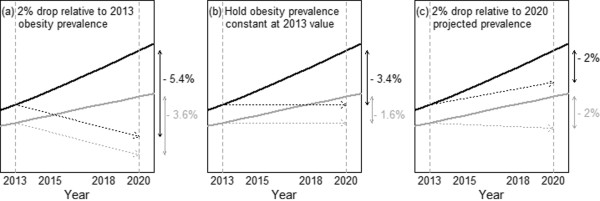
Obesity prevalence in Quebec is projected to rise steadily from 2013 to 2030 in both men (from 18.0-19.4% to 22.2-30.4%) and women (from 15.5-16.3% to 18.2-22.4%). Corresponding projected numbers of obese individuals are (579,000-625,000 to 790,000-1,084,000) in men and (514,000-543,000 to 661,000-816,000) in women. These projected increases are found to be primarily an 'epidemiologic' rather than 'demographic' phenomenon and thus potentially amenable to public health intervention. Assessment of obesity targets for 2020 illustrates the necessity of using projected rather than current prevalence; for example a targeted 2% drop in obesity prevalence relative to 2013 translates into a 3.6-5.4% drop relative to 2020 projected levels. Type 2 diabetes is projected to increase from 6.9% to 9.2-10.1% in men and from 5.7% to 7.1-7.5% in women, from 2011-2012 to 2030. A substantial proportion of this change (25-44% for men, and 27-43% for women) is attributable to the changing BMI distribution.
Obesity in Quebec is projected to increase and should therefore continue to be a public health priority. Application of projections to estimate the proportion of change potentially amenable to intervention, feasible health targets, and future chronic disease prevalence are demonstrated. Projection analyses have limitations, but represent a pertinent tool for public health planning.
预测分析可以估算体重指数(BMI)上升对未来健康造成的负担,是公共卫生规划中一种相关且有用的工具。我们的研究呈现了魁北克成年男性和女性按BMI类别划分的患病率及人数的长期(2013 - 2030年)预测。提供了预测的三种应用,以更直接地估算与公共卫生规划相关的结果,并深入讨论了局限性,目的是鼓励公共卫生官员更多地使用预测分析。
将加权成分回归方法应用于从16个横断面调查周期得出的患病率时间序列,以分析线性变化和减速情况。对预计变化中可能适合干预的部分、未来健康目标以及对2型糖尿病的预计影响进行了估算。
预计魁北克的肥胖患病率在2013年至2030年期间男性(从18.0 - 19.4%升至22.2 - 30.4%)和女性(从15.5 - 16.3%升至18.2 - 22.4%)均稳步上升。相应的肥胖个体预计数量男性为(579,000 - 625,000至790,000 - 1,084,000),女性为(514,000 - 543,000至661,000 - 816,000)。这些预计的增长主要是一种“流行病学”而非“人口统计学”现象,因此可能适合公共卫生干预。对2020年肥胖目标的评估表明使用预计患病率而非当前患病率的必要性;例如,相对于2013年将肥胖患病率目标降低2%,相对于2020年预计水平则意味着降低3.6 - 5.4%。预计2型糖尿病在男性中从2011 - 2012年的6.9%升至2030年的9.2 - 10.1%,在女性中从5.7%升至7.1 - 7.5%。这一变化的很大一部分(男性为25 - 44%,女性为27 - 43%)可归因于BMI分布的变化。
预计魁北克的肥胖情况会增加,因此应继续作为公共卫生的重点。展示了运用预测来估算可能适合干预的变化比例、可行的健康目标以及未来慢性病患病率。预测分析有局限性,但仍是公共卫生规划的一种相关工具。