Thielman Justin, Harrington Daniel, Rosella Laura C, Manson Heather
Department of Health Promotion, Chronic Disease & Injury Prevention Public Health Ontario, Toronto, Ontario, Canada.
School of Public Health and Health Systems, University of Waterloo, Waterloo, Canada.
BMJ Open. 2018 Sep 5;8(9):e022029. doi: 10.1136/bmjopen-2018-022029.
To evaluate whether combining three cycles of the Canadian Health Measures Survey (CHMS) produces provincially representative and valid estimates of overweight and obesity in Ontario and Quebec.
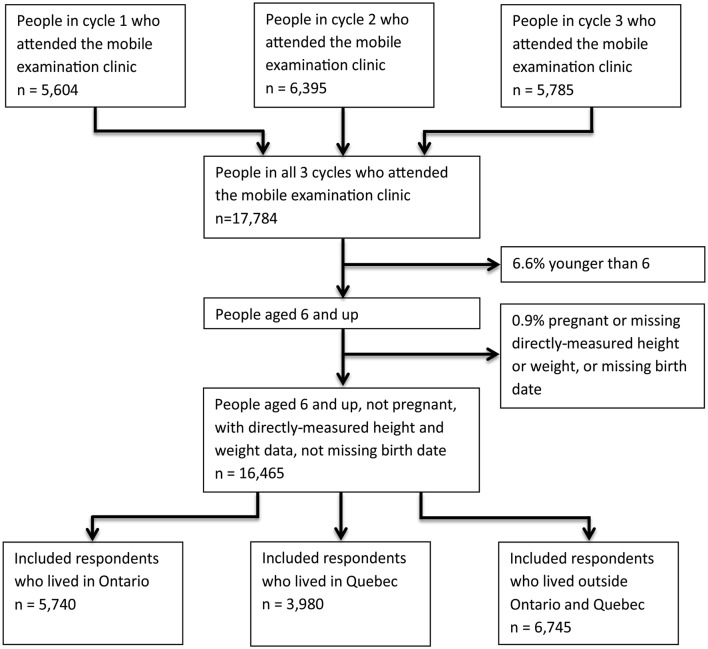
An ongoing, nationally representative health survey in Canada, with data released every 2 years. Objective measures of height and weight were taken at mobile examination centres located within 100 km of participants' residences. To increase sample size, we combined three cycles completed during 2007-2013.
5740 Ontario residents and 3980 Quebec residents aged 6-79, with birth dates and directly measured height and weight recorded in the CHMS. Pregnant females were excluded. Sociodemographic characteristics of the Ontario and Quebec portions of the CHMS appeared similar to characteristics from the 2006 Canada Census.
Objectively measured overweight and obesity prevalence overall and among males and females in the following age groups: 6-11, 12-19, 20-39, 40-59 and 60-79. We compared these with provincially representative and objectively measured estimates from the 2015 Canadian Community Health Survey (CCHS)-Nutrition.
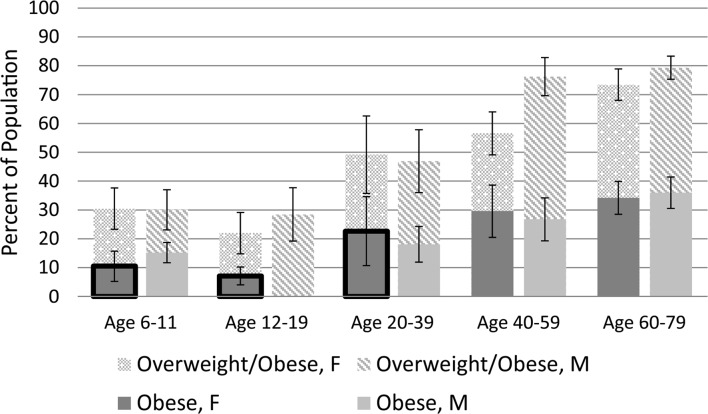
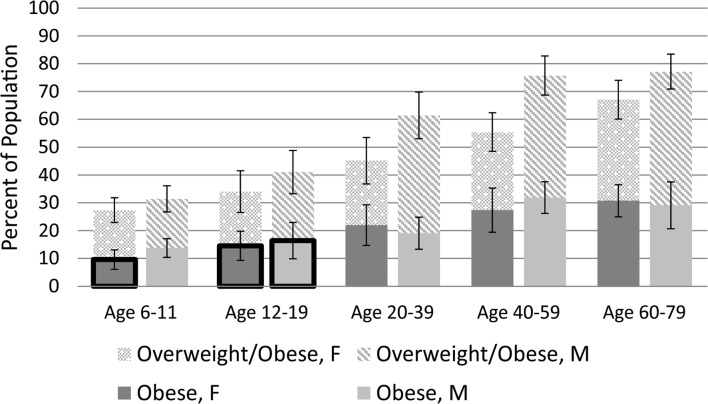
57.1% (95% CI 52.8% to 61.4%) of Ontarians were classified overweight or obese and 24.0% (95% CI 20.3% to 27.6%) obese, while Quebec's corresponding percentages were 56.2% (95% CI 51.3% to 61.1%) and 24.4% (95% CI 20.6% to 28.3%). Generally, overweight and obesity combined was higher in older age groups and males. Comparisons with the CCHS-Nutrition did not yield unexplainable differences between surveys.
Combining three CHMS cycles can produce estimates of overweight and obesity in populations representative of Ontario and Quebec. As new CHMS data are collected, these estimates can be updated and used to evaluate trends.
评估合并三个周期的加拿大健康措施调查(CHMS)是否能得出安大略省和魁北克省具有全省代表性且有效的超重和肥胖估计值。
一项正在进行的、具有全国代表性的加拿大健康调查,每两年发布一次数据。在距离参与者住所100公里范围内的流动检查中心对身高和体重进行客观测量。为增加样本量,我们合并了2007年至2013年期间完成的三个周期的数据。
5740名年龄在6至79岁之间的安大略省居民和3980名魁北克省居民,其出生日期以及在CHMS中直接测量的身高和体重均有记录。排除怀孕女性。CHMS中安大略省和魁北克省部分的社会人口学特征与2006年加拿大人口普查的特征相似。
总体以及以下年龄组男性和女性中客观测量的超重和肥胖患病率:6至11岁、12至19岁、20至39岁、40至59岁和60至79岁。我们将这些数据与2015年加拿大社区健康调查(CCHS)-营养部分中具有全省代表性且经客观测量的估计值进行了比较。
57.1%(95%置信区间52.8%至61.4%)的安大略省居民被归类为超重或肥胖,24.0%(95%置信区间20.3%至27.6%)为肥胖,而魁北克省的相应百分比分别为56.2%(95%置信区间51.3%至61.1%)和24.4%(95%置信区间20.6%至28.3%)。一般来说,年龄较大的群体和男性中超重和肥胖合并患病率较高。与CCHS-营养部分的比较在各调查之间未产生无法解释的差异。
合并三个CHMS周期可以得出代表安大略省和魁北克省人群的超重和肥胖估计值。随着新的CHMS数据的收集,这些估计值可以更新并用于评估趋势。