Department of Epidemiology, German Institute of Human Nutrition Potsdam- Rehbruecke, Nuthetal, Germany.
PLoS One. 2011;6(11):e27455. doi: 10.1371/journal.pone.0027455. Epub 2011 Nov 10.
To investigate trends in obesity prevalence in recent years and to predict the obesity prevalence in 2015 in European populations.
Data of 97,942 participants from seven cohorts involved in the European Prospective Investigation into Cancer and Nutrition (EPIC) study participating in the Diogenes project (named as "Diogenes cohort" in the following) with weight measurements at baseline and follow-up were used to predict future obesity prevalence with logistic linear and non-linear (leveling off) regression models. In addition, linear and leveling off models were fitted to the EPIC-Potsdam dataset with five weight measures during the observation period to find out which of these two models might provide the more realistic prediction.
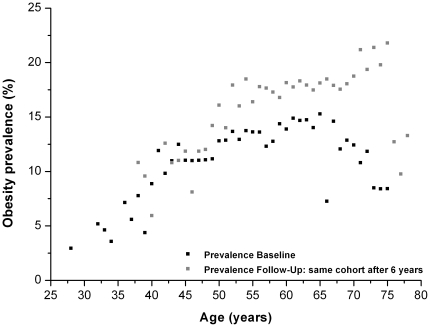
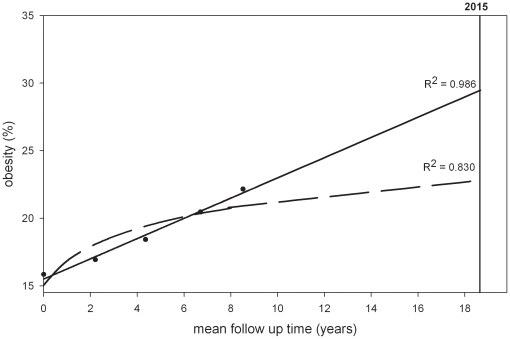
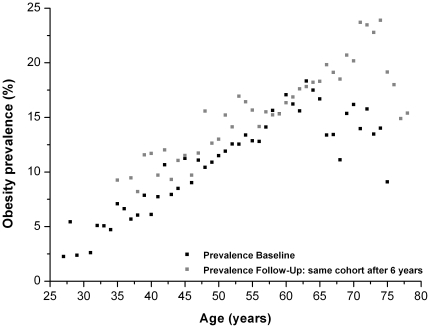
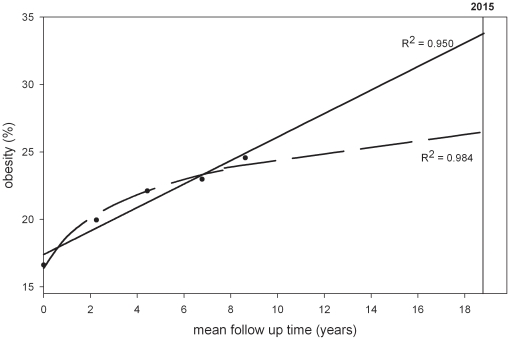
During a mean follow-up period of 6 years, the obesity prevalence in the Diogenes cohort increased from 13% to 17%. The linear prediction model predicted an overall obesity prevalence of about 30% in 2015, whereas the leveling off model predicted a prevalence of about 20%. In the EPIC-Potsdam cohort, the shape of obesity trend favors a leveling off model among men (R² = 0.98), and a linear model among women (R² = 0.99).
Our data show an increase in obesity prevalence since the 1990ies, and predictions by 2015 suggests a sizeable further increase in European populations. However, the estimates from the leveling off model were considerably lower.
研究近年来肥胖患病率的趋势,并预测 2015 年欧洲人群的肥胖患病率。
利用参与欧洲癌症前瞻性调查与营养研究(EPIC)的七个队列中 97942 名参与者的数据,这些参与者参与了 Diogenes 项目(在以下内容中称为“Diogenes 队列”),在基线和随访时进行了体重测量,使用逻辑线性和非线性(平稳)回归模型预测未来肥胖的患病率。此外,还对 EPIC-Potsdam 数据集进行了线性和平稳模型拟合,以在观察期间进行五次体重测量,以找出这两种模型中哪一种可能提供更现实的预测。
在平均 6 年的随访期间,Diogenes 队列的肥胖患病率从 13%增加到 17%。线性预测模型预测 2015 年总体肥胖患病率约为 30%,而平稳模型预测患病率约为 20%。在 EPIC-Potsdam 队列中,男性肥胖趋势的形状有利于平稳模型(R²=0.98),而女性肥胖趋势则有利于线性模型(R²=0.99)。
我们的数据显示,自 20 世纪 90 年代以来肥胖患病率有所增加,到 2015 年的预测表明欧洲人群的肥胖患病率将进一步大幅增加。然而,平稳模型的估计值要低得多。