Cordero David, Solé Xavier, Crous-Bou Marta, Sanz-Pamplona Rebeca, Paré-Brunet Laia, Guinó Elisabet, Olivares David, Berenguer Antonio, Santos Cristina, Salazar Ramón, Biondo Sebastiano, Moreno Víctor
Unit of Biomarkers and Susceptibility, Cancer Prevention and Control Program, Catalan Institute of Oncology (ICO), Av Gran Via 199-203, E-08907 L'Hospitalet de Llobregat, Barcelona, Spain.
BMC Cancer. 2014 Sep 24;14:708. doi: 10.1186/1471-2407-14-708.
Dysregulation of transcriptional programs leads to cell malfunctioning and can have an impact in cancer development. Our study aims to characterize global differences between transcriptional regulatory programs of normal and tumor cells of the colon.
Affymetrix Human Genome U219 expression arrays were used to assess gene expression in 100 samples of colon tumor and their paired adjacent normal mucosa. Transcriptional networks were reconstructed using ARACNe algorithm using 1,000 bootstrap replicates consolidated into a consensus network. Networks were compared regarding topology parameters and identified well-connected clusters. Functional enrichment was performed with SIGORA method. ENCODE ChIP-Seq data curated in the hmChIP database was used for in silico validation of the most prominent transcription factors.
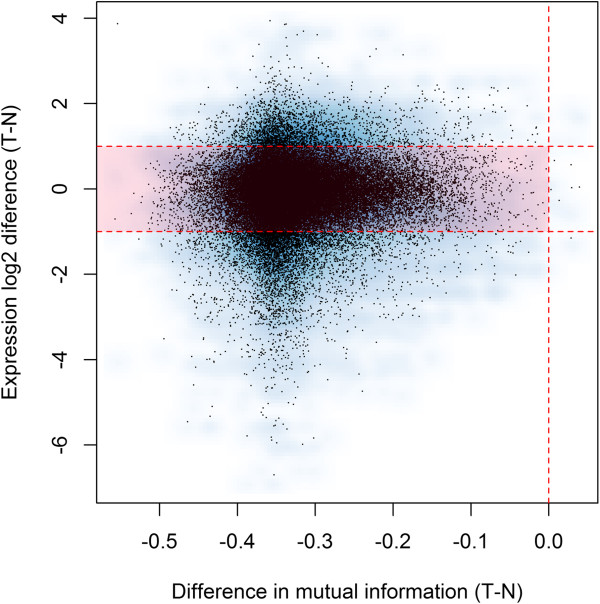
The normal network contained 1,177 transcription factors, 5,466 target genes and 61,226 transcriptional interactions. A large loss of transcriptional interactions in the tumor network was observed (11,585; 81% reduction), which also contained fewer transcription factors (621; 47% reduction) and target genes (2,190; 60% reduction) than the normal network. Gene silencing was not a main determinant of this loss of regulatory activity, since the average gene expression was essentially conserved. Also, 91 transcription factors increased their connectivity in the tumor network. These genes revealed a tumor-specific emergent transcriptional regulatory program with significant functional enrichment related to colorectal cancer pathway. In addition, the analysis of clusters again identified subnetworks in the tumors enriched for cancer related pathways (immune response, Wnt signaling, DNA replication, cell adherence, apoptosis, DNA repair, among others). Also multiple metabolism pathways show differential clustering between the tumor and normal network.
These findings will allow a better understanding of the transcriptional regulatory programs altered in colon cancer and could be an invaluable methodology to identify potential hubs with a relevant role in the field of cancer diagnosis, prognosis and therapy.
转录程序失调会导致细胞功能异常,并可能影响癌症的发展。我们的研究旨在表征结肠正常细胞和肿瘤细胞转录调控程序之间的整体差异。
使用Affymetrix人类基因组U219表达阵列评估100个结肠肿瘤样本及其配对的相邻正常黏膜中的基因表达。使用ARACNe算法重建转录网络,通过1000次自展重复合并为一个共识网络。比较网络的拓扑参数并识别连接良好的簇。使用SIGORA方法进行功能富集分析。在hmChIP数据库中整理的ENCODE ChIP-Seq数据用于对最突出的转录因子进行计算机模拟验证。
正常网络包含1177个转录因子、5466个靶基因和61226个转录相互作用。在肿瘤网络中观察到转录相互作用大量减少(11585个;减少81%),其转录因子(621个;减少47%)和靶基因(2190个;减少60%)也比正常网络少。基因沉默不是这种调控活性丧失的主要决定因素,因为平均基因表达基本保持不变。此外,91个转录因子在肿瘤网络中的连接性增加。这些基因揭示了一种肿瘤特异性的新兴转录调控程序,与结直肠癌通路具有显著的功能富集相关性。此外,对簇的分析再次在肿瘤中识别出富含癌症相关通路(免疫反应、Wnt信号传导、DNA复制、细胞黏附、凋亡、DNA修复等)的子网络。多个代谢通路在肿瘤网络和正常网络之间也表现出不同的聚类。
这些发现将有助于更好地理解结肠癌中改变的转录调控程序,并且可能是一种在癌症诊断、预后和治疗领域识别具有相关作用的潜在枢纽的宝贵方法。