Yu Christina Y, Mitrofanova Antonina
Department of Biomedical and Health Informatics, School of Health Professions, Rutgers, The State University of New Jersey, Newark, NJ, United States.
Rutgers Cancer Institute of New Jersey, Rutgers, The State University of New Jersey, New Brunswick, NJ, United States.
Front Genet. 2021 Aug 2;12:687813. doi: 10.3389/fgene.2021.687813. eCollection 2021.
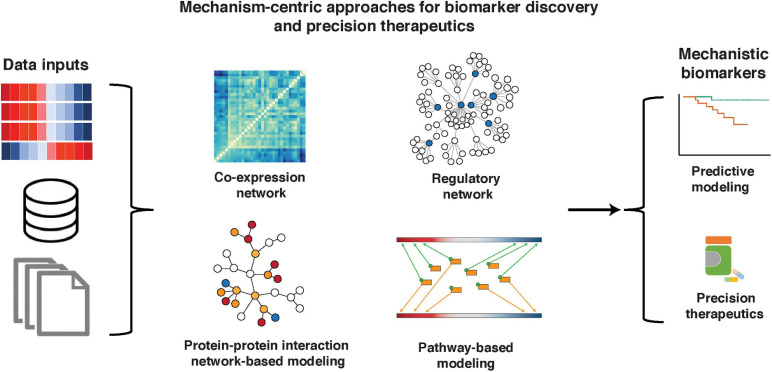
Biomarker discovery is at the heart of personalized treatment planning and cancer precision therapeutics, encompassing disease classification and prognosis, prediction of treatment response, and therapeutic targeting. However, many biomarkers represent passenger rather than driver alterations, limiting their utilization as functional units for therapeutic targeting. We suggest that identification of driver biomarkers through mechanism-centric approaches, which take into account upstream and downstream regulatory mechanisms, is fundamental to the discovery of functionally meaningful markers. Here, we examine computational approaches that identify mechanism-centric biomarkers elucidated from gene co-expression networks, regulatory networks (e.g., transcriptional regulation), protein-protein interaction (PPI) networks, and molecular pathways. We discuss their objectives, advantages over gene-centric approaches, and known limitations. Future directions highlight the importance of input and model interpretability, method and data integration, and the role of recently introduced technological advantages, such as single-cell sequencing, which are central for effective biomarker discovery and time-cautious precision therapeutics.
生物标志物的发现是个性化治疗规划和癌症精准治疗的核心,涵盖疾病分类与预后、治疗反应预测以及治疗靶点确定。然而,许多生物标志物代表的是过客而非驱动改变,限制了它们作为治疗靶点功能单元的应用。我们认为,通过以机制为中心的方法来识别驱动生物标志物,即考虑上游和下游调控机制,对于发现具有功能意义的标志物至关重要。在此,我们研究了从基因共表达网络、调控网络(如转录调控)、蛋白质-蛋白质相互作用(PPI)网络和分子途径中识别以机制为中心的生物标志物的计算方法。我们讨论了它们的目标、相对于以基因为中心的方法的优势以及已知的局限性。未来的方向突出了输入和模型可解释性、方法和数据整合的重要性,以及最近引入的技术优势(如单细胞测序)的作用,这些对于有效的生物标志物发现和及时的精准治疗至关重要。