Wu Zilong, Wang Ziyi, Wang Songyou, Zhong Zhenyang
State Key Laboratory of Surface Physics and Key Laboratory of Micro- and Nano-Photonic Structures (Ministry of Education) and Department of Physics, Fudan University, Shanghai 200433, China.
Key Laboratory of Micro and Nano Photonic Structures, Ministry of Education, Shanghai Engineering Research Center of Ultra-Precision Optical Manufacturing, Department of Optical Science and Engineering, Fudan University, Shanghai 200433, China.
Nanoscale Res Lett. 2014 Sep 15;9(1):495. doi: 10.1186/1556-276X-9-495. eCollection 2014.
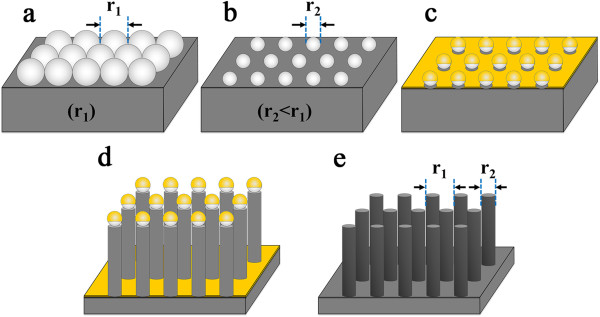
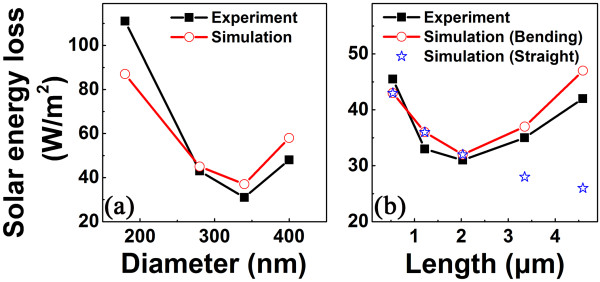
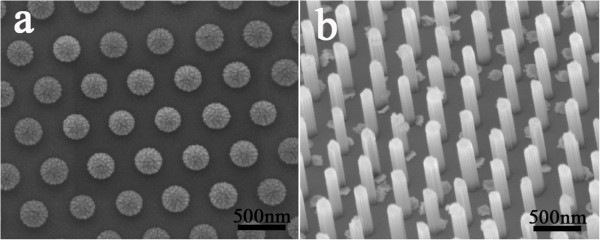
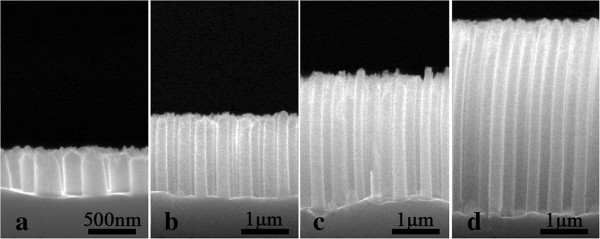
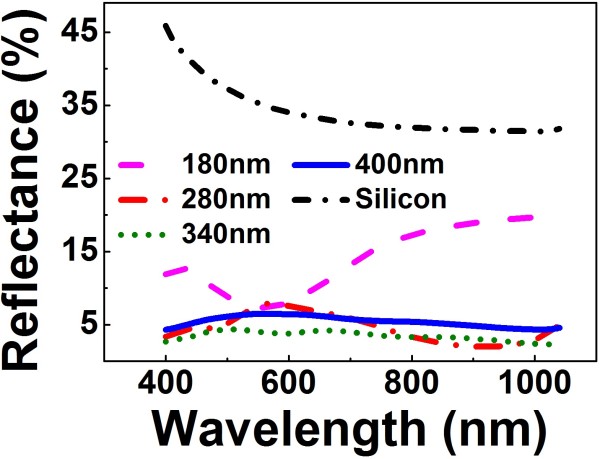
The reflectance of the controlled periodic Si nanowire (NW) arrays is systematically explored, which characterizes the influence on the solar energy harnessing ability by the geometries of the NW. A unique dependence of the reflectance of the Si NW array on the diameter, the height, and the bending of the NW are disclosed. The solar energy loss caused by the reflection of the Si NW array exhibits the minimum for the NW with intermediate diameter and length. A plane-wave-based transfer-matrix method (TMM) simulation is performed, which is well consistent with the experimental results. Our results demonstrate the design principle to optimize the Si NW arrays for high-efficiency solar cells.
81.07.-b; 78.67.-n; 81.16.-c.
系统地研究了可控周期性硅纳米线(NW)阵列的反射率,该反射率表征了NW几何形状对太阳能利用能力的影响。揭示了硅NW阵列反射率对NW直径、高度和弯曲度的独特依赖性。由硅NW阵列反射引起的太阳能损失对于具有中等直径和长度的NW呈现最小值。进行了基于平面波的传输矩阵方法(TMM)模拟,其与实验结果非常吻合。我们的结果证明了优化用于高效太阳能电池的硅NW阵列的设计原则。
81.07.-b;78.67.-n;81.16.-c。