Fraser Mariecia D, Fleming Hannah R, Moorby Jon M
Institute of Biological, Environmental and Rural Sciences, Aberystwyth University, Aberystwyth, Ceredigion, United Kingdom.
PLoS One. 2014 Sep 26;9(9):e107861. doi: 10.1371/journal.pone.0107861. eCollection 2014.
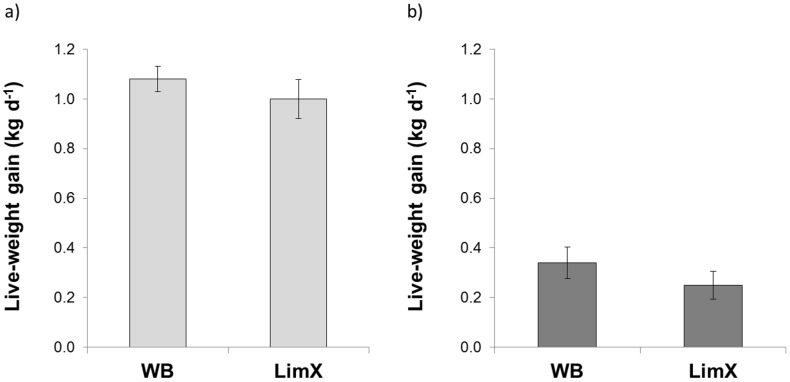
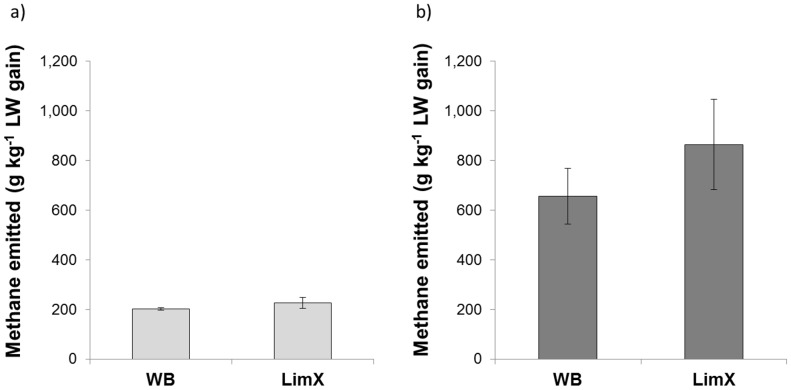
Ruminant livestock turn forages and poor-quality feeds into human edible products, but enteric methane (CH4) emissions from ruminants are a significant contributor to greenhouse gases (GHGs) and hence to climate change. Despite the predominance of pasture-based beef production systems in many parts of Europe there are little data available regarding enteric CH4 emissions from free-ranging grazing cattle. It is possible that differences in physiology or behaviour could influence comparative emissions intensities for traditional and modern breed types depending on the nutritional characteristics of the herbage grazed. This study investigated the role of breed type in influencing CH4 emissions from growing beef steers managed on contrasting grasslands typical of intensive (lowland) and extensive (upland) production systems. Using the SF6 dilution technique CH4 emissions were estimated for a modern, fast-growing crossbred (Limousin cross) and a smaller and hardier native breed (Welsh Black) when grazing lowland perennial ryegrass (high nutritional density, low sward heterogeneity) and semi-improved upland pasture (low/medium nutritional density, high sward heterogeneity). Live-weight gain was substantially lower for steers on the upland system compared to the lowland system (0.31 vs. 1.04 kg d-1; s.e.d. = 0.085 kg d-1; P<0.001), leading to significant differences in estimated dry matter intakes (8.0 vs. 11.1 kg DM d-1 for upland and lowland respectively; s.e.d. = 0.68 kg DM d-1; P<0.001). While emissions per unit feed intake were similar for the lowland and upland systems, CH4 emissions per unit of live-weight gain (LWG) were substantially higher when the steers grazed the poorer quality hill pasture (760 vs 214 g kg-1 LWG; s.e.d. = 133.5 g kg-1 LWG; P<0.001). Overall any effects of breed type were relatively small relative to the combined influence of pasture type and location.
反刍家畜能将草料和低质饲料转化为人类可食用的产品,但反刍动物的肠道甲烷(CH4)排放是温室气体(GHG)的重要来源,因此也是气候变化的重要因素。尽管欧洲许多地区以牧场为基础的牛肉生产系统占主导地位,但关于自由放牧牛的肠道CH4排放数据却很少。根据所采食牧草的营养特性,生理或行为上的差异可能会影响传统和现代品种类型的相对排放强度。本研究调查了品种类型对生长育肥牛CH4排放的影响,这些牛在集约化(低地)和粗放型(高地)生产系统典型的不同草地上饲养。使用SF6稀释技术,估计了现代快速生长的杂交品种(利木赞杂交)和体型较小、更耐寒的本地品种(威尔士黑牛)在采食低地多年生黑麦草(高营养密度、低草皮异质性)和半改良高地牧场(低/中营养密度、高草皮异质性)时的CH4排放量。与低地系统相比,高地系统的育肥牛体重增加显著更低(分别为0.31 vs. 1.04 kg d-1;标准误=0.085 kg d-1;P<0.001),导致估计的干物质摄入量有显著差异(高地和低地分别为8.0 vs. 11.1 kg DM d-1;标准误=0.68 kg DM d-1;P<0.001)。虽然低地和高地系统每单位采食量的排放量相似,但当育肥牛采食质量较差的山地牧场时,每单位体重增加(LWG)的CH4排放量显著更高(760 vs 214 g kg-1 LWG;标准误=133.5 g kg-1 LWG;P<0.001)。总体而言,相对于牧场类型和地点的综合影响,品种类型的任何影响都相对较小。