Saradjian Anahid H, Paleressompoulle Dany, Louber Didier, Coyle Thelma, Blouin Jean, Mouchnino Laurence
Aix-Marseille Université, CNRS, Laboratoire Neurosciences Cognitives UMR 7291, Marseille, France.
Fédération de Recherche 3C Comportement-Cerveau-Cognition, CNRS -Aix-Marseille University, Marseille, France.
PLoS One. 2014 Sep 26;9(9):e108636. doi: 10.1371/journal.pone.0108636. eCollection 2014.
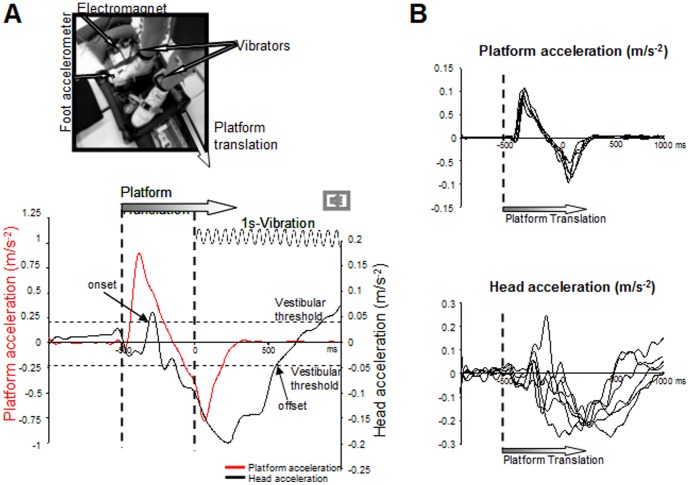
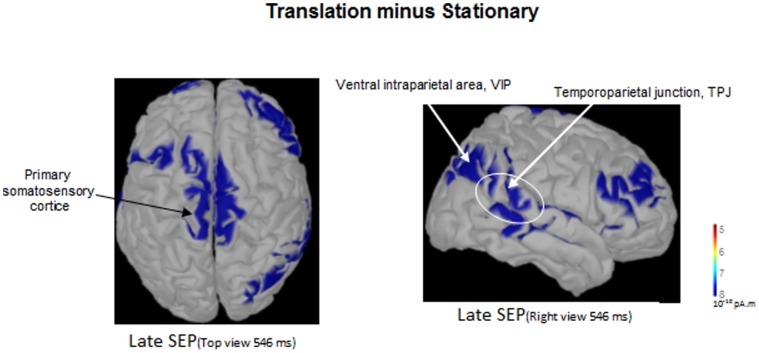
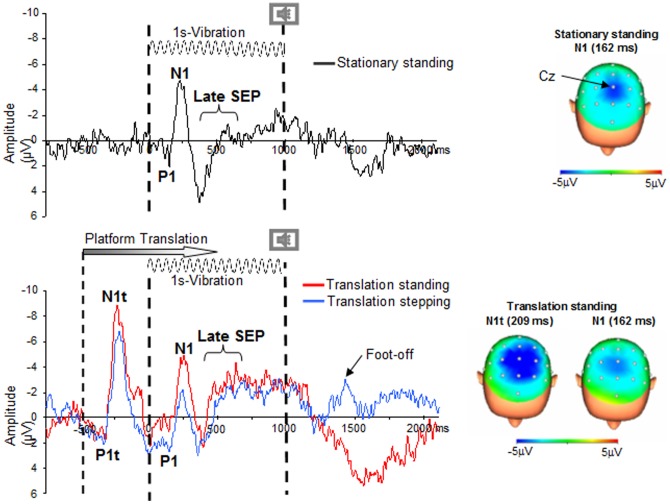
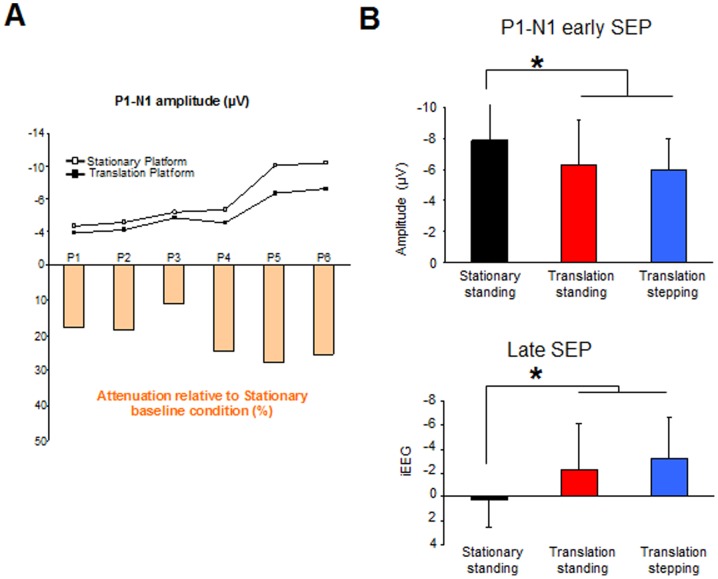
We recently found that the cortical response to proprioceptive stimulation was greater when participants were planning a step than when they stood still, and that this sensory facilitation was suppressed in microgravity. The aim of the present study was to test whether the absence of gravity-related sensory afferents during movement planning in microgravity prevented the proprioceptive cortical processing to be enhanced. We reestablished a reference frame in microgravity by providing and translating a horizontal support on which the participants were standing and verified whether this procedure restored the proprioceptive facilitation. The slight translation of the base of support (lateral direction), which occurred prior to step initiation, stimulated at least cutaneous and vestibular receptors. The sensitivity to proprioceptive stimulation was assessed by measuring the amplitude of the cortical somatosensory-evoked potential (SEP, over the Cz electrode) following the vibration of the leg muscle. The vibration lasted 1 s and the participants were asked to either initiate a step at the vibration offset or to remain still. We found that the early SEP (90-160 ms) was smaller when the platform was translated than when it remained stationary, revealing the existence of an interference phenomenon (i.e., when proprioceptive stimulation is preceded by the stimulation of different sensory modalities evoked by the platform translation). By contrast, the late SEP (550 ms post proprioceptive stimulation onset) was greater when the translation preceded the vibration compared to a condition without pre-stimulation (i.e., no translation). This suggests that restoring a body reference system which is impaired in microgravity allowed a greater proprioceptive cortical processing. Importantly, however, the late SEP was similarly increased when participants either produced a step or remained still. We propose that the absence of step-induced facilitation of proprioceptive cortical processing results from a decreased weight of proprioception in the absence of balance constraints in microgravity.
我们最近发现,与参与者静止站立时相比,他们在计划迈出一步时,皮质对本体感觉刺激的反应更强,并且这种感觉促进在微重力环境中受到抑制。本研究的目的是测试在微重力环境下运动计划过程中与重力相关的感觉传入缺失是否会阻止本体感觉皮质处理能力的增强。我们通过提供并平移一个参与者站立其上的水平支撑物,在微重力环境中重新建立了一个参考系,并验证了这一过程是否恢复了本体感觉促进作用。在迈步开始之前发生的支撑物底部的轻微平移(横向)至少刺激了皮肤和前庭感受器。通过测量腿部肌肉振动后皮质体感诱发电位(SEP,在Cz电极上方)的幅度,评估对本体感觉刺激的敏感性。振动持续1秒,要求参与者在振动停止时要么迈出一步,要么保持静止。我们发现,当平台平移时,早期SEP(90 - 160毫秒)比平台静止时小,这揭示了一种干扰现象的存在(即当本体感觉刺激之前是由平台平移引起的不同感觉模态的刺激时)。相比之下,与没有预刺激(即没有平移)的情况相比,当平移先于振动时,晚期SEP(本体感觉刺激开始后550毫秒)更大。这表明恢复在微重力环境中受损的身体参考系统可以使本体感觉皮质处理能力更强。然而,重要的是,当参与者要么迈出一步要么保持静止时,晚期SEP同样会增加。我们认为,在微重力环境中缺乏平衡约束的情况下,本体感觉在本体感觉皮质处理中权重降低,导致了迈步诱导的本体感觉皮质处理促进作用的缺失。