Sánchez-Molano Enrique, Woolliams John A, Pong-Wong Ricardo, Clements Dylan N, Blott Sarah C, Wiener Pamela
The Roslin Institute and Royal (Dick) School of Veterinary Studies, University of Edinburgh, Easter Bush, Midlothian EH25 9RG, Scotland, UK.
BMC Genomics. 2014 Oct 1;15(1):833. doi: 10.1186/1471-2164-15-833.
Canine hip dysplasia (CHD) is characterised by a malformation of the hip joint, leading to osteoarthritis and lameness. Current breeding schemes against CHD have resulted in measurable but moderate responses. The application of marker-assisted selection, incorporating specific markers associated with the disease, or genomic selection, incorporating genome-wide markers, has the potential to dramatically improve results of breeding schemes. Our aims were to identify regions associated with hip dysplasia or its related traits using genome and chromosome-wide analysis, study the linkage disequilibrium (LD) in these regions and provide plausible gene candidates. This study is focused on the UK Labrador Retriever population, which has a high prevalence of the disease and participates in a recording program led by the British Veterinary Association (BVA) and The Kennel Club (KC).
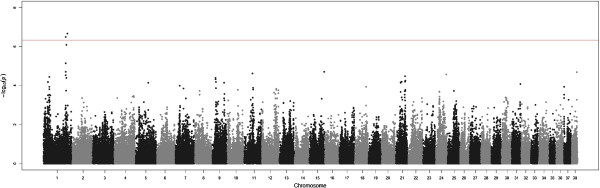
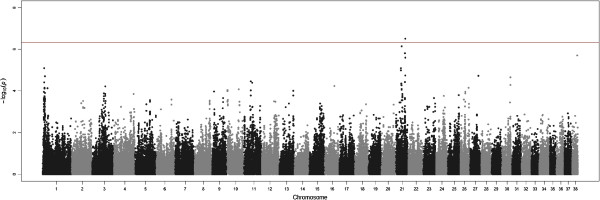
Two genome-wide and several chromosome-wide QTLs affecting CHD and its related traits were identified, indicating regions related to hip dysplasia.
Consistent with previous studies, the genetic architecture of CHD appears to be based on many genes with small or moderate effect, suggesting that genomic selection rather than marker-assisted selection may be an appropriate strategy for reducing this disease.
犬髋关节发育不良(CHD)的特征是髋关节畸形,导致骨关节炎和跛行。目前针对CHD的育种方案已取得了可测量但程度适中的成效。应用标记辅助选择(纳入与该疾病相关的特定标记)或基因组选择(纳入全基因组标记)有可能显著改善育种方案的结果。我们的目标是通过全基因组和全染色体分析确定与髋关节发育不良或其相关性状相关的区域,研究这些区域的连锁不平衡(LD)并提供合理的候选基因。本研究聚焦于英国拉布拉多猎犬群体,该群体中该疾病的患病率较高,且参与了由英国兽医协会(BVA)和英国养犬俱乐部(KC)主导的记录项目。
确定了两个全基因组以及几个全染色体范围影响CHD及其相关性状的数量性状位点(QTL),表明存在与髋关节发育不良相关的区域。
与先前的研究一致,CHD的遗传结构似乎基于许多具有小或中等效应的基因,这表明基因组选择而非标记辅助选择可能是降低该疾病的合适策略。