Liu Guangyi, Han Fei, Xiao Wenbo, Wang Qidong, Xu Ying, Chen Jianghua
Kidney Disease Center, First Affiliated Hospital, College of Medicine, Zhejiang University; Key Laboratory of Kidney Disease Prevention and Control Technology, Zhejiang Province; The Third Grade Laboratory under the National State Administration of Traditional Chinese Medicine, Hangzhou, China.
BMC Nephrol. 2014 Oct 1;15:158. doi: 10.1186/1471-2369-15-158.
Acute rejection (AR) and acute tubular necrosis (ATN) are main causes of early renal allograft dysfunction. Blood oxygen level-dependent magnetic resonance imaging (BOLD MRI) and Diffusion weighted (DW) MRI can provide valuable information about changes of oxygen bioavailability and water diffusion by measuring R2* or apparent diffusion coefficient (ADC) respectively. We aimed to determine the value of BOLD MRI and DW MRI in detecting causes for early allograft dysfunction in renal allograft recipients.
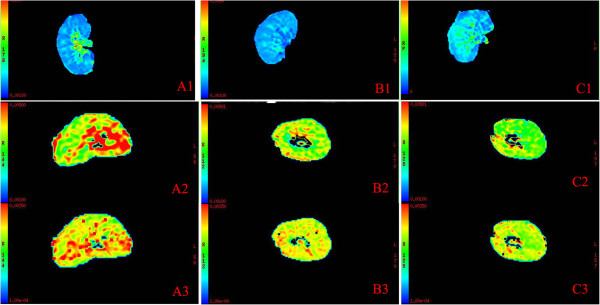
Fifty patients received renal allografts from deceased donors were analyzed, including 35 patients with normal renal function (control group), 10 AR patients and 5 ATN patients. Cortical R2* (CR2*) and medullary R2* (MR2*) were measured by BOLD MRI. Ten diffusion gradient b values (0, 5, 10, 20, 50, 100, 200, 400, 800, 1200s/mm2) were used in DW MRI. ADC values were measured in renal cortex (CADC) and medulla (MADC). CADCl and MADCl were measured under low b values (b ≤ 200 s/mm2), while CADCh and MADCh were measured under high b values (b > 200 s/mm2).
MR2* was significantly lower in AR group (18.2 ± 1.5/s) than control group (23.8 ± 5.0/s, p = 0.001) and ATN group (25.8 ± 5.0/s, p = 0.004). There was a tendency of lower levels on CADCl, MADCl, CADCh or MADCh in AR group than in control group. There were no differences on ADC values between AR group and ATN group.
BOLD MRI was a valuable method in detection of renal allografts with acute rejection.
急性排斥反应(AR)和急性肾小管坏死(ATN)是早期肾移植功能障碍的主要原因。血氧水平依赖性功能磁共振成像(BOLD MRI)和扩散加权(DW)MRI分别通过测量R2*或表观扩散系数(ADC),能够提供有关氧生物利用度和水扩散变化的有价值信息。我们旨在确定BOLD MRI和DW MRI在检测肾移植受者早期移植肾功能障碍病因方面的价值。
对50例接受来自已故供体肾移植的患者进行分析,包括35例肾功能正常的患者(对照组)、10例AR患者和5例ATN患者。通过BOLD MRI测量皮质R2*(CR2*)和髓质R2*(MR2*)。DW MRI使用10个扩散梯度b值(0、5、10、20、50、100、200、400、800、1200 s/mm²)。在肾皮质(CADC)和髓质(MADC)测量ADC值。在低b值(b≤200 s/mm²)下测量CADCl和MADCl,而在高b值(b>200 s/mm²)下测量CADCh和MADCh。
AR组的MR2*(18.2±1.5/s)显著低于对照组(23.8±5.0/s,p = 0.001)和ATN组(25.8±5.0/s,p = 0.004)。AR组的CADCl、MADCl、CADCh或MADCh水平有低于对照组的趋势。AR组和ATN组之间的ADC值没有差异。
BOLD MRI是检测发生急性排斥反应的肾移植的一种有价值的方法。