Sun Xiaoming, Sun Qiao, Yang Minjuan, Zhou Xianfeng, Li Xiaopan, Yu Aiqing, Geng Fuhai, Guo Yuming
Center for Disease Prevention and Control of Pudong New Area, Shanghai, 3039 Zhangyang Rd, Shanghai 200136, People's Republic of China.
Environ Health. 2014 Oct 2;13:76. doi: 10.1186/1476-069X-13-76.
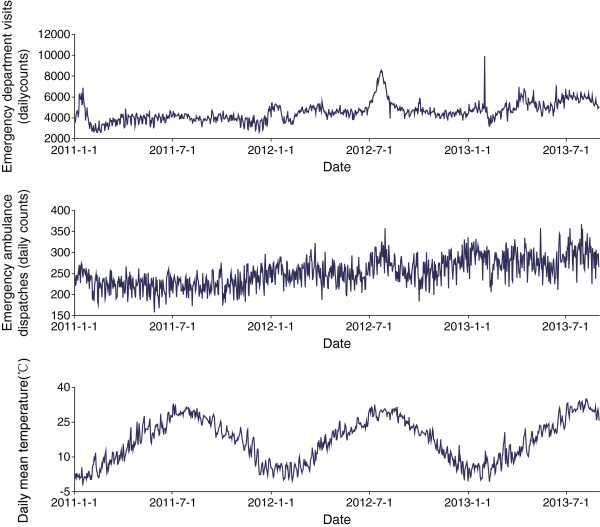
In July 2013, an extended heat episode with extreme high temperature covered Pudong New Area, the largest district in Shanghai. The current study estimates the impacts of temperature and heat waves on emergency department visits (EDV) and emergency ambulance dispatches (EAD) using time-series approaches in Pudong, from 2011 to 2013.
An over-dispersed Poisson generalized additive model was used to examine the association between temperature and EDV and EAD. Heat wave effects with different heat wave definitions considering both the intensity and durations were also estimated.
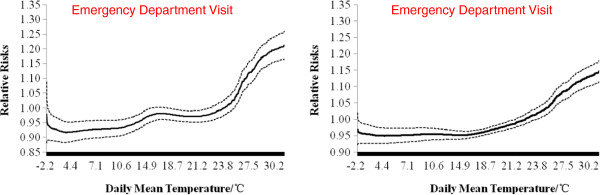
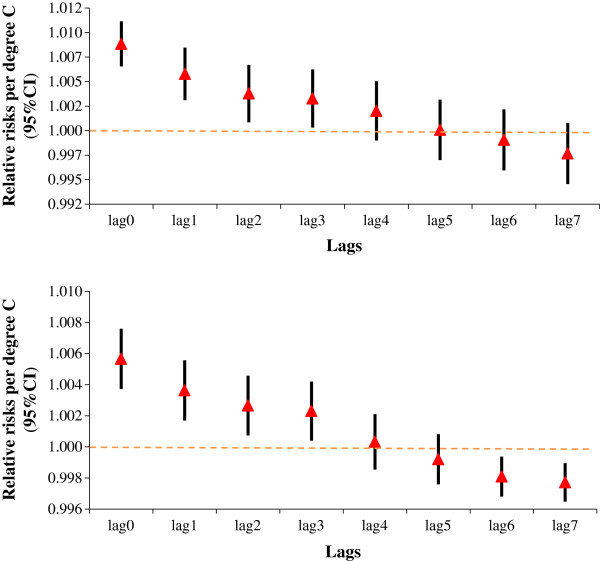
Immediate effects of temperature on EDV and EAD were detected, after controlling for trends of time and day of week. The exposure-response relationships showed J-shaped curves with higher threshold temperature of EDV than that of EAD visually. When estimating risk changes on heat days compared with non-heat days using different percentiles of daily mean temperature in definition, EAD showed significant increases while non-significant or even negative associations were found for EDV. Heat wave with intensity above the 90th percentile had 2.62% (95% CI: 1.78%, 3.46%) and 0.95% (95% CI: 0.22%, 1.69%) increases in EDV for a duration of at least 2 days and 3 days respectively. The relative increase of EAD were 4.85% (95% CI: 1.42%, 8.39%) and 3.94% (95% CI: 0.88%, 7.10%).
Varied effects of temperature and heat waves on emergency department visits and emergency ambulance dispatches were investigated. This wider view of the health effect of temperature indicated that interventions for both public health education and health services management should be considered in the study region.
2013年7月,一场伴有极端高温的长时间热浪侵袭了上海最大的行政区——浦东新区。本研究采用时间序列方法,对2011年至2013年浦东新区温度和热浪对急诊就诊量(EDV)和急救车派遣量(EAD)的影响进行了评估。
采用过度分散的泊松广义相加模型,研究温度与EDV和EAD之间的关联。同时,考虑强度和持续时间,对不同热浪定义下的热浪效应进行了估计。
在控制了时间趋势和星期几的因素后,检测到温度对EDV和EAD的即时影响。暴露-反应关系呈J形曲线,从直观上看,EDV的阈值温度高于EAD。在使用不同日平均温度百分位数定义来估计热浪日与非热浪日的风险变化时,EAD显示出显著增加,而EDV则呈现不显著甚至负相关。强度高于第90百分位数的热浪,持续至少2天和3天时,EDV分别增加2.62%(95%置信区间:1.78%,3.46%)和0.95%(95%置信区间:0.22%,1.69%)。EAD的相对增加分别为4.85%(95%置信区间:1.42%,8.39%)和3.94%(95%置信区间:0.88%,7.10%)。
研究了温度和热浪对急诊就诊和急救车派遣的不同影响。这种对温度健康影响的更广泛视角表明,研究区域应考虑公共健康教育和卫生服务管理两方面的干预措施。