Wang Xuemei, Pu Hongwei, Ma Chuang, Jiang Tao, Wei Qin, Zhang Chun, Duan Mingjun, Shou Xi, Su Lipin, Zhang Jianlong, Yang Yining
Xinjiang Key Laboratory of Medical Animal Model Research, First Affiliated Hospital of Xinjiang Medical University, Urumqi, China (mainland).
Department of Science and Research Education Center, First Affiliated Hospital of Xinjiang Medical University, Urumqi, China (mainland).
Med Sci Monit. 2014 Oct 2;20:1792-800. doi: 10.12659/MSM.892299.
We investigated whether the anti-atherosclerosis of adiponectin (APN) relates to the reduction of oxidative stress. We observed the overexpression of adiponectin gene with different titers on atherosclerosis (AS) models of high-fat apolipoprotein E-deficient (ApoE-/-) mice.
We divided 48 male ApoE-/- mice into 4 groups: control group, high-fat diet group, low adiponectin group, and high adiponectin group. The low and high adiponectin group mice were treated with recombinant adenovirus expressing mice adiponectin (Ad-APN) with low-dose adiponectin 1.0×10⁸ p.f.u. and high-dose adiponectin 5.0×10⁸ p.f.u. via the tail every 2 weeks and given a high-fat diet for the last 8 weeks. On the 14th day after injection, blood samples were obtained from the vena cava.
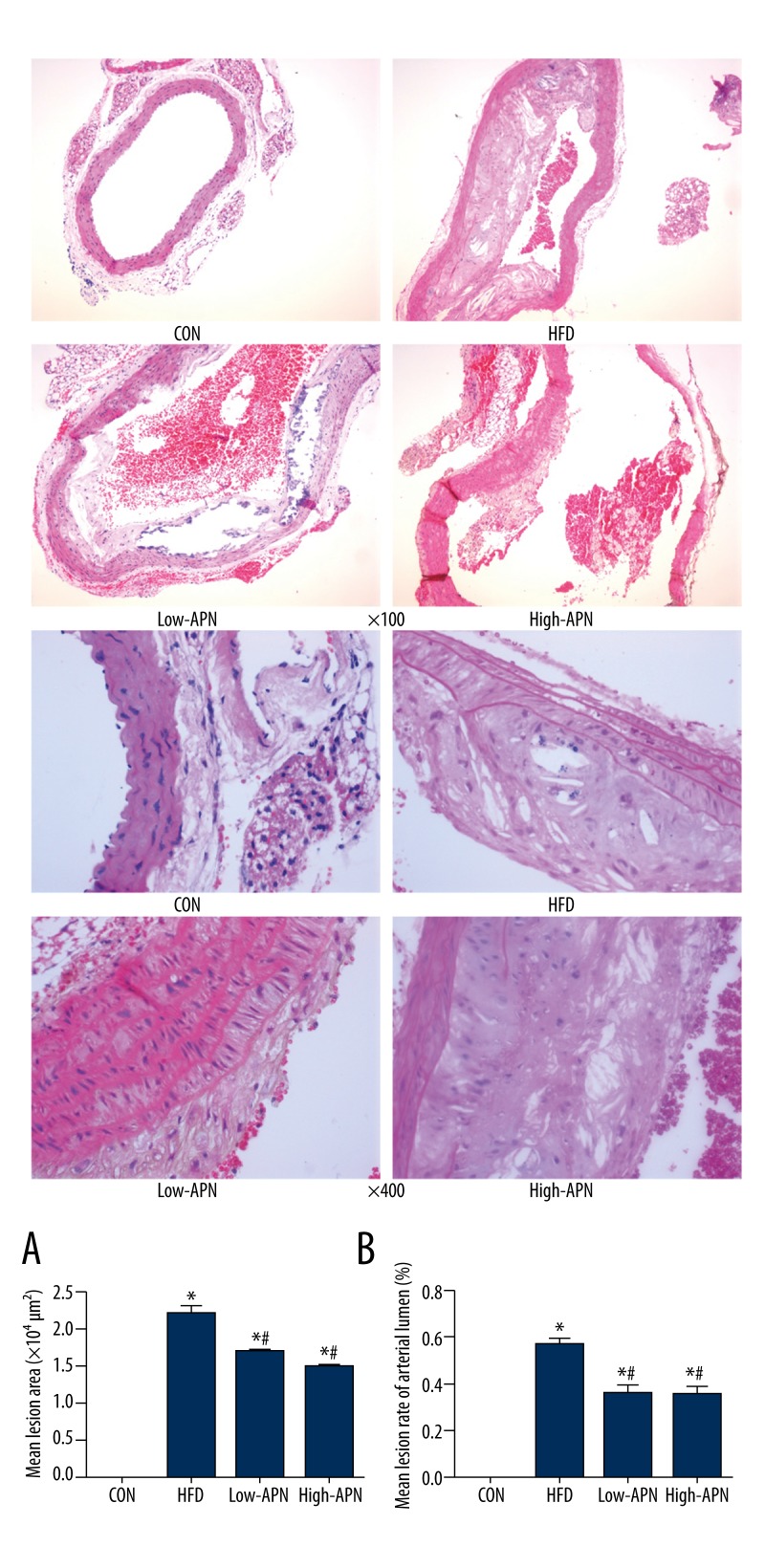
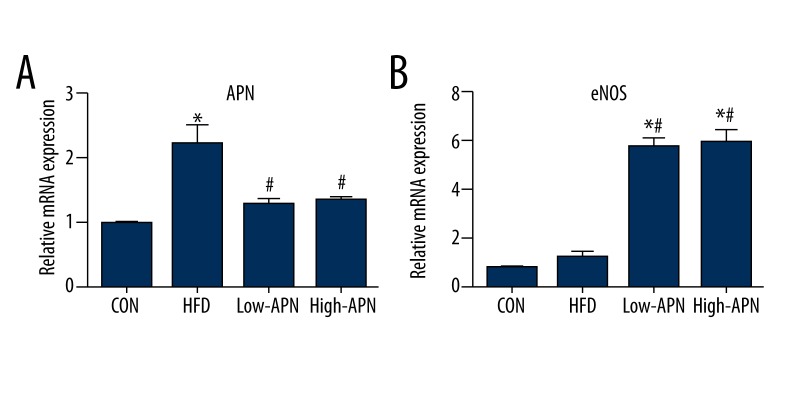
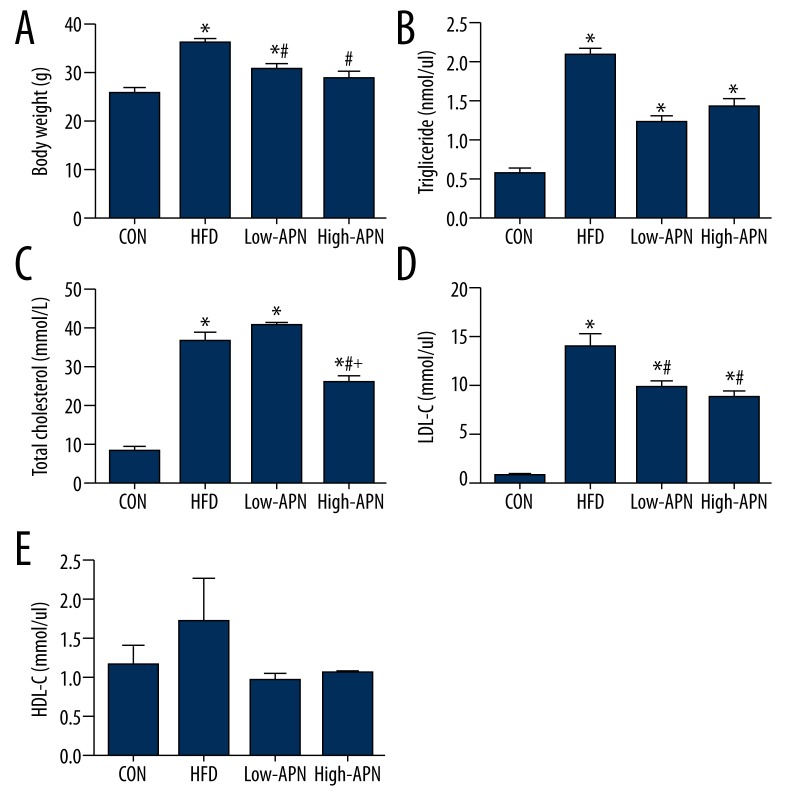
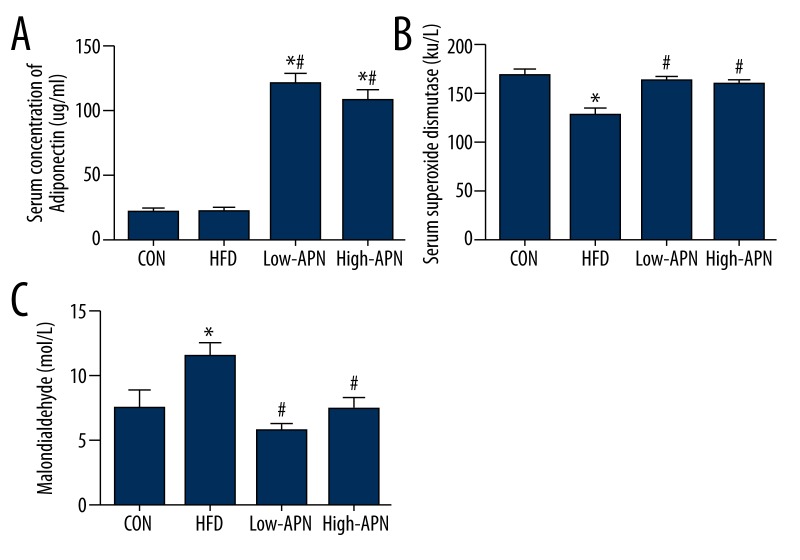
Along with increased serum adiponectin, serum superoxide dismutase (SOD) activity increased (P<0.05) and concentration of malondialdehyde (MDA) was decreased (P<0.05). Levels of total cholesterol (TC), triglyceride (TG), and low-density lipoprotein cholesterol (LDL-C) were decreased, especially TC and LDL-C (P<0.05). A real-time fluorescent quantitative polymerase chain reaction test was used to analyze levels of mRNA expression for endothelial nitric oxide synthase (eNOS) and adiponectin in the aorta. Along with increased adiponectin, the mRNA expression of eNOS in the aorta was increased significantly (P<0.05). The lesion formation in the aortic sinus was inhibited by 25% and 31% in the low-APN group and high-APN group, respectively (P<0.05). Along with the increase of adiponectin doses, the damage of atherosclerosis gradually eased. However, the differences between the low-APN group and high-APN group had no statistical significance.
Adiponectin may protect the aorta from atherosclerosis injury by reducing oxidative stress, reducing lesion formation size in the aortic root and reducing TC, TG, and LDL-C in serum. The molecular mechanism may involve preservation of SOD, reducing MDA in serum, and increasing eNOS and adiponectin mRNA expression in the aorta.
我们研究了脂联素(APN)的抗动脉粥样硬化作用是否与氧化应激的降低有关。我们在高脂载脂蛋白E缺陷(ApoE-/-)小鼠的动脉粥样硬化(AS)模型上观察了不同滴度脂联素基因的过表达情况。
将48只雄性ApoE-/-小鼠分为4组:对照组、高脂饮食组、低脂联素组和高脂联素组。低脂联素组和高脂联素组小鼠每2周通过尾静脉注射表达小鼠脂联素的重组腺病毒(Ad-APN),低剂量脂联素为1.0×108 p.f.u.,高剂量脂联素为5.0×10⁸ p.f.u.,并在最后8周给予高脂饮食。注射后第14天,从腔静脉采集血样。
随着血清脂联素水平升高,血清超氧化物歧化酶(SOD)活性增加(P<0.05),丙二醛(MDA)浓度降低(P<0.05)。总胆固醇(TC)、甘油三酯(TG)和低密度脂蛋白胆固醇(LDL-C)水平降低,尤其是TC和LDL-C(P<0.05)。采用实时荧光定量聚合酶链反应检测分析主动脉中内皮型一氧化氮合酶(eNOS)和脂联素的mRNA表达水平。随着脂联素水平升高,主动脉中eNOS的mRNA表达显著增加(P<0.05)。低脂联素组和高脂联素组主动脉窦病变形成分别受到25%和31%的抑制(P<0.05)。随着脂联素剂量增加,动脉粥样硬化损伤逐渐减轻。然而,低脂联素组和高脂联素组之间的差异无统计学意义。
脂联素可能通过降低氧化应激、减小主动脉根部病变形成大小以及降低血清中TC、TG和LDL-C水平来保护主动脉免受动脉粥样硬化损伤。其分子机制可能涉及维持SOD水平、降低血清中MDA水平以及增加主动脉中eNOS和脂联素mRNA表达。