
18F-FDG PET/CT 除了能检测原发性肿瘤外,很少能为肺类癌肿瘤患者提供其他额外信息。
18F-FDG PET/CT rarely provides additional information other than primary tumor detection in patients with pulmonary carcinoid tumors.
机构信息
Department of Nuclear Medicine, Ataturk Chest Diseases and Thoracic Surgery Training and Research Hospital, Ankara, Turkey.
Department of Radiology, Ataturk Chest Diseases and Thoracic Surgery Training and Research Hospital, Ankara, Turkey.
出版信息
Ann Thorac Med. 2014 Oct;9(4):227-31. doi: 10.4103/1817-1737.140134.
AIM
The purpose of this study was to assess the contribution of (18)F-fluorodeoxyglucose (FDG) Positron Emission Tomography (PET)/Computed Tomography (CT) in detection and staging of pulmonary carcinoid tumors.
METHODS
A total of 22 patients with pulmonary carcinoid tumors (14 typical, 8 atypical) were reviewed in this retrospective study. PET/CT images of all patients were evaluated for primary tumor as well as metastatic regional lymph nodes, bone and other distant metastases. PET/CT positivity of primary tumors was determined by visual interpretation. Tumor size, SUVmax and Hounsfield Unit (HU) values of the tumors were used to test for differences between tumor groups (typical carcinoids and atypical carcinoids).
RESULTS
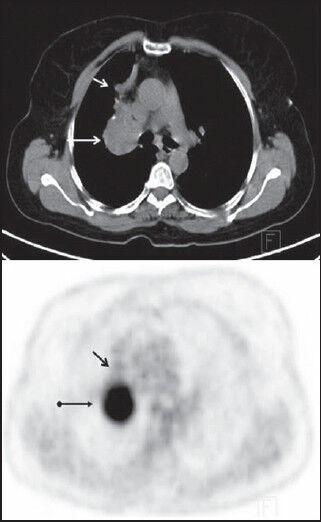
SUVmax of carcinoids ranged from 1.24 to 11.1 (mean, 5.0; median, 2.67). The mean largest diameter of primary tumors was 2.7 ± 1.3 cm, ranging from 1 to 5.5 cm. The overall sensitivity of FDG PET/CT for detection of pulmonary carcinoid tumors was 81.8%. Tumor size, SUVmax and Hounsfield Unit (HU) values of the atypical carcinoids were higher than those for typical carcinoids. However, the results were not statistically meaningful (P > 0.05). The sensitivity and specificity of FDG PET/CT in the detection of mediastinal and hilar lymph nodes metastases were 25% and 83% respectively. One patient had bone metastasis.
CONCLUSION
Although FDG PET/CT can be a useful tool for the detection of pulmonary carcinoid tumors and distant metastasis, it cannot discriminate typical carcinoids from atypical ones and absence of an FDG avid lesion cannot exclude pulmonary carcinoid tumors. Moreover, PET/CT is not a reliable tool in the staging of mediastinal and hilar lymph nodes especially for those patients with typical carcinoids.
目的
本研究旨在评估氟代脱氧葡萄糖(FDG)正电子发射断层扫描(PET)/计算机断层扫描(CT)在肺类癌肿瘤的检测和分期中的作用。
方法
回顾性分析 22 例肺类癌肿瘤患者(14 例典型,8 例非典型)的资料。所有患者的 PET/CT 图像均用于评估原发肿瘤以及局部转移的区域淋巴结、骨骼和其他远处转移。通过视觉解释确定原发肿瘤的 PET/CT 阳性。使用肿瘤大小、SUVmax 和 Hounsfield 单位(HU)值来测试肿瘤组(典型类癌和非典型类癌)之间的差异。
结果
类癌的 SUVmax 范围为 1.24 至 11.1(平均值 5.0;中位数 2.67)。原发肿瘤的最大直径平均为 2.7±1.3cm,范围为 1 至 5.5cm。FDG PET/CT 对肺类癌肿瘤的总体检测灵敏度为 81.8%。非典型类癌的肿瘤大小、SUVmax 和 Hounsfield 单位(HU)值均高于典型类癌,但结果无统计学意义(P>0.05)。FDG PET/CT 检测纵隔和肺门淋巴结转移的灵敏度和特异性分别为 25%和 83%。1 例患者有骨转移。
结论
尽管 FDG PET/CT 可用于检测肺类癌肿瘤和远处转移,但不能区分典型类癌和非典型类癌,并且不存在 FDG 摄取病灶不能排除肺类癌肿瘤。此外,PET/CT 不是纵隔和肺门淋巴结分期的可靠工具,尤其是对于典型类癌患者。
 Zotero 插件