Thuillier Philippe, Liberini Virginia, Rampado Osvaldo, Gallio Elena, De Santi Bruno, Ceci Francesco, Metovic Jasna, Papotti Mauro, Volante Marco, Molinari Filippo, Deandreis Désirée
Nuclear Medicine Unit, Department of Medical Sciences, University of Turin, 10126 Turin, Italy.
Department of Endocrinology, University Hospital of Brest, 29200 Brest, France.
Biomedicines. 2021 Mar 10;9(3):281. doi: 10.3390/biomedicines9030281.
To evaluate if conventional Positron emission tomography (PET) parameters and radiomic features (RFs) extracted by 18F-FDG-PET/CT can differentiate among different histological subtypes of lung neuroendocrine neoplasms (Lu-NENs).
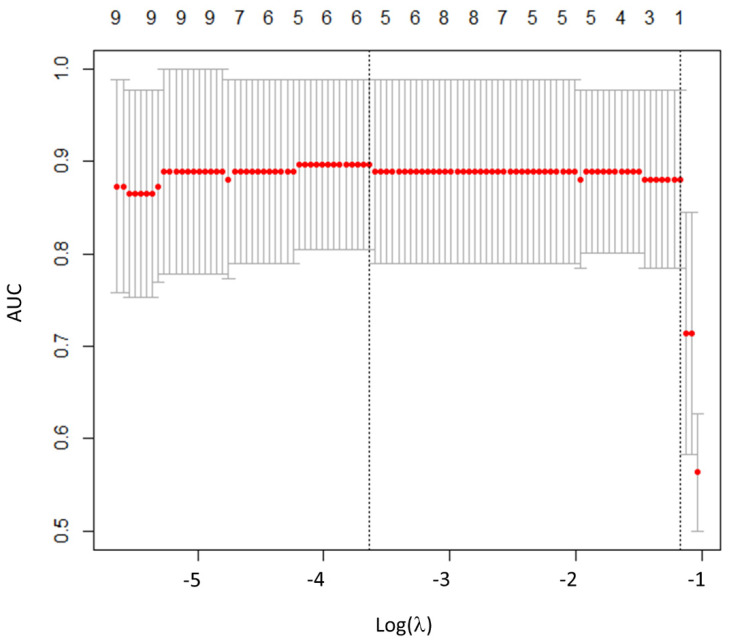
Forty-four naïve-treatment patients on whom 18F-FDG-PET/CT was performed for histologically confirmed Lu-NEN (n = 46) were retrospectively included. Manual segmentation was performed by two operators allowing for extraction of four conventional PET parameters (SUVmax, SUVmean, metabolic tumor volume (MTV), and total lesion glycolysis (TLG)) and 41 RFs. Lu-NENs were classified into two groups: lung neuroendocrine tumors (Lu-NETs) vs. lung neuroendocrine carcinomas (Lu-NECs). Lu-NETs were classified according to histological subtypes (typical (TC)/atypical carcinoid (AC)), Ki67-level, and TNM staging. The least absolute shrink age and selection operator (LASSO) method was used to select the most predictive RFs for classification and Pearson correlation analysis was performed between conventional PET parameters and selected RFs.
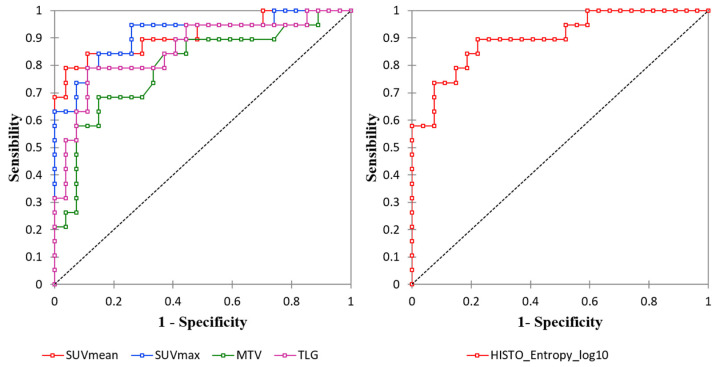
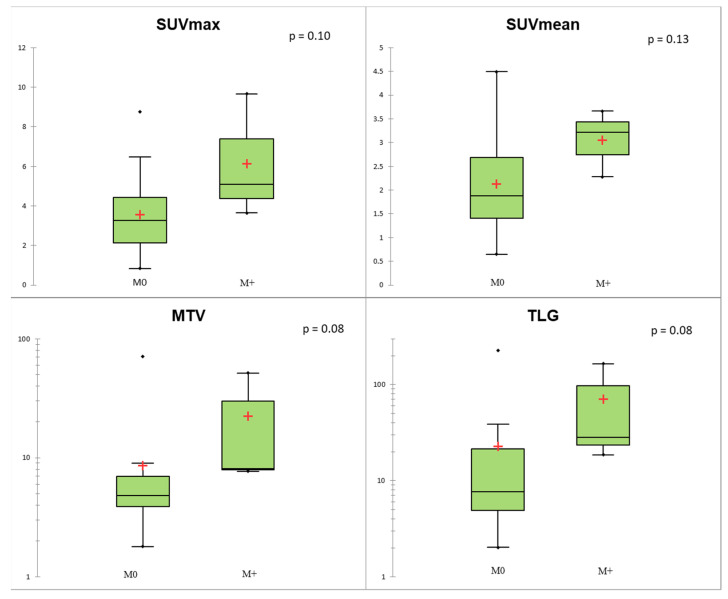
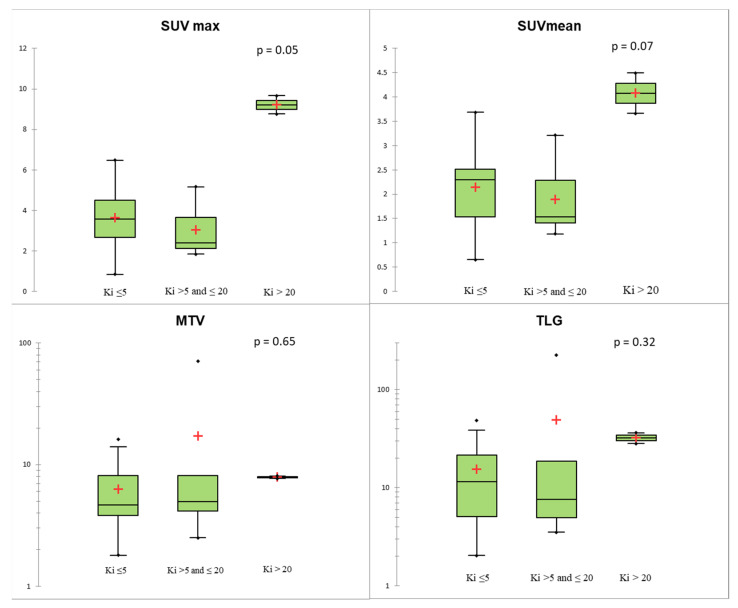
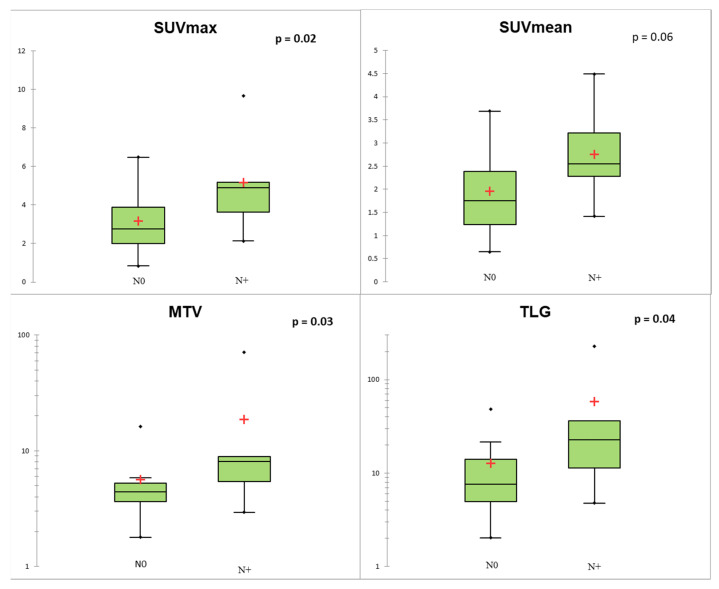
PET parameters, in particular, SUVmax (area under the curve (AUC) = 0.91; cut-off = 5.16) were higher in Lu-NECs vs. Lu-NETs ( < 0.001). Among RFs, HISTO_Entropy_log10 was the most predictive (AUC = 0.90), but correlated with SUVmax/SUVmean (r = 0.95/r = 0.94, respectively). No statistical differences were found between conventional PET parameters and RFs ( > 0.05) and TC vs. AC classification. Conventional PET parameters were correlated with N+ status in Lu-NETs.
In our study, conventional PET parameters were able to distinguish Lu-NECs from Lu-NETs, but not TC from AC. RFs did not provide additional information.
评估常规正电子发射断层扫描(PET)参数以及通过18F-FDG-PET/CT提取的放射组学特征(RFs)能否区分肺神经内分泌肿瘤(Lu-NENs)的不同组织学亚型。
回顾性纳入44例初治患者,这些患者因组织学确诊为Lu-NEN(n = 46)而接受了18F-FDG-PET/CT检查。由两名操作人员进行手动分割,以提取四个常规PET参数(最大标准摄取值(SUVmax)、平均标准摄取值(SUVmean)、代谢肿瘤体积(MTV)和总病变糖酵解(TLG))以及41个RFs。Lu-NENs分为两组:肺神经内分泌肿瘤(Lu-NETs)与肺神经内分泌癌(Lu-NECs)。Lu-NETs根据组织学亚型(典型类癌(TC)/非典型类癌(AC))、Ki67水平和TNM分期进行分类。使用最小绝对收缩和选择算子(LASSO)方法选择用于分类的最具预测性的RFs,并对常规PET参数与所选RFs进行Pearson相关性分析。
PET参数,尤其是SUVmax(曲线下面积(AUC)= 0.91;截断值 = 5.16)在Lu-NECs中高于Lu-NETs(< 0.001)。在RFs中,HISTO_Entropy_log10最具预测性(AUC = 0.90),但与SUVmax/SUVmean相关(分别为r = 0.95/r = 0.94)。常规PET参数与RFs之间(> 0.05)以及TC与AC分类之间未发现统计学差异。常规PET参数与Lu-NETs中的N+状态相关。
在我们的研究中,常规PET参数能够区分Lu-NECs与Lu-NETs,但不能区分TC与AC。RFs未提供额外信息。