Richardson Andrea S, Meyer Katie A, Howard Annie Green, Boone-Heinonen Janne, Popkin Barry M, Evenson Kelly R, Kiefe Catarina I, Lewis Cora E, Gordon-Larsen Penny
Department of Nutrition, University of North Carolina at Chapel Hill, NC 27516, USA; Carolina Population Center, 137 East Franklin St. Campus Box 8120, Chapel Hill, NC 27516, USA.
Department of Nutrition, University of North Carolina at Chapel Hill, NC 27516, USA.
Health Place. 2014 Nov;30:145-53. doi: 10.1016/j.healthplace.2014.08.011. Epub 2014 Sep 30.
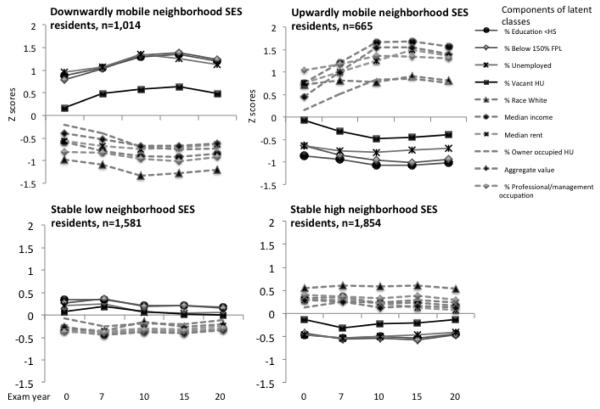
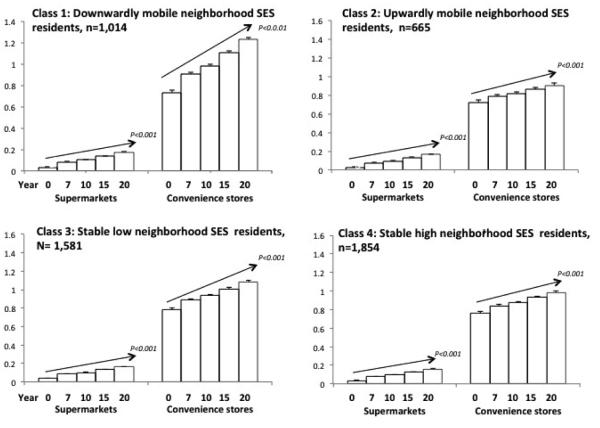
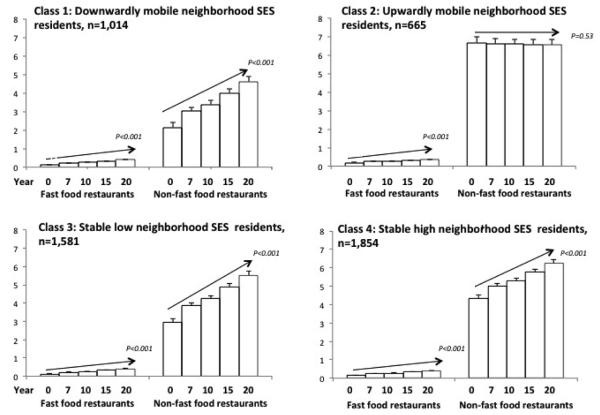
Cross-sectional studies suggest that neighborhood socioeconomic (SES) disadvantage is associated with obesogenic food environments. Yet, it is unknown how exposure to neighborhood SES patterning through adulthood corresponds to food environments that also change over time. We used latent class analysis (LCA) to classify participants in the U.S.-based Coronary Artery Risk Development in Young Adults study [n=5,114 at baseline 1985-1986 to 2005-2006] according to their longitudinal neighborhood SES residency patterns (upward, downward, stable high and stable low). For most classes of residents, the availability of fast food and non-fast food restaurants and supermarkets and convenience stores increased (p<0.001). Yet, socioeconomically disadvantaged neighborhood residents had fewer fast food and non-fast food restaurants, more convenience stores, and the same number of supermarkets in their neighborhoods than the advantaged residents. In addition to targeting the pervasive fast food restaurant and convenient store retail growth, improving neighborhood restaurant options for disadvantaged residents may reduce food environment disparities.
横断面研究表明,社区社会经济(SES)劣势与致胖的食物环境相关。然而,成年期暴露于社区SES模式如何与随时间变化的食物环境相对应尚不清楚。我们在美国年轻人冠状动脉风险发展研究中(1985 - 1986年基线时n = 5114,随访至2005 - 2006年),使用潜在类别分析(LCA)根据参与者纵向的社区SES居住模式(上升、下降、稳定高和稳定低)对他们进行分类。对于大多数居民类别,快餐店、非快餐店、超市和便利店的数量增加了(p<0.001)。然而,社会经济处于劣势的社区居民所在社区的快餐店和非快餐店数量较少,便利店较多,超市数量与优势居民所在社区相同。除了针对普遍存在的快餐店和便利店零售增长外,改善弱势居民社区的餐馆选择可能会减少食物环境差异。