Li Hui, Pei Fei, Shao Liying, Chen Jingzhou, Sun Kai, Zhang Xinyu, Zhang Channa, Liu Jibing, Xiao Chuanshi, Hui Rutai
Department of Cardiology, The First Hospital Affiliated to Shanxi Medical University, 85 Jiefang South Road, Taiyuan City, Shanxi Province 030001, China.
BMC Cardiovasc Disord. 2014 Oct 4;14:136. doi: 10.1186/1471-2261-14-136.
The various prevalence of LVH and abnormal LV geometry have been reported in different populations. So far, only a few reports are available on the prevalence of LV geometric patterns in a large Chinese untreated hypertensive population.
A total of 9,286 subjects (5167 men and 4119 women) completed the survey and 1641 untreated hypertensive patients (1044 males and 597 females) enrolled in the present study. The LV geometry was classified into four patterns: normal; abnormal,defined as concentric remodeling;concentric or eccentric hypertrophy based on the values of left ventricular mass index (LVMI) and relative wall thickness (RWT). Logistic regression model was applied to determine the odds ratio (OR) and 95% confidence intervals (CI) of the risk factors of left ventricular hypertrophy.
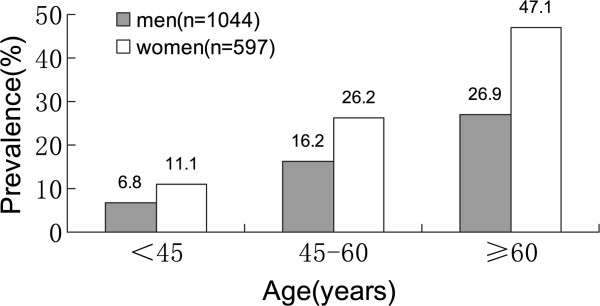
The prevalence of LVH was 20.2% in untreated hypertensive patients, much higher in women (30.8%) than in men (14.2%) (P < 0.01). The prevalence of LV geometrical patterns was 34.9%, 11.1%, 9.1% for concentric remodeling, concentric and eccentric hypertrophy,respectively. After adjustment by using Logistic regression model, the risk factors for LVH and abnormal LV geometry were age, female, systolic blood pressure, and body mass index. And low high density lipoprotein maybe a positive factor.
The prevalence of LVH and abnormal LV geometric patterns was higher in women than in men and increased with age. It is crucial to improve the awareness rate of hypertension and control the risk factors of CV complications in untreated hypertensive population.
不同人群中左心室肥厚(LVH)和左心室几何形态异常的患病率各不相同。迄今为止,关于中国大型未经治疗的高血压人群中左心室几何形态模式患病率的报告较少。
共有9286名受试者(5167名男性和4119名女性)完成了调查,本研究纳入了1641名未经治疗的高血压患者(1044名男性和597名女性)。根据左心室质量指数(LVMI)和相对壁厚度(RWT)的值,将左心室几何形态分为四种模式:正常;异常,定义为向心性重构;向心性或离心性肥厚。应用逻辑回归模型确定左心室肥厚危险因素的比值比(OR)和95%置信区间(CI)。
未经治疗的高血压患者中LVH的患病率为20.2%,女性(30.8%)远高于男性(14.2%)(P<0.01)。左心室几何形态模式的患病率分别为向心性重构34.9%、向心性和离心性肥厚11.1%、9.1%。使用逻辑回归模型进行调整后,LVH和左心室几何形态异常的危险因素为年龄、女性、收缩压和体重指数。而低高密度脂蛋白可能是一个正向因素。
女性LVH和左心室几何形态异常的患病率高于男性,且随年龄增加。提高高血压知晓率并控制未经治疗的高血压人群心血管并发症的危险因素至关重要。