Abejew Asrat Agalu, Denboba Ayele A, Mekonnen Alemayehu Gashaw
Department of Pharmacy, College of Medicine and Health Sciences, P, O, Box: 1145, Dessie, Ethiopia.
BMC Res Notes. 2014 Oct 3;7:687. doi: 10.1186/1756-0500-7-687.
Different studies have indicated that urinary tract infections frequently occur in both community and hospital environments and are of the most common bacterial infections in humans. the outcomes of urinary tract infections are increased hospitalization, increased direct patient costs and mortality. In Dessie, the prevalence of the commmon pathogens and antibiotic susceptibility pattern is not well studied sofar. Thus, the aim of this study is to address these gaps in the study area.
Retrospective study was conducted in Dessie regional health reseacrh laboratory from January 1-March 31, 2012. All culture and antibiotic susceptibility test results of patients' diagnosed with UTI from September 2002 to September 2011 G.C were included in the study. Data were abstracted using structured questionnaires and finally, entered into SPSS Windows version 16.0, and descriptive statistics was generated to meet the study objective.
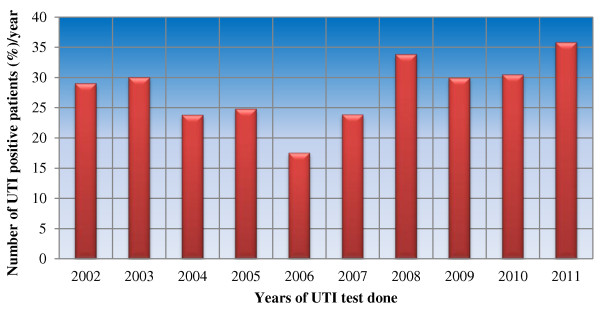
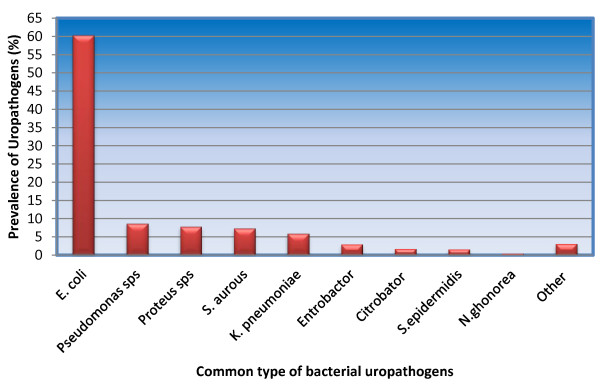
During the last ten years 680 (27.35%) bacteria were isolated in the regional laboratory. The most commonly isolated were E. coli 410 (60.29%), Pseudomonas species 59 (8.68%), Proteus species 53 (7.79%), S. aurous 50 (7.35%) and Klebsiella species 40 (5.88%). The E.coli were susceptible to Nitrofurantoin 43 (89.6%), furantoin 124 (87.3%), Nalidixic acid 91 (86.7%), kanamycin 116 (80%) & ciprofloxacin 66 (71.7%) but were almost resistant to Ampicillin, tetracycline, & trimethoprim-sulfamethoxazole. Similarly Pseudomonas and proteus species were resistant to almost all antibiotics except Gentamycin.
The E.coli, pseudomonas and proteus species were the commonly isolated bacteria in the regional health research laboratory. A majority of isolated bacterial microbes were resistant to antibiotics commonly used in clinical practices and generally available in the local economy without prescription. Culture results are necessary before initiating antibiotics.
不同研究表明,尿路感染在社区和医院环境中均频繁发生,是人类最常见的细菌感染之一。尿路感染的后果是住院率增加、患者直接成本增加以及死亡率上升。在德西,常见病原体的流行情况和抗生素敏感性模式迄今尚未得到充分研究。因此,本研究的目的是填补该研究领域的这些空白。
2012年1月1日至3月31日在德西地区卫生研究实验室进行了回顾性研究。纳入了2002年9月至2011年9月被诊断为UTI的患者的所有培养和抗生素敏感性测试结果。使用结构化问卷提取数据,最后录入SPSS Windows 16.0版本,并生成描述性统计数据以实现研究目标。
在过去十年中,该地区实验室分离出680株(27.35%)细菌。最常分离出的是大肠杆菌410株(60.29%)、假单胞菌属59株(8.68%)、变形杆菌属53株(7.79%)、金黄色葡萄球菌50株(7.35%)和克雷伯菌属40株(5.88%)。大肠杆菌对呋喃妥因43株(89.6%)、夫西地酸124株(87.3%)、萘啶酸91株(86.7%)、卡那霉素116株(80%)和环丙沙星66株(71.7%)敏感,但对氨苄西林、四环素和甲氧苄啶 - 磺胺甲恶唑几乎耐药。同样,假单胞菌属和变形杆菌属除庆大霉素外对几乎所有抗生素均耐药。
大肠杆菌、假单胞菌属和变形杆菌属是该地区卫生研究实验室中最常分离出的细菌。大多数分离出的细菌微生物对临床实践中常用且当地经济中无需处方即可普遍获得的抗生素耐药。在开始使用抗生素之前进行培养结果检测很有必要。