Department of Microbiology, College of Medicine, The Catholic University of Korea, Seoul 137-701, Republic of Korea.
BMC Complement Altern Med. 2014 Oct 7;14:379. doi: 10.1186/1472-6882-14-379.
Scutellaria baicalensis Georgi is a commonly used medicinal herb in several Asian countries like Korea, China and Japan for thousands of years. It has been reported to have various medicinal properties such as anti-microbial, anti-inflammatory and anti-cancer effects. However, the anti-inflammatory mechanism of S. baicalensis G at proteome level has not yet been reported. Hence, we performed a proteome analysis to study differentially expressed proteins and its anti-inflammatory role in lipopolysaccharide (LPS) stimulated L6 skeletal muscle cells response to flavonoids isolated from S. baicalensis G.
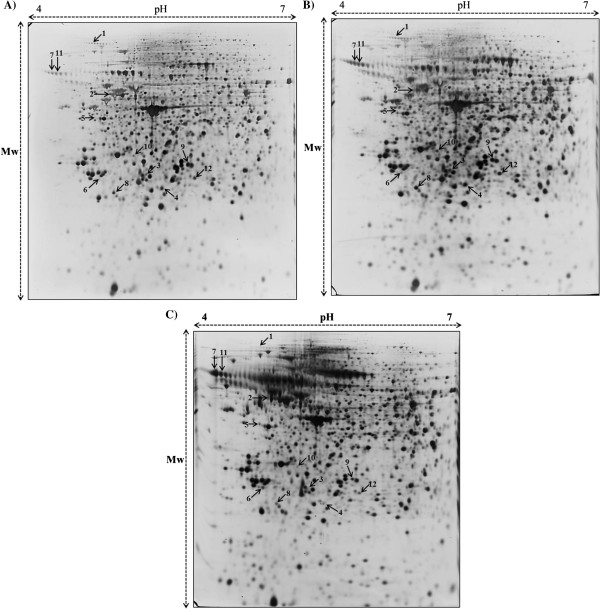
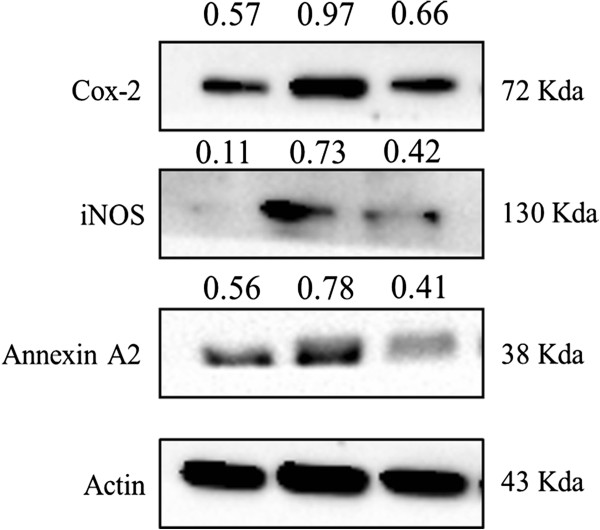
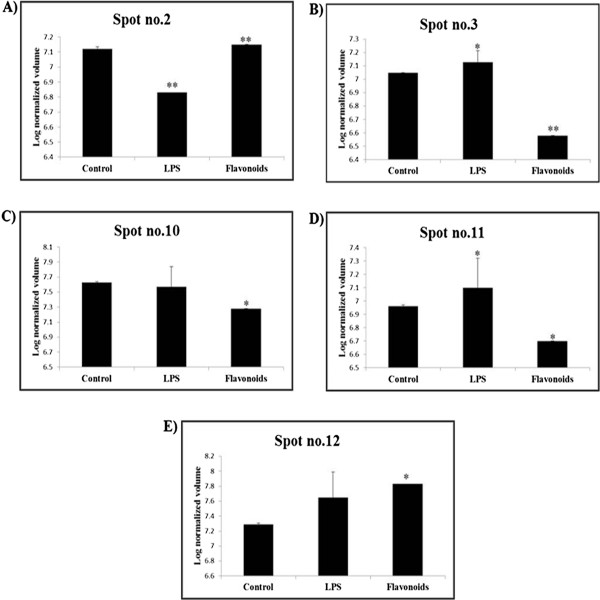
For that, 150 μg of proteins from the L6 cells of the control (Vehicle only), LPS treated and flavonoid treated groups were separated using 18 cm, pH 4-7 IPG strips in the first dimension and resolved by 12% linear gradient SDS-polyacrylamide gel electrophoresis (SDS-PAGE). The silver stained gels were analyzed by using progenesis SameSpots software and twenty six differentially expressed protein spots (≥ 2 fold, p < 0.05) were selected for matrix assisted laser desorption ionization- time of flight mass spectroscopy/mass spectrometry (MALDI-TOF/MS) analysis. Also, the expression of COX-2, iNOS and Annexin A2 proteins were analyzed by western blot.
Totally, 12 differentially expressed proteins were successfully identified by MALDI-TOF/MS and database searching, that's involved in inflammatory responses such vimentin, T-box transcription factor TBX3, annexin A1, annexin A2 and annexin A5. In addition, flavonoids inhibited the expression of COX-2, iNOS and Annexin A2 proteins in LPS-stimulated L6 skeletal muscle cells.
The findings revealed that the flavonoids from S. baicalensis G. directly protect the LPS stimulated inflammation process in L6 cells and, would be helpful to study further the muscle cell inflammatory mechanism. This is the first proteome study provide the anti-inflammatory mechanism of flavonoids from S. baicalensis G. in LPS stimulated L6 skeletal muscle cells.
黄芩是一种在韩国、中国和日本等亚洲国家使用了数千年的常用草药。据报道,它具有多种药用特性,如抗菌、抗炎和抗癌作用。然而,黄芩在蛋白质组水平上的抗炎机制尚未得到报道。因此,我们进行了蛋白质组分析,以研究从黄芩中分离得到的类黄酮在脂多糖(LPS)刺激的 L6 骨骼肌细胞反应中的差异表达蛋白及其抗炎作用。
为此,将对照组(仅用载体)、LPS 处理组和类黄酮处理组的 L6 细胞中的 150 μg 蛋白质用 18 cm、pH4-7 IPG 条在第一维分离,并在 12%线性梯度 SDS-聚丙烯酰胺凝胶电泳(SDS-PAGE)中解析。银染凝胶用 progenesis SameSpots 软件分析,选择 26 个差异表达蛋白点(≥2 倍,p<0.05)进行基质辅助激光解吸电离-飞行时间质谱/质谱(MALDI-TOF/MS)分析。此外,还通过 Western blot 分析 COX-2、iNOS 和膜联蛋白 A2 蛋白的表达。
通过 MALDI-TOF/MS 和数据库搜索共成功鉴定了 12 个差异表达蛋白,这些蛋白涉及炎症反应,如波形蛋白、T 盒转录因子 TBX3、膜联蛋白 A1、膜联蛋白 A2 和膜联蛋白 A5。此外,类黄酮抑制了 LPS 刺激的 L6 骨骼肌细胞中 COX-2、iNOS 和膜联蛋白 A2 蛋白的表达。
研究结果表明,黄芩中的类黄酮直接保护 LPS 刺激的 L6 细胞中的炎症过程,这将有助于进一步研究肌肉细胞炎症机制。这是首次对黄芩中的类黄酮在 LPS 刺激的 L6 骨骼肌细胞中的抗炎机制进行蛋白质组研究。