Lara Jose, Evans Elizabeth H, O'Brien Nicola, Moynihan Paula J, Meyer Thomas D, Adamson Ashley J, Errington Linda, Sniehotta Falko F, White Martin, Mathers John C
Human Nutrition Research Centre, Newcastle University, Biomedical Research Building, Campus for Ageing and Vitality, Newcastle upon Tyne NE4 5PL, UK.
BMC Med. 2014 Oct 7;12:177. doi: 10.1186/s12916-014-0177-3.
There is a need for development of more effective interventions to achieve healthy eating, enhance healthy ageing, and to reduce the risk of age-related diseases. The aim of this study was to identify the behaviour change techniques (BCTs) used in complex dietary behaviour change interventions and to explore the association between BCTs utilised and intervention effectiveness.
We undertook a secondary analysis of data from a previous systematic review with meta-analysis of the effectiveness of dietary interventions among people of retirement age. BCTs were identified using the reliable CALO-RE taxonomy in studies reporting fruit and vegetable (F and V) consumption as outcomes. The mean difference in F and V intake between active and control arms was compared between studies in which the BCTs were identified versus those not using the BCTs. Random-effects meta-regression models were used to assess the association of interventions BCTs with F and V intakes.
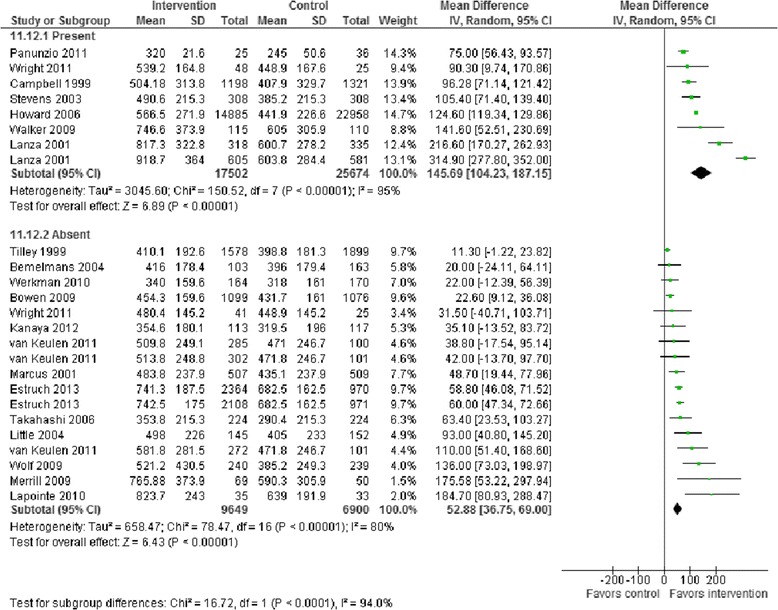
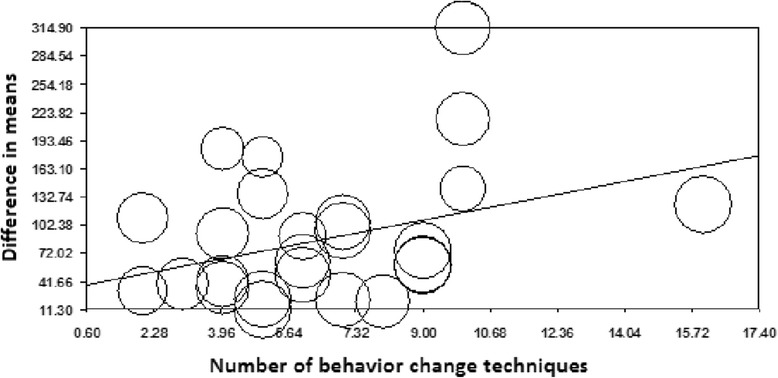
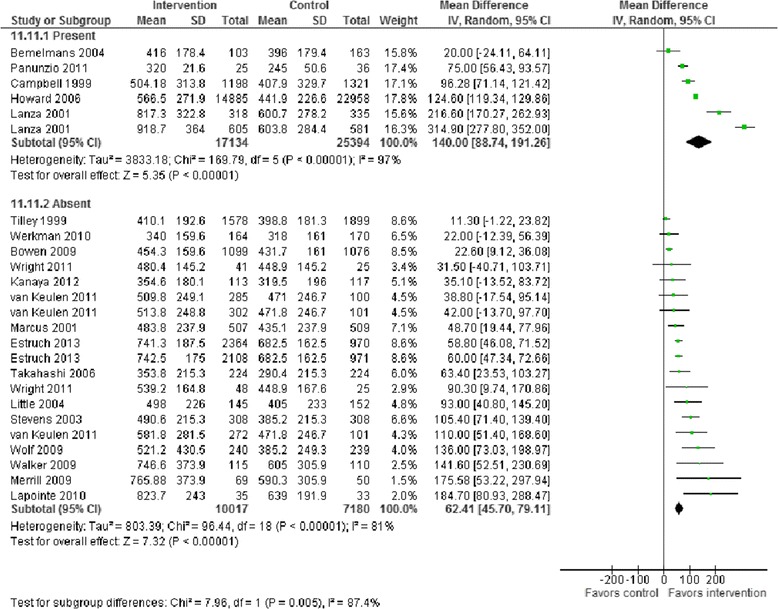
Twenty-eight of the 40 BCTs listed in the CALO-RE taxonomy were identified in the 22 papers reviewed. Studies using the techniques 'barrier identification/problem solving' (93 g, 95% confidence interval (CI) 48 to 137 greater F and V intake), 'plan social support/social change' (78 g, 95%CI 24 to 132 greater F and V intake), 'goal setting (outcome)' (55 g 95%CI 7 to 103 greater F and V intake), 'use of follow-up prompts' (66 g, 95%CI 10 to 123 greater F and V intake) and 'provide feedback on performance' (39 g, 95%CI -2 to 81 greater F and V intake) were associated with greater effects of interventions on F and V consumption compared with studies not using these BCTs. The number of BCTs per study ranged from 2 to 16 (median = 6). Meta-regression showed that one additional BCT led to 8.3 g (95%CI 0.006 to 16.6 g) increase in F and V intake.
Overall, this study has identified BCTs associated with effectiveness suggesting that these might be active ingredients of dietary interventions which will be effective in increasing F and V intake in older adults. For interventions targeting those in the peri-retirement age group, 'barrier identification/problem solving' and 'plan for social support/social change' may be particularly useful in increasing the effectiveness of dietary interventions.
需要开发更有效的干预措施,以实现健康饮食、促进健康老龄化并降低与年龄相关疾病的风险。本研究的目的是确定复杂饮食行为改变干预措施中使用的行为改变技术(BCTs),并探讨所使用的BCTs与干预效果之间的关联。
我们对之前一项系统评价的数据进行了二次分析,并对退休年龄人群饮食干预的有效性进行了荟萃分析。在将水果和蔬菜(F和V)摄入量作为结果报告的研究中,使用可靠的CALO-RE分类法识别BCTs。比较了识别出BCTs的研究与未使用BCTs的研究中,干预组和对照组之间F和V摄入量的平均差异。使用随机效应荟萃回归模型评估干预措施BCTs与F和V摄入量之间的关联。
在 reviewed 的22篇论文中,识别出了CALO-RE分类法中列出的40种BCTs中的28种。与未使用这些BCTs的研究相比,使用 “障碍识别/问题解决”(F和V摄入量增加93克,95%置信区间(CI)为48至137克)、“计划社会支持/社会变革”(F和V摄入量增加78克,95%CI为24至132克)、“设定目标(结果)”(F和V摄入量增加55克,95%CI为7至103克)、“使用后续提示”(F和V摄入量增加66克,95%CI为10至123克)和 “提供绩效反馈”(F和V摄入量增加39克,95%CI为 -2至81克)这些技术的研究,干预措施对F和V消费的影响更大。每项研究中BCTs的数量范围为2至16个(中位数 = 6)。荟萃回归显示,每增加一项BCT,F和V摄入量增加8.3克(95%CI为0.006至16.6克)。
总体而言,本研究确定了与有效性相关的BCTs,表明这些可能是饮食干预的有效成分,对增加老年人的F和V摄入量有效。对于针对围退休年龄组人群的干预措施,“障碍识别/问题解决” 和 “社会支持/社会变革计划” 可能对提高饮食干预的有效性特别有用。