Adelman David M, Selber Jesse C, Butler Charles E
Department of Plastic Surgery, The University of Texas, MD Anderson Cancer Center, Houston, Tex.
Plast Reconstr Surg Glob Open. 2014 Jun 6;2(5):e155. doi: 10.1097/GOX.0000000000000072. eCollection 2014 May.
Porcine and bovine acellular dermal matrices (PADM and BADM, respectively) are the most commonly used biologic meshes for ventral hernia repair. A previous study suggests a higher rate of intraoperative device failures using PADM than BADM. We hypothesize that this difference is, in part, related to intrinsic mechanical properties of the matrix substrate and source material. The following study directly compares these 2 matrices to identify any potential differences in mechanical properties that may relate to clinical outcomes.
Sections of PADM (Strattice; Lifecell, Branchburg, N.J.) and BADM (SurgiMend; TEI Biosciences, Boston, Mass.) were subjected to a series of biomechanical tests, including suture retention, tear strength, and uniaxial tensile strength. Results were collected and compared statistically.
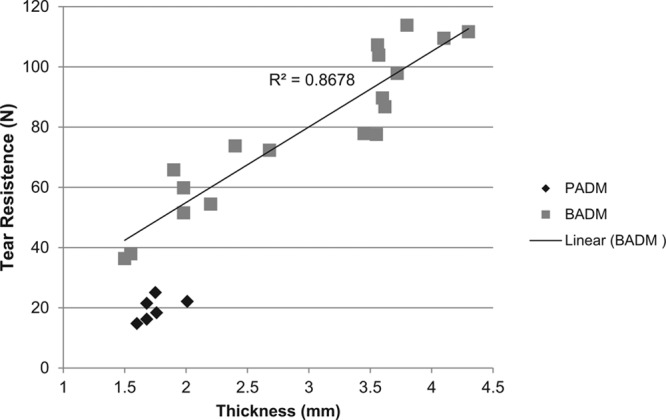
In all parameters, BADM exhibited a superior mechanical strength profile compared with PADM of similar thickness. Increased BADM thickness correlated with increased mechanical strength. In suture tear-through testing with steel wire, failure of the steel wire occurred in the 4-mm-thick BADM, whereas the matrix material failed in all other thicknesses of BADM and PADM.
Before implantation, BADM is inherently stronger than PADM at equivalent thicknesses and considerably stronger at increased thicknesses. These results corroborate clinical data from a previous study in which PADM was associated with a higher intraoperative device failure rate. Although numerous properties of acellular dermal matrix contribute to clinical outcomes, surgeons should consider initial mechanical strength properties when choosing acellular dermal matrices for load-bearing applications such as hernia repair.
猪脱细胞真皮基质(PADM)和牛脱细胞真皮基质(分别为BADM)是腹疝修补术中最常用的生物补片。先前的一项研究表明,使用PADM时术中器械故障率高于BADM。我们推测这种差异部分与基质底物和原材料的固有机械性能有关。以下研究直接比较这两种补片,以确定可能与临床结果相关的机械性能方面的任何潜在差异。
对PADM(Strattice;Lifecell,新泽西州布兰奇堡)和BADM(SurgiMend;TEI生物科学公司,马萨诸塞州波士顿)切片进行一系列生物力学测试,包括缝线保留、撕裂强度和单轴拉伸强度。收集结果并进行统计学比较。
在所有参数中,与厚度相似的PADM相比,BADM表现出更好的机械强度特征。BADM厚度增加与机械强度增加相关。在钢丝缝线撕裂测试中,4毫米厚的BADM中钢丝发生断裂,而在BADM和PADM的所有其他厚度中,基质材料发生断裂。
在植入前,同等厚度下BADM本质上比PADM更强,厚度增加时更强得多。这些结果证实了先前一项研究的临床数据,该研究中PADM与更高的术中器械故障率相关。尽管脱细胞真皮基质的许多特性会影响临床结果,但外科医生在选择用于疝修补等承重应用的脱细胞真皮基质时,应考虑其初始机械强度特性。