Jespers Vicky, Crucitti Tania, Menten Joris, Verhelst Rita, Mwaura Mary, Mandaliya Kishor, Ndayisaba Gilles F, Delany-Moretlwe Sinead, Verstraelen Hans, Hardy Liselotte, Buvé Anne, van de Wijgert Janneke
Unit of Epidemiology and Control of HIV/STD, Department of Public Health, Institute of Tropical Medicine, Antwerp, Belgium.
HIV/STI Reference Laboratory, Department of Clinical Sciences, Institute of Tropical Medicine, Antwerp, Belgium.
PLoS One. 2014 Oct 7;9(10):e109670. doi: 10.1371/journal.pone.0109670. eCollection 2014.
Clinical development of vaginally applied products aimed at reducing the transmission of HIV and other sexually transmitted infections, has highlighted the need for a better characterisation of the vaginal environment. We set out to characterise the vaginal environment in women in different settings in sub-Saharan Africa.
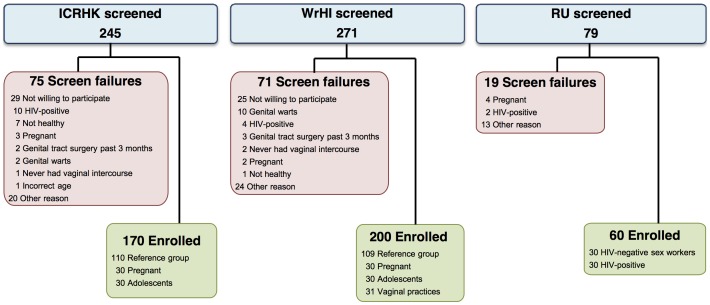
A longitudinal study was conducted in Kenya, Rwanda and South-Africa. Women were recruited into pre-defined study groups including adult, non-pregnant, HIV-negative women; pregnant women; adolescent girls; HIV-negative women engaging in vaginal practices; female sex workers; and HIV-positive women. Consenting women were interviewed and underwent a pelvic exam. Samples of vaginal fluid and a blood sample were taken and tested for bacterial vaginosis (BV), HIV and other reproductive tract infections (RTIs). This paper presents the cross-sectional analyses of BV Nugent scores and RTI prevalence and correlates at the screening and the enrolment visit.
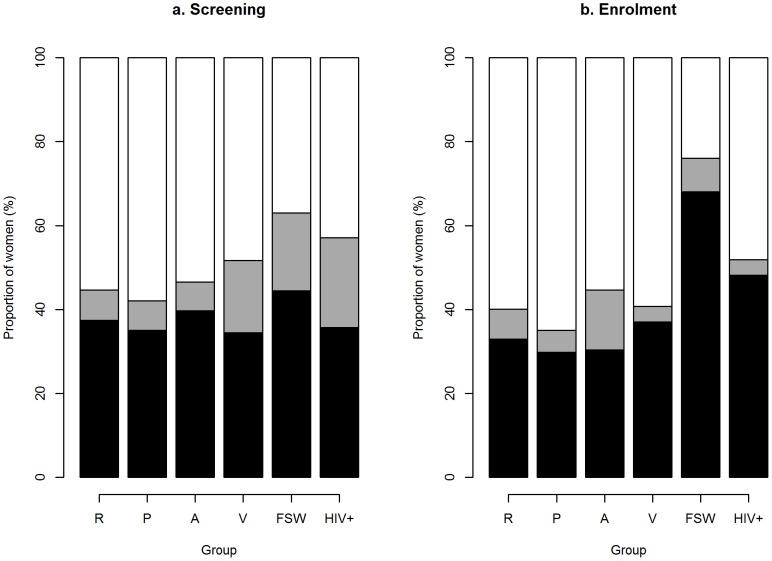
At the screening visit 38% of women had BV defined as a Nugent score of 7-10, and 64% had more than one RTI (N. gonorrhoea, C. trachomatis, T. vaginalis, syphilis) and/or Candida. At screening the likelihood of BV was lower in women using progestin-only contraception and higher in women with more than one RTI. At enrolment, BV scores were significantly associated with the presence of prostate specific antigen (PSA) in the vaginal fluid and with being a self-acknowledged sex worker. Further, sex workers were more likely to have incident BV by Nugent score at enrolment.
Our study confirmed some of the correlates of BV that have been previously reported but the most salient finding was the association between BV and the presence of PSA in the vaginal fluid which is suggestive of recent unprotected sexual intercourse.
旨在减少艾滋病毒及其他性传播感染传播的阴道用产品的临床开发,凸显了更好地描述阴道环境的必要性。我们着手描述撒哈拉以南非洲不同环境下女性的阴道环境。
在肯尼亚、卢旺达和南非进行了一项纵向研究。将女性招募到预先定义的研究组中,包括成年、非孕、艾滋病毒阴性女性;孕妇;青少年女孩;有阴道性行为的艾滋病毒阴性女性;女性性工作者;以及艾滋病毒阳性女性。同意参与的女性接受了访谈并接受了盆腔检查。采集了阴道液样本和血液样本,检测细菌性阴道病(BV)、艾滋病毒及其他生殖道感染(RTIs)。本文呈现了筛查和入组访视时BV Nugent评分、RTIs患病率及其相关性的横断面分析。
在筛查访视时,38%的女性BV定义为Nugent评分为7 - 10,64%的女性有一种以上的RTIs(淋病奈瑟菌、沙眼衣原体、阴道毛滴虫、梅毒)和/或念珠菌。筛查时,仅使用孕激素避孕的女性患BV的可能性较低,而有一种以上RTIs的女性患BV的可能性较高。在入组时,BV评分与阴道液中前列腺特异性抗原(PSA)的存在以及自我承认是性工作者显著相关。此外,性工作者在入组时根据Nugent评分更有可能发生BV。
我们的研究证实了一些先前报道的BV相关因素,但最显著的发现是BV与阴道液中PSA的存在之间的关联,这提示近期有无保护的性行为。