Schäfer Georgia, Hitchcock Jessica K, Shaw Tamlyn M, Katz Arieh A, Parker M Iqbal
Division of Medical Biochemistry, Faculty of Health Sciences, University of Cape Town, Cape Town, South Africa; Institute of Infectious Disease and Molecular Medicine (IDM), University of Cape Town, Cape Town, South Africa.
J Cell Biochem. 2015 Mar;116(3):408-17. doi: 10.1002/jcb.24989.
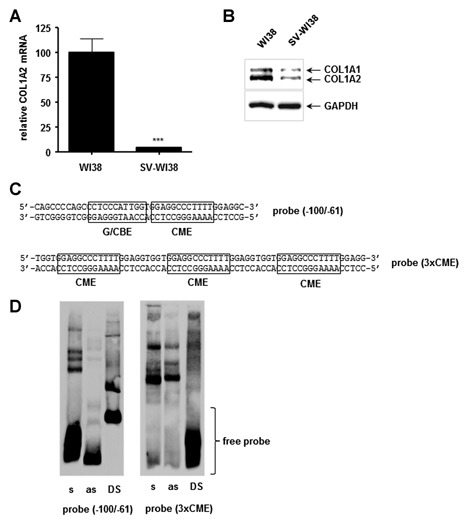
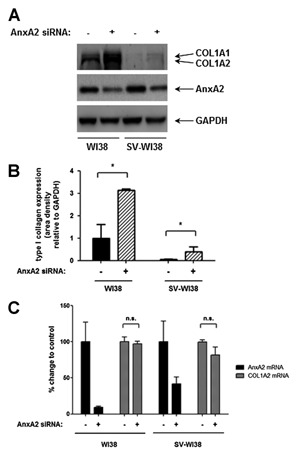
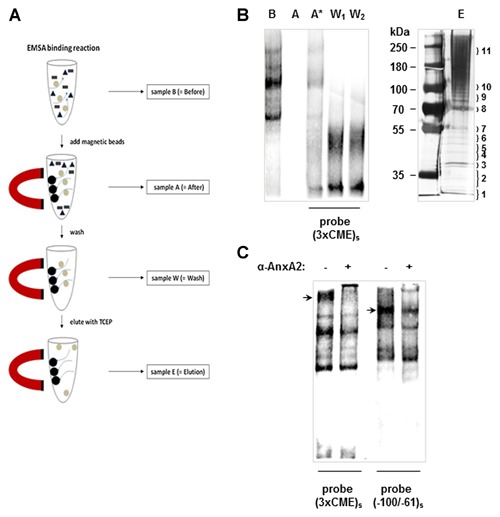
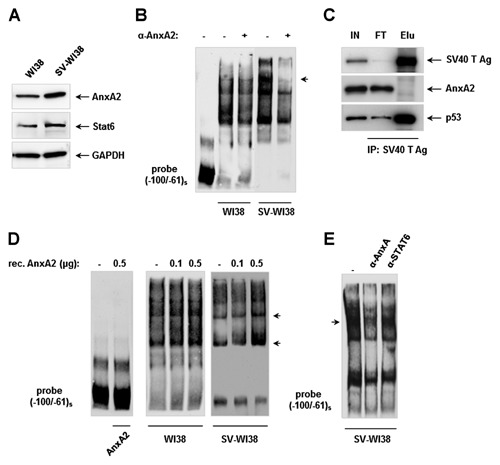
The fibrillar collagen scaffold of the extracellular matrix provides a structural framework for cells in tissues and regulates intercellular communication; its disregulation has been associated with tumour development and progression. Previous work has shown that expression of type I collagen, the most abundant mammalian extracellular matrix protein, is decreased in chemically or virally transformed cells. This negative regulation could be mapped to a proximal COL1A2 promoter element spanning a CME (Collagen Modulating Element) site in SV40-transformed human fibroblasts (SV-WI38) that binds an unknown repressing protein. By magnetic bead pull-down, we observed a multi-protein complex bound to the CME with preference for single-stranded over conventional double-stranded DNA. MALDI-TOF mass spectrometry of the CME-binding protein complex revealed involvement of nuclear annexin A2 (AnxA2) which was increased in SV40-transformed cells. Further EMSA analysis demonstrated that AnxA2 did not directly bind to the DNA but stabilised the complex and led to an increase in protein binding to the CME in SV-WI38 but not untransformed WI38 cells. Knockdown of AnxA2 by siRNA increased type I collagen production in both WI38 and SV-WI38 cells; however, these effects were not mediated at the transcriptional level. Rather, our data indicate a novel functional role of AnxA2 in the negative post-transcriptional regulation of type I collagen synthesis in human fibroblasts. In SV40-transformed cells, AnxA2 is accumulated at the proximal COL1A2 promoter region, suggesting close association with the transcriptional machinery that possibly facilitates binding to the emerging mRNA, eventually contributing to overall repression of type I collagen protein synthesis.
细胞外基质的纤维状胶原蛋白支架为组织中的细胞提供结构框架并调节细胞间通讯;其失调与肿瘤的发生和发展相关。先前的研究表明,I型胶原蛋白是哺乳动物细胞外基质中最丰富的蛋白质,在化学或病毒转化的细胞中其表达降低。这种负调控可定位到一个近端COL1A2启动子元件,该元件跨越SV40转化的人成纤维细胞(SV-WI38)中的一个CME(胶原调节元件)位点,该位点结合一种未知的抑制蛋白。通过磁珠下拉实验,我们观察到一种多蛋白复合物与CME结合,相比于传统双链DNA,其更倾向于单链DNA。对CME结合蛋白复合物进行基质辅助激光解吸电离飞行时间质谱分析,结果显示核膜联蛋白A2(AnxA2)参与其中,且在SV40转化的细胞中AnxA2有所增加。进一步的电泳迁移率变动分析表明,AnxA2并不直接与DNA结合,而是稳定复合物,并导致SV-WI38细胞(而非未转化的WI38细胞)中与CME结合的蛋白增加。通过小干扰RNA敲低AnxA2可增加WI38和SV-WI38细胞中I型胶原蛋白的产生;然而,这些效应并非在转录水平介导。相反,我们的数据表明AnxA2在人成纤维细胞I型胶原蛋白合成的负转录后调控中具有新的功能作用。在SV40转化的细胞中,AnxA2在近端COL1A部位积累,提示其与转录机制密切相关,这可能有助于与新出现的mRNA结合,最终导致I型胶原蛋白合成的整体抑制。