Segarra Amélie, Baillon Laury, Tourbiez Delphine, Benabdelmouna Abdellah, Faury Nicole, Bourgougnon Nathalie, Renault Tristan
Ifremer (Institut Français de Recherche pour l'Exploitation de la Mer), Unité Santé Génétique et Microbiologie des Mollusques (SG2M), Laboratoire de Génétique et Pathologie des Mollusques Marins (LGPMM), Avenue de Mus de Loup, 17390, La Tremblade, France.
Université de Bretagne Sud (UBS), Centre d'Enseignement et de Recherche Yves Coppens, Laboratoire de Biotechnologie et Chimie Marines EA3884 (LBCM), Université Européenne de Bretagne (UEB), Campus de Tohannic, BP573, 56017, Vannes Cedex, France.
Vet Res. 2014 Oct 8;45(1):103. doi: 10.1186/s13567-014-0103-x.
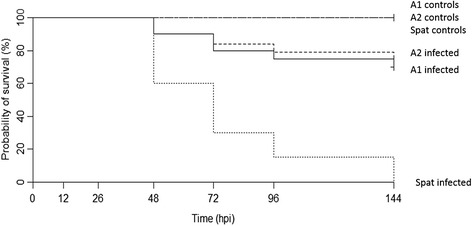
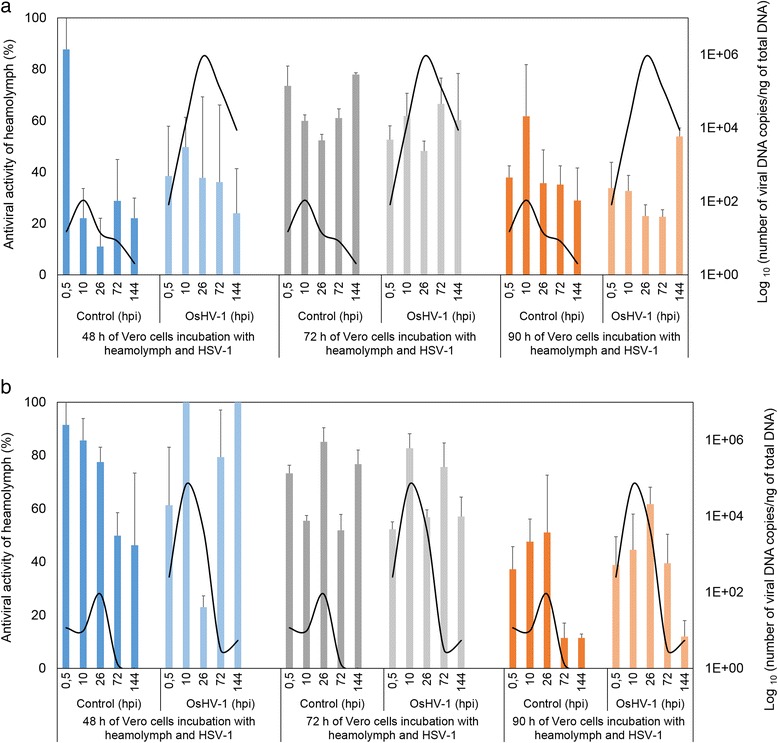
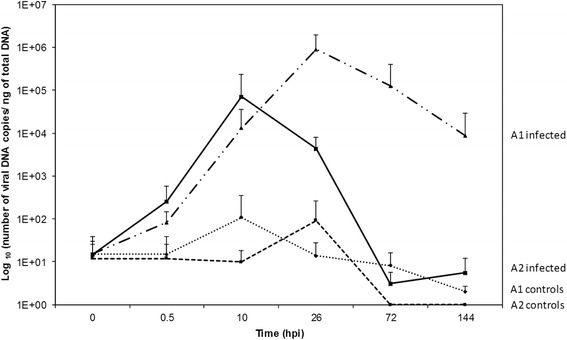
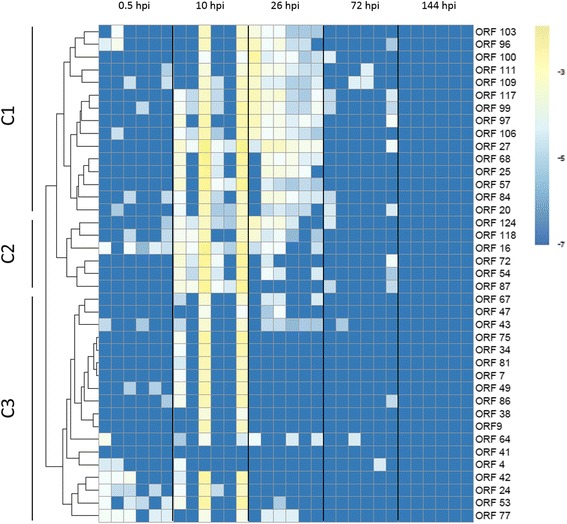
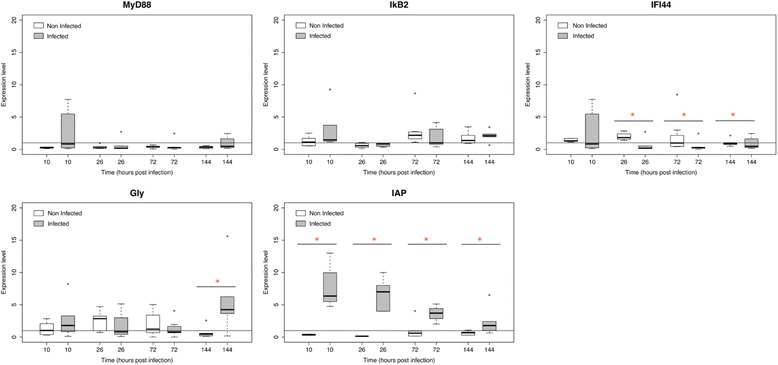
Since 2008, massive mortality outbreaks associated with OsHV-1 detection have been reported in Crassostrea gigas spat and juveniles in several countries. Nevertheless, adult oysters do not demonstrate mortality in the field related to OsHV-1 detection and were thus assumed to be more resistant to viral infection. Determining how virus and adult oyster interact is a major goal in understanding why mortality events are not reported among adult Pacific oysters. Dual transcriptomics of virus-host interactions were explored by real-time PCR in adult oysters after a virus injection. Thirty-nine viral genes and five host genes including MyD88, IFI44, IkB2, IAP and Gly were measured at 0.5, 10, 26, 72 and 144 hours post infection (hpi). No viral RNA among the 39 genes was detected at 144 hpi suggesting the adult oysters are able to inhibit viral replication. Moreover, the IAP gene (oyster gene) shows significant up-regulation in infected adults compared to control adults. This result suggests that over-expression of IAP could be a reaction to OsHV-1 infection, which may induce the apoptotic process. Apoptosis could be a main mechanism involved in disease resistance in adults. Antiviral activity of haemolymph against herpes simplex virus (HSV-1) was not significantly different between infected adults versus control.
自2008年以来,在几个国家的太平洋牡蛎稚贝和幼贝中报告了与检测到的牡蛎疱疹病毒1型(OsHV-1)相关的大规模死亡疫情。然而,成年牡蛎在野外并未表现出与检测到OsHV-1相关的死亡,因此被认为对病毒感染更具抵抗力。确定病毒与成年牡蛎如何相互作用是理解为何成年太平洋牡蛎未报告死亡事件的一个主要目标。在病毒注射后,通过实时PCR对成年牡蛎中病毒-宿主相互作用的双重转录组学进行了研究。在感染后0.5、10、26、72和144小时(hpi)测量了39个病毒基因和5个宿主基因,包括髓样分化因子88(MyD88)、干扰素诱导蛋白44(IFI44)、核因子κB抑制蛋白2(IkB2)、凋亡抑制蛋白(IAP)和糖原(Gly)。在144 hpi时,39个基因中未检测到病毒RNA,这表明成年牡蛎能够抑制病毒复制。此外,与对照成年牡蛎相比,IAP基因(牡蛎基因)在受感染的成年牡蛎中显著上调。这一结果表明,IAP的过表达可能是对OsHV-1感染的一种反应,这可能会诱导凋亡过程。凋亡可能是成年牡蛎抗病的主要机制。感染成年牡蛎与对照成年牡蛎之间,血淋巴对单纯疱疹病毒(HSV-1)的抗病毒活性没有显著差异。