• 文献检索
  • 文档翻译
  • 深度研究
  • 学术资讯
  • Suppr Zotero 插件Zotero 插件
  • 邀请有礼
  • 套餐&价格
  • 历史记录
应用&插件
Suppr Zotero 插件Zotero 插件浏览器插件Mac 客户端Windows 客户端微信小程序
定价
高级版会员购买积分包购买API积分包
服务
文献检索文档翻译深度研究API 文档MCP 服务
关于我们
关于 Suppr公司介绍联系我们用户协议隐私条款
关注我们

Suppr 超能文献

核心技术专利:CN118964589B侵权必究
粤ICP备2023148730 号-1Suppr @ 2026

文献检索

告别复杂PubMed语法,用中文像聊天一样搜索,搜遍4000万医学文献。AI智能推荐,让科研检索更轻松。

立即免费搜索

文件翻译

保留排版,准确专业,支持PDF/Word/PPT等文件格式,支持 12+语言互译。

免费翻译文档

深度研究

AI帮你快速写综述,25分钟生成高质量综述,智能提取关键信息,辅助科研写作。

立即免费体验

先天免疫的进化:从无脊椎动物到鱼类再到哺乳动物的线索。

Evolution of Innate Immunity: Clues from Invertebrates via Fish to Mammals.

机构信息

Department of Veterinary Disease Biology, Faculty of Health and Medical Sciences, University of Copenhagen , Copenhagen , Denmark.

出版信息

Front Immunol. 2014 Sep 23;5:459. doi: 10.3389/fimmu.2014.00459. eCollection 2014.

DOI:10.3389/fimmu.2014.00459
PMID:25295041
原文链接:https://pmc.ncbi.nlm.nih.gov/articles/PMC4172062/
Abstract

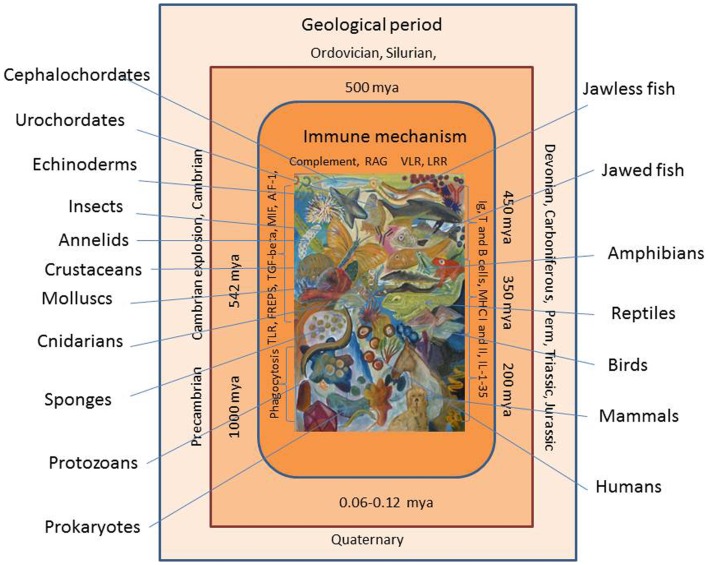
Host responses against invading pathogens are basic physiological reactions of all living organisms. Since the appearance of the first eukaryotic cells, a series of defense mechanisms have evolved in order to secure cellular integrity, homeostasis, and survival of the host. Invertebrates, ranging from protozoans to metazoans, possess cellular receptors, which bind to foreign elements and differentiate self from non-self. This ability is in multicellular animals associated with presence of phagocytes, bearing different names (amebocytes, hemocytes, coelomocytes) in various groups including animal sponges, worms, cnidarians, mollusks, crustaceans, chelicerates, insects, and echinoderms (sea stars and urchins). Basically, these cells have a macrophage-like appearance and function and the repair and/or fight functions associated with these cells are prominent even at the earliest evolutionary stage. The cells possess pathogen recognition receptors recognizing pathogen-associated molecular patterns, which are well-conserved molecular structures expressed by various pathogens (virus, bacteria, fungi, protozoans, helminths). Scavenger receptors, Toll-like receptors, and Nod-like receptors (NLRs) are prominent representatives within this group of host receptors. Following receptor-ligand binding, signal transduction initiates a complex cascade of cellular reactions, which lead to production of one or more of a wide array of effector molecules. Cytokines take part in this orchestration of responses even in lower invertebrates, which eventually may result in elimination or inactivation of the intruder. Important innate effector molecules are oxygen and nitrogen species, antimicrobial peptides, lectins, fibrinogen-related peptides, leucine rich repeats (LRRs), pentraxins, and complement-related proteins. Echinoderms represent the most developed invertebrates and the bridge leading to the primitive chordates, cephalochordates, and urochordates, in which many autologous genes and functions from their ancestors can be found. They exhibit numerous variants of innate recognition and effector molecules, which allow fast and innate responses toward diverse pathogens despite lack of adaptive responses. The primitive vertebrates (agnathans also termed jawless fish) were the first to supplement innate responses with adaptive elements. Thus hagfish and lampreys use LRRs as variable lymphocyte receptors, whereas higher vertebrates [cartilaginous and bony fishes (jawed fish), amphibians, reptiles, birds, and mammals] developed the major histocompatibility complex, T-cell receptors, and B-cell receptors (immunoglobulins) as additional adaptive weaponry to assist innate responses. Extensive cytokine networks are recognized in fish, but related signal molecules can be traced among invertebrates. The high specificity, antibody maturation, immunological memory, and secondary responses of adaptive immunity were so successful that it allowed higher vertebrates to reduce the number of variants of the innate molecules originating from both invertebrates and lower vertebrates. Nonetheless, vertebrates combine the two arms in an intricate inter-dependent network. Organisms at all developmental stages have, in order to survive, applied available genes and functions of which some may have been lost or may have changed function through evolution. The molecular mechanisms involved in evolution of immune molecules, might apart from simple base substitutions be as diverse as gene duplication, deletions, alternative splicing, gene recombination, domain shuffling, retrotransposition, and gene conversion. Further, variable regulation of gene expression may have played a role.
https://cdn.ncbi.nlm.nih.gov/pmc/blobs/2468/4172062/155eab417d02/fimmu-05-00459-g001.jpg
摘要

宿主对入侵病原体的反应是所有生物的基本生理反应。自从真核细胞出现以来,为了确保细胞的完整性、内环境稳定和宿主的生存,一系列防御机制已经进化出来。从原生动物到后生动物的无脊椎动物都拥有细胞受体,这些受体可以与外来元素结合,并将自身与非自身区分开来。这种能力在多细胞动物中与吞噬细胞的存在有关,这些吞噬细胞在不同的群体中具有不同的名称(变形细胞、血细胞、体腔细胞),包括动物海绵、蠕虫、刺胞动物、软体动物、甲壳动物、螯肢动物、昆虫和棘皮动物(海星和海胆)。基本上,这些细胞具有类似于巨噬细胞的外观和功能,与这些细胞相关的修复和/或对抗功能在最早的进化阶段就很明显。这些细胞拥有病原体识别受体,可以识别病原体相关的分子模式,这些模式是各种病原体(病毒、细菌、真菌、原生动物、寄生虫)表达的高度保守的分子结构。清道夫受体、Toll 样受体和 Nod 样受体(NLRs)是该宿主受体群中的突出代表。在受体-配体结合之后,信号转导启动了一个复杂的细胞反应级联,导致产生一种或多种广泛的效应分子。细胞因子甚至在较低等的无脊椎动物中参与这种反应的协调,最终可能导致入侵者的消除或失活。重要的先天效应分子是氧和氮物种、抗菌肽、凝集素、纤维蛋白原相关肽、富含亮氨酸重复序列(LRRs)、五聚体和补体相关蛋白。棘皮动物是最发达的无脊椎动物,是连接原始脊索动物、头索动物和尾索动物的桥梁,在这些动物中可以找到来自其祖先的许多同源基因和功能。它们表现出多种先天识别和效应分子的变体,这使得它们能够快速地对各种病原体产生先天反应,尽管缺乏适应性反应。原始的脊椎动物(无颌鱼也称为无颌鱼)是第一个用适应性元素补充先天反应的动物。因此,盲鳗和七鳃鳗将 LRR 用作可变淋巴细胞受体,而高等脊椎动物[软骨鱼和硬骨鱼(有颌鱼)、两栖动物、爬行动物、鸟类和哺乳动物]则开发了主要组织相容性复合体、T 细胞受体和 B 细胞受体(免疫球蛋白)作为辅助先天反应的额外适应性武器。鱼类中已经识别出广泛的细胞因子网络,但在无脊椎动物中也可以追踪到相关的信号分子。适应性免疫的高特异性、抗体成熟、免疫记忆和二次反应是如此成功,以至于高等脊椎动物减少了来自无脊椎动物和低等脊椎动物的先天分子的变体数量。尽管如此,脊椎动物在一个复杂的相互依存的网络中结合了这两个分支。为了生存,所有发育阶段的生物都应用了可用的基因和功能,其中一些可能已经丢失,或者可能通过进化改变了功能。参与免疫分子进化的分子机制可能不仅限于简单的碱基替换,还可能包括基因复制、缺失、选择性剪接、基因重组、结构域洗牌、逆转录转座和基因转换。此外,基因表达的可变调节可能也发挥了作用。

相似文献

1
Evolution of Innate Immunity: Clues from Invertebrates via Fish to Mammals.先天免疫的进化:从无脊椎动物到鱼类再到哺乳动物的线索。
Front Immunol. 2014 Sep 23;5:459. doi: 10.3389/fimmu.2014.00459. eCollection 2014.
2
The ancestry and cumulative evolution of immune reactions.免疫反应的起源与累积进化。
Acta Biochim Pol. 2010;57(4):443-66. Epub 2010 Nov 1.
3
Neutrophils and aquatic pathogens.中性粒细胞与水生病原体。
Parasite Immunol. 2022 Jun;44(6):e12915. doi: 10.1111/pim.12915. Epub 2022 Mar 22.
4
The ancestral complement system in sea urchins.海胆的原始补体系统。
Immunol Rev. 2001 Apr;180:16-34. doi: 10.1034/j.1600-065x.2001.1800102.x.
5
New insights into alternative mechanisms of immune receptor diversification.免疫受体多样化替代机制的新见解。
Adv Immunol. 2005;87:209-36. doi: 10.1016/S0065-2776(05)87006-3.
6
Recognition strategies in the innate immune system of ancestral chordates.原始脊索动物先天免疫系统中的识别策略。
Mol Immunol. 2004 Nov;41(11):1077-87. doi: 10.1016/j.molimm.2004.06.010.
7
The complexity of immune and alloimmune response.免疫和同种免疫反应的复杂性。
Transpl Immunol. 2002 Aug;10(2-3):91-100. doi: 10.1016/s0966-3274(02)00054-0.
8
A Comparison of the Innate and Adaptive Immune Systems in Cartilaginous Fish, Ray-Finned Fish, and Lobe-Finned Fish.软骨鱼、硬骨鱼和肺鱼的固有免疫系统和适应性免疫系统比较。
Front Immunol. 2019 Oct 10;10:2292. doi: 10.3389/fimmu.2019.02292. eCollection 2019.
9
The Natural History of Teneurins: A Billion Years of Evolution in Three Key Steps.Ten-eurins的自然史:三个关键步骤中的十亿年进化历程。
Front Neurosci. 2019 Mar 15;13:109. doi: 10.3389/fnins.2019.00109. eCollection 2019.
10
Evolution of innate and adaptive immune systems in jawless vertebrates.无颌脊椎动物固有和适应性免疫系统的进化。
Microbiol Immunol. 2013 Jan;57(1):1-12. doi: 10.1111/j.1348-0421.2012.00500.x.

引用本文的文献

1
Discovery of a Potent Antimicrobial Peptide Through Rational Design: A New Frontier in Pathogen Control.通过合理设计发现一种强效抗菌肽:病原体控制的新前沿。
Biomolecules. 2025 Jul 11;15(7):989. doi: 10.3390/biom15070989.
2
Antimicrobial peptides (AMPs) of lizards: a first comprehensive characterization of beta-defensins, ovo-defensins and cathelicidins from Podarcis lilfordi and closely related Lacertidae species.蜥蜴的抗菌肽:对来自利氏壁蜥及近缘蜥蜴科物种的β-防御素、卵防御素和cathelicidin的首次全面表征
BMC Genomics. 2025 Jul 21;26(1):677. doi: 10.1186/s12864-025-11797-2.
3
Exploring the Innate Immunity in Invertebrates.

本文引用的文献

1
Evolution of adaptive immunity: implications of a third lymphocyte lineage in lampreys.适应性免疫的进化:七鳃鳗中第三种淋巴细胞谱系的影响
Bioessays. 2014 Mar;36(3):244-50. doi: 10.1002/bies.201300145. Epub 2013 Dec 19.
2
Adaptive and innate immune molecules in developing rainbow trout, Oncorhynchus mykiss eggs and larvae: expression of genes and occurrence of effector molecules.发育中的虹鳟(Oncorhynchus mykiss)卵和幼体中的适应性和先天性免疫分子:基因表达及效应分子的存在情况
Fish Shellfish Immunol. 2014 May;38(1):25-33. doi: 10.1016/j.fsi.2014.02.010. Epub 2014 Feb 21.
3
A tetrapod-like repertoire of innate immune receptors and effectors for coelacanths.
探索无脊椎动物的先天免疫
Adv Exp Med Biol. 2025;1476:411-423. doi: 10.1007/978-3-031-85340-1_16.
4
Refined Phylogenetic Ortholog Inference Reveals Coevolutionary Expansion of the MAPK Signaling Network Through Finetuning of Pathway Specificity.精细的系统发育直系同源物推断揭示了通过微调途径特异性实现的丝裂原活化蛋白激酶信号网络的协同进化扩展。
J Mol Evol. 2025 May 30. doi: 10.1007/s00239-025-10254-8.
5
Mannose-modified hemocyanin enhances pathogen endocytosis by crustacean hemocytes.甘露糖修饰的血蓝蛋白增强甲壳动物血细胞对病原体的内吞作用。
J Biol Chem. 2025 May 28;301(7):110304. doi: 10.1016/j.jbc.2025.110304.
6
Itaconate modulates immune responses via inhibition of peroxiredoxin 5.衣康酸通过抑制过氧化物还原酶5来调节免疫反应。
Nat Metab. 2025 Apr 18. doi: 10.1038/s42255-025-01275-0.
7
The Roles of Distinct Transcriptional Factors in the Innate Immunity of .不同转录因子在……先天免疫中的作用
Cells. 2025 Feb 21;14(5):327. doi: 10.3390/cells14050327.
8
Identification and Characterization of a Novel GAPDH-Derived Antimicrobial Peptide From Jellyfish.一种来自水母的新型甘油醛-3-磷酸脱氢酶衍生抗菌肽的鉴定与表征
J Pept Sci. 2025 Apr;31(4):e70011. doi: 10.1002/psc.70011.
9
Mechanisms and environmental factors shaping the ecosystem of brain macrophages.塑造脑巨噬细胞生态系统的机制和环境因素。
Front Immunol. 2025 Jan 24;16:1539988. doi: 10.3389/fimmu.2025.1539988. eCollection 2025.
10
Experimental adaptation to singular pathogen challenge reduces susceptibility to novel pathogens in .对单一病原体攻击的实验性适应降低了对新型病原体的易感性。
Curr Res Insect Sci. 2024 Dec 31;7:100105. doi: 10.1016/j.cris.2024.100105. eCollection 2025.
腔棘鱼先天免疫受体和效应器类似四足动物的组成。
J Exp Zool B Mol Dev Evol. 2014 Sep;322(6):415-37. doi: 10.1002/jez.b.22559. Epub 2014 Jan 30.
4
Evolution of a cellular immune response in Drosophila: a phenotypic and genomic comparative analysis.果蝇细胞免疫反应的进化:表型与基因组比较分析
Genome Biol Evol. 2014 Feb;6(2):273-89. doi: 10.1093/gbe/evu012.
5
Elephant shark genome provides unique insights into gnathostome evolution.象鲨基因组为颌口动物进化提供了独特的见解。
Nature. 2014 Jan 9;505(7482):174-9. doi: 10.1038/nature12826.
6
An amphioxus RAG1-like DNA fragment encodes a functional central domain of vertebrate core RAG1.文昌鱼 RAG1 样 DNA 片段编码脊椎动物核心 RAG1 的功能中心域。
Proc Natl Acad Sci U S A. 2014 Jan 7;111(1):397-402. doi: 10.1073/pnas.1318843111. Epub 2013 Dec 24.
7
Prokaryotic ancestry of eukaryotic protein networks mediating innate immunity and apoptosis.真核生物固有免疫和细胞凋亡相关蛋白网络的原核祖先。
J Mol Biol. 2014 Apr 3;426(7):1568-82. doi: 10.1016/j.jmb.2013.11.030. Epub 2013 Dec 9.
8
Cloning, characterization, and expression of the macrophage migration inhibitory factor gene from the Pacific white shrimp Litopenaeus vannamei (Penaeidae).凡纳滨对虾(对虾科)巨噬细胞移动抑制因子基因的克隆、特征分析及表达
Genet Mol Res. 2013 Nov 22;12(4):5872-9. doi: 10.4238/2013.November.22.15.
9
Ancient origins of vertebrate-specific innate antiviral immunity.脊椎动物特异性先天性抗病毒免疫的古老起源。
Mol Biol Evol. 2014 Jan;31(1):140-53. doi: 10.1093/molbev/mst184. Epub 2013 Oct 8.
10
The characterization of sponge NLRs provides insight into the origin and evolution of this innate immune gene family in animals.海绵动物NLRs的特征为深入了解该先天性免疫基因家族在动物中的起源和进化提供了线索。
Mol Biol Evol. 2014 Jan;31(1):106-20. doi: 10.1093/molbev/mst174. Epub 2013 Oct 3.