Ammendola Michele, Leporini Christian, Marech Ilaria, Gadaleta Cosmo Damiano, Scognamillo Giovanni, Sacco Rosario, Sammarco Giuseppe, De Sarro Giovambattista, Russo Emilio, Ranieri Girolamo
Department of Medical and Surgery Sciences, Clinical Surgery Unit, University "Magna Graecia" Medical School, Viale Europa, Germaneto, 88100 Catanzaro, Italy.
Department of Health Science, Clinical Pharmacology and Pharmacovigilance Unit and Pharmacovigilance's Centre Calabria Region, University of Catanzaro "Magna Graecia" Medical School, Viale Europa, Germaneto, 88100 Catanzaro, Italy.
Biomed Res Int. 2014;2014:154702. doi: 10.1155/2014/154702. Epub 2014 Sep 11.
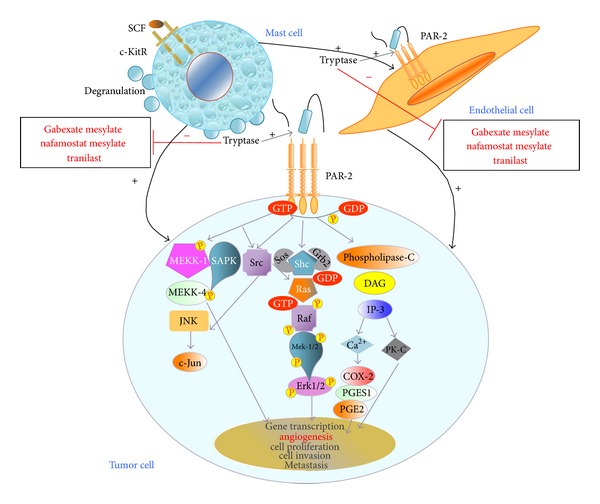
Angiogenesis is a complex process finely regulated by the balance between angiogenesis stimulators and inhibitors. As a result of proangiogenic factors overexpression, it plays a crucial role in cancer development. Although initially mast cells (MCs) role has been defined in hypersensitivity reactions and in immunity, it has been discovered that MCs have a crucial interplay on the regulatory function between inflammatory and tumor cells through the release of classical proangiogenic factors (e.g., vascular endothelial growth factor) and nonclassical proangiogenic mediators granule-associated (mainly tryptase). In fact, in several animal and human malignancies, MCs density is highly correlated with tumor angiogenesis. In particular, tryptase, an agonist of the proteinase-activated receptor-2 (PAR-2), represents one of the most powerful angiogenic mediators released by human MCs after c-Kit receptor activation. This protease, acting on PAR-2 by its proteolytic activity, has angiogenic activity stimulating both human vascular endothelial and tumor cell proliferation in paracrine manner, helping tumor cell invasion and metastasis. Based on literature data it is shown that tryptase may represent a promising target in cancer treatment due to its proangiogenic activity. Here we focused on molecular mechanisms of three tryptase inhibitors (gabexate mesylate, nafamostat mesylate, and tranilast) in order to consider their prospective role in cancer therapy.
血管生成是一个复杂的过程,受到血管生成刺激因子和抑制因子之间平衡的精细调节。由于促血管生成因子的过度表达,它在癌症发展中起着关键作用。尽管肥大细胞(MCs)最初的作用被定义为参与超敏反应和免疫,但人们发现,MCs通过释放经典的促血管生成因子(如血管内皮生长因子)和颗粒相关的非经典促血管生成介质(主要是类胰蛋白酶),在炎症细胞和肿瘤细胞之间的调节功能上有着至关重要的相互作用。事实上,在几种动物和人类恶性肿瘤中,MCs的密度与肿瘤血管生成高度相关。特别是类胰蛋白酶,作为蛋白酶激活受体-2(PAR-2)的激动剂,是人类MCs在c-Kit受体激活后释放的最强大的血管生成介质之一。这种蛋白酶通过其蛋白水解活性作用于PAR-2,具有血管生成活性,以旁分泌方式刺激人类血管内皮细胞和肿瘤细胞增殖,促进肿瘤细胞的侵袭和转移。基于文献数据表明,由于其促血管生成活性,类胰蛋白酶可能是癌症治疗中有前景的靶点。在这里,我们聚焦于三种类胰蛋白酶抑制剂(甲磺酸加贝酯、甲磺酸萘莫司他和曲尼司特)的分子机制,以探讨它们在癌症治疗中的潜在作用。