Pereira Lilian Varanda, de Vasconcelos Patrícia Pereira, Souza Layz Alves Ferreira, Pereira Gilberto de Araújo, Nakatani Adélia Yaeko Kyosen, Bachion Maria Márcia
Faculdade de Enfermagem, Universidade Federal de Goiás, Goiânia, GO, Brazil.
aff2.
Rev Lat Am Enfermagem. 2014 Jul-Aug;22(4):662-9. doi: 10.1590/0104-1169.3591.2465.
to identify the prevalence and intensity of chronic pain among elderly people of the community and to analyze associations with the self-perceived health status.
cross-sectional study with a populational sample (n=934), conducted through household interviews in the city of Goiânia, Brazil. The intensity of chronic pain (existing for 6 months or more) was measured using a numerical scale (0-10) and the self-perceived health through a verbal scale (very good, good, fair, poor, very poor). For the statistical analysis, the absolute frequency and percentage, CI (95%), Chi-square test, Odds ratio, and regression analysis were used. Significance of 5%.
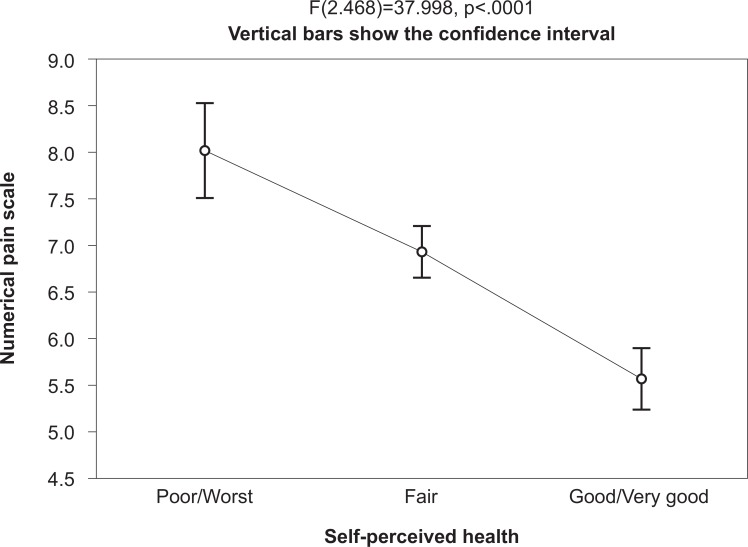
The prevalence of chronic pain was 52.8% [CI (95%):49.4-56.1]; most frequently located in the lower limbs (34.5%) and lumbar region (29.5%); with high or the worst possible intensity for 54.6% of the elderly people. The occurrence of chronic pain was associated with (p<0.0001) a worse self-perception of health (OR=4.2:2.5-7.0), a greater number of chronic diseases (OR=1.8:1.2-2.7), joint disease (OR=3.5:2.4-5.1) and the female gender (OR=2.3:1.7-3.0). A lower intensity of chronic pain was associated with a better self-perception of health (p<0.0001).
the majority of the elderly people of the community reported chronic pain, of a severe intensity, and located in areas related to movement activities, thus influencing the morbidity and mortality of this population.
确定社区老年人慢性疼痛的患病率和严重程度,并分析其与自我感知健康状况的关联。
在巴西戈亚尼亚市进行的一项针对人群样本(n = 934)的横断面研究,通过入户访谈开展。使用数字量表(0 - 10)测量慢性疼痛(持续6个月或更长时间)的严重程度,通过文字量表(非常好、好、一般、差、非常差)评估自我感知健康状况。统计分析采用绝对频数和百分比、95%置信区间、卡方检验、优势比和回归分析。显著性水平为5%。
慢性疼痛的患病率为52.8% [95%置信区间:49.4 - 56.1];最常出现在下肢(34.5%)和腰部(29.5%);54.6%的老年人疼痛程度为重度或极重度。慢性疼痛的发生与自我健康感知较差(p < 0.0001;优势比 = 4.2:2.5 - 7.0)、更多的慢性疾病(优势比 = 1.8:1.2 - 2.7)、关节疾病(优势比 = 3.5:2.4 - 5.1)以及女性性别(优势比 = 2.3:1.7 - 3.0)相关。慢性疼痛程度较低与较好的自我健康感知相关(p < 0.0001)。
社区中的大多数老年人报告存在重度慢性疼痛,且疼痛部位与活动相关,从而影响了该人群的发病率和死亡率。