Walker Rebekah J, Gebregziabher Mulugeta, Martin-Harris Bonnie, Egede Leonard E
Health Equity and Rural Outreach Innovation Center (HEROIC), Charleston VA HSR&D COIN, Ralph H, Johnson VAMC, Charleston, SC, USA.
BMC Endocr Disord. 2014 Oct 9;14:82. doi: 10.1186/1472-6823-14-82.
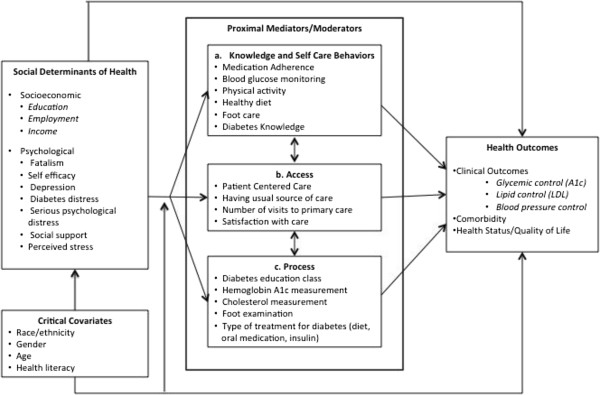
The aim of this study was to empirically validate a conceptual framework and elucidate the pathways linking social determinants of health to outcomes in individuals with type 2 diabetes.
615 adults were recruited from adult primary care clinics in the southeastern United States. The model was estimated using path analysis to determine if socioeconomic (education, employment, income) and psychosocial (fatalism, self-efficacy, depression, diabetes distress, serious psychological distress, social support, and perceived stress) factors would independently predict glycemic control or be associated with mediator/moderators of self-care, access to care, and processes of care. Covariates were gender, age, race and health literacy.
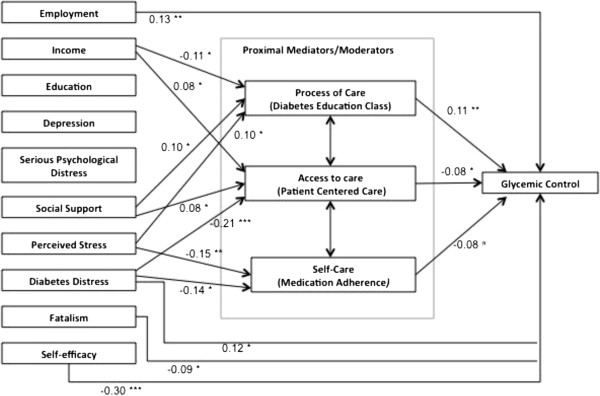
The final model (chi2 (15) = 17.68, p = 0.28; RMSEA = 0.02, CFI = 0.99) showed lower glycemic control was directly associated with less hours worked (r = 0.13, p = 0.002), more fatalistic attitudes (r = -0.09, p = 0.03), more self-efficacy (r = -0.30, p < 0.001), and less diabetes distress (r = 0.12, p = 0.03), with the majority of total effects being direct. Significant paths associated self-care with diabetes distress (r = -0.14, p = 0.01) and perceived stress (r = -0.15, p = .001); access to care with income (r = 0.08, p = 0.03), diabetes distress (r = -0.21, p < 0.001) and social support (r = 0.08, p = 0.03); and processes of care with income (r = -0.11, p = 0.03), social support (r = 0.10, p = 0.04), and perceived stress (r = 0.10, p = 0.04). The paths explained 76% of the variance in the model.
Consistent with the conceptual framework, social determinants were associated with glycemic control through a direct association and mediators/moderators of self-care, access to care and processes of care. This study provides the first validation of a conceptual framework for the relationship between socioeconomic and psychological components of social determinants of health and diabetes outcomes.
本研究的目的是通过实证验证一个概念框架,并阐明健康的社会决定因素与2型糖尿病患者结局之间的联系途径。
从美国东南部的成人初级保健诊所招募了615名成年人。使用路径分析对模型进行估计,以确定社会经济因素(教育、就业、收入)和心理社会因素(宿命论、自我效能感、抑郁、糖尿病困扰、严重心理困扰、社会支持和感知压力)是否能独立预测血糖控制,或与自我护理、获得医疗服务和护理过程的中介/调节因素相关。协变量包括性别、年龄、种族和健康素养。
最终模型(卡方(15)=17.68,p = 0.28;RMSEA = 0.02,CFI = 0.99)显示,血糖控制较差与工作时长较短(r = 0.13,p = 0.002)、宿命论态度更强(r = -0.09,p = 0.03)、自我效能感更高(r = -0.30,p < 0.001)以及糖尿病困扰更少(r = 0.12,p = 0.03)直接相关,且大多数总效应为直接效应。与自我护理相关的显著路径包括糖尿病困扰(r = -0.14,p = 0.01)和感知压力(r = -0.15,p = 0.001);与获得医疗服务相关的路径包括收入(r = 0.08,p = 0.03)、糖尿病困扰(r = -0.21,p < 0.001)和社会支持(r = 0.08,p = 0.03);与护理过程相关的路径包括收入(r = -0.11,p = 0.03)、社会支持(r = 0.10,p = 0.04)和感知压力(r = 0.10,p = 0.04)。这些路径解释了模型中76%的方差。
与概念框架一致,社会决定因素通过直接关联以及自我护理、获得医疗服务和护理过程的中介/调节因素与血糖控制相关。本研究首次验证了一个关于健康的社会决定因素的社会经济和心理成分与糖尿病结局之间关系的概念框架。