Abe Kimihiro, Kawano Yuta, Iwamoto Keito, Arai Kenji, Maruyama Yuki, Eichenberger Patrick, Sato Tsutomu
Research Center of Micro-Nano Technology, Hosei University, Koganei, Tokyo, Japan.
Department of Frontier Bioscience, Hosei University, Koganei, Tokyo, Japan.
PLoS Genet. 2014 Oct 9;10(10):e1004636. doi: 10.1371/journal.pgen.1004636. eCollection 2014 Oct.
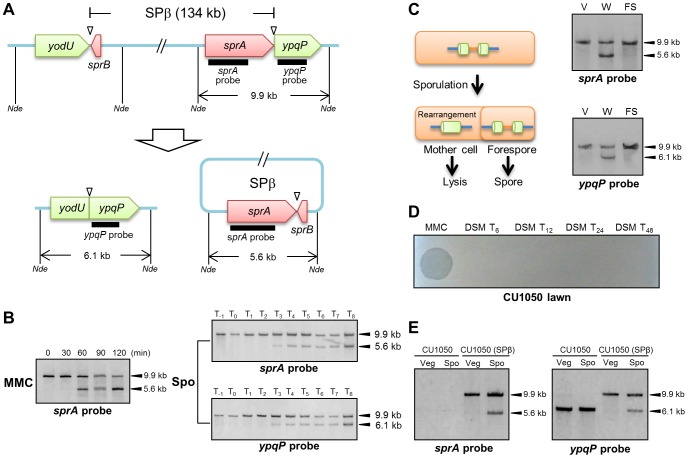
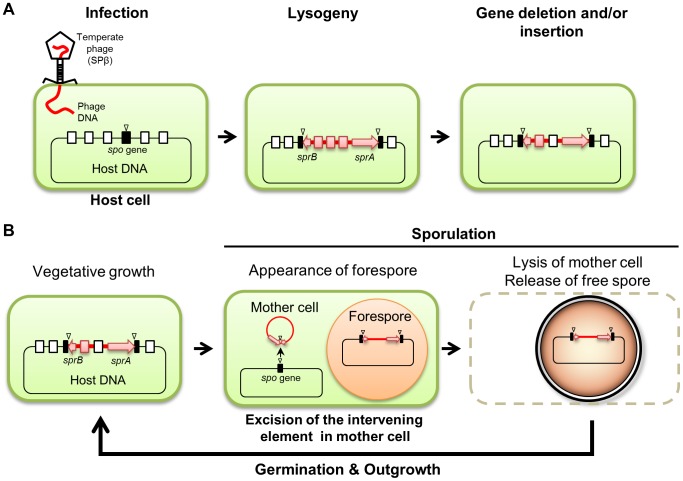
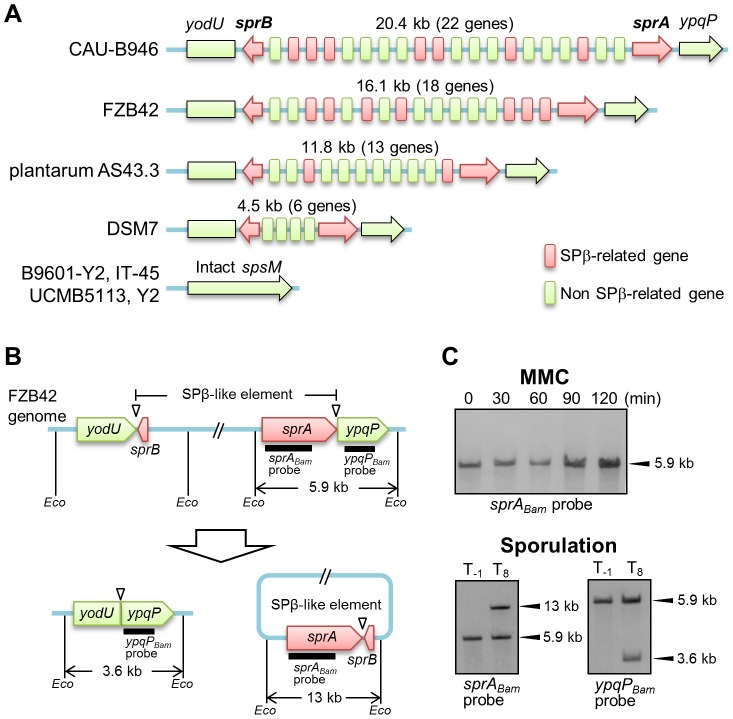
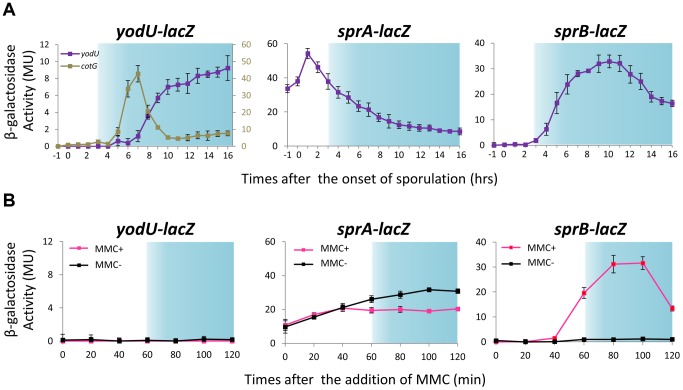
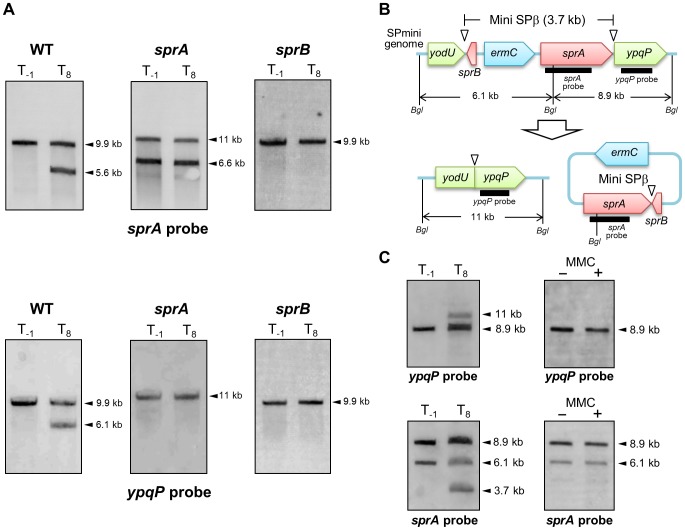
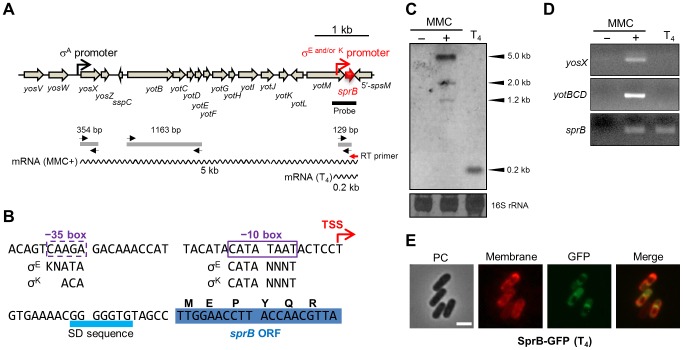
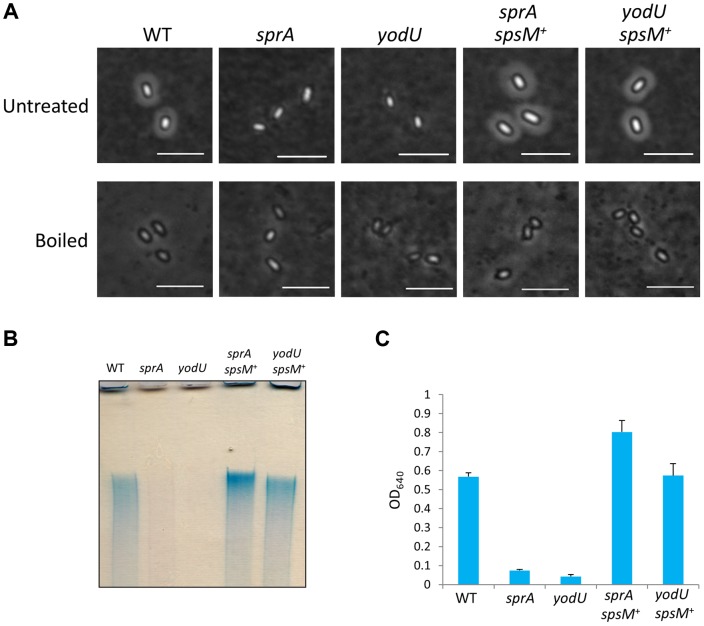
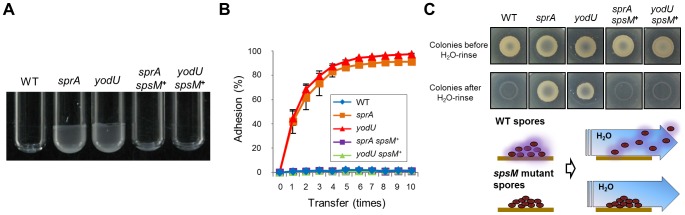
Temperate phages infect bacteria by injecting their DNA into bacterial cells, where it becomes incorporated into the host genome as a prophage. In the genome of Bacillus subtilis 168, an active prophage, SPβ, is inserted into a polysaccharide synthesis gene, spsM. Here, we show that a rearrangement occurs during sporulation to reconstitute a functional composite spsM gene by precise excision of SPβ from the chromosome. SPβ excision requires a putative site-specific recombinase, SprA, and an accessory protein, SprB. A minimized SPβ, where all the SPβ genes were deleted, except sprA and sprB, retained the SPβ excision activity during sporulation, demonstrating that sprA and sprB are necessary and sufficient for the excision. While expression of sprA was observed during vegetative growth, sprB was induced during sporulation and upon mitomycin C treatment, which triggers the phage lytic cycle. We also demonstrated that overexpression of sprB (but not of sprA) resulted in SPβ prophage excision without triggering the lytic cycle. These results suggest that sprB is the factor that controls the timing of phage excision. Furthermore, we provide evidence that spsM is essential for the addition of polysaccharides to the spore envelope. The presence of polysaccharides on the spore surface renders the spore hydrophilic in water. This property may be beneficial in allowing spores to disperse in natural environments via water flow. A similar rearrangement occurs in Bacillus amyloliquefaciens FZB42, where a SPβ-like element is excised during sporulation to reconstitute a polysaccharide synthesis gene, suggesting that this type of gene rearrangement is common in spore-forming bacteria because it can be spread by phage infection.
温和噬菌体通过将其DNA注入细菌细胞来感染细菌,在细菌细胞中,它作为原噬菌体整合到宿主基因组中。在枯草芽孢杆菌168的基因组中,一个活跃的原噬菌体SPβ插入到一个多糖合成基因spsM中。在这里,我们表明在芽孢形成过程中发生了重排,通过从染色体上精确切除SPβ来重新构建一个功能性的复合spsM基因。SPβ切除需要一个假定的位点特异性重组酶SprA和一个辅助蛋白SprB。一个最小化的SPβ,其中除了sprA和sprB之外所有的SPβ基因都被删除,在芽孢形成过程中保留了SPβ切除活性,这表明sprA和sprB对于切除是必要且充分的。虽然在营养生长期间观察到sprA的表达,但sprB在芽孢形成期间以及丝裂霉素C处理后被诱导,丝裂霉素C处理会触发噬菌体裂解周期。我们还证明,sprB(而不是sprA)的过表达导致SPβ原噬菌体切除而不触发裂解周期。这些结果表明sprB是控制噬菌体切除时间点的因素。此外,我们提供证据表明spsM对于向芽孢包膜添加多糖是必不可少的。芽孢表面多糖的存在使芽孢在水中具有亲水性。这种特性可能有利于芽孢通过水流在自然环境中扩散。在解淀粉芽孢杆菌FZB42中发生了类似的重排,在芽孢形成过程中一个类似SPβ的元件被切除以重新构建一个多糖合成基因,这表明这种类型的基因重排在形成芽孢的细菌中很常见,因为它可以通过噬菌体感染传播。