Leulmi Hamza, Socolovschi Cristina, Laudisoit Anne, Houemenou Gualbert, Davoust Bernard, Bitam Idir, Raoult Didier, Parola Philippe
Aix Marseille Université, URMITE, UM63, CNRS 7278, IRD 198, Inserm 1095, Marseille, France.
The University of Liverpool, Institute of Integrative Biology, University of Liverpool, Liverpool, United Kingdom; University of Antwerp, Evolutionary Ecology, Groenenborgerlaan, Antwerp, Belgium.
PLoS Negl Trop Dis. 2014 Oct 9;8(10):e3152. doi: 10.1371/journal.pntd.0003152. eCollection 2014 Oct.
Little is known about the presence/absence and prevalence of Rickettsia spp, Bartonella spp. and Yersinia pestis in domestic and urban flea populations in tropical and subtropical African countries.
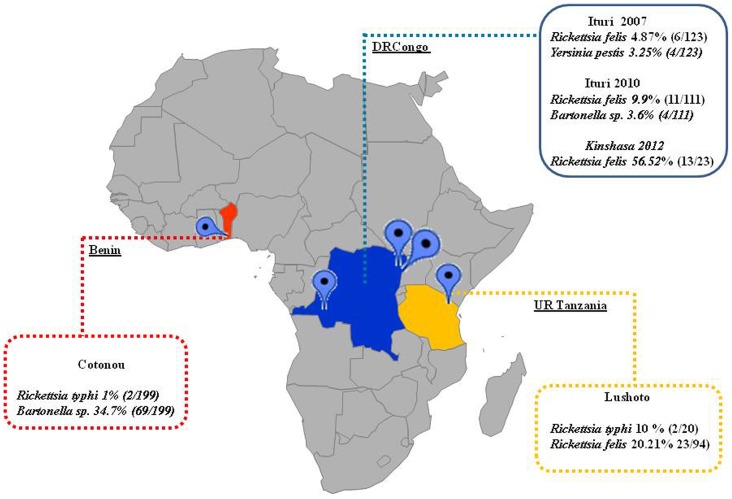
METHODOLOGY/PRINCIPAL FINDINGS: Fleas collected in Benin, the United Republic of Tanzania and the Democratic Republic of the Congo were investigated for the presence and identity of Rickettsia spp., Bartonella spp. and Yersinia pestis using two qPCR systems or qPCR and standard PCR. In Xenopsylla cheopis fleas collected from Cotonou (Benin), Rickettsia typhi was detected in 1% (2/199), and an uncultured Bartonella sp. was detected in 34.7% (69/199). In the Lushoto district (United Republic of Tanzania), R. typhi DNA was detected in 10% (2/20) of Xenopsylla brasiliensis, and Rickettsia felis was detected in 65% (13/20) of Ctenocephalides felis strongylus, 71.4% (5/7) of Ctenocephalides canis and 25% (5/20) of Ctenophthalmus calceatus calceatus. In the Democratic Republic of the Congo, R. felis was detected in 56.5% (13/23) of Ct. f. felis from Kinshasa, in 26.3% (10/38) of Ct. f. felis and 9% (1/11) of Leptopsylla aethiopica aethiopica from Ituri district and in 19.2% (5/26) of Ct. f. strongylus and 4.7% (1/21) of Echidnophaga gallinacea. Bartonella sp. was also detected in 36.3% (4/11) of L. a. aethiopica. Finally, in Ituri, Y. pestis DNA was detected in 3.8% (1/26) of Ct. f. strongylus and 10% (3/30) of Pulex irritans from the villages of Wanyale and Zaa.
Most flea-borne infections are neglected diseases which should be monitored systematically in domestic rural and urban human populations to assess their epidemiological and clinical relevance. Finally, the presence of Y. pestis DNA in fleas captured in households was unexpected and raises a series of questions regarding the role of free fleas in the transmission of plague in rural Africa, especially in remote areas where the flea density in houses is high.
关于立克次氏体属、巴尔通体属和鼠疫耶尔森菌在热带和亚热带非洲国家家养及城市跳蚤种群中的存在与否及流行情况,人们了解甚少。
方法/主要发现:使用两种定量聚合酶链反应(qPCR)系统或qPCR与标准PCR,对在贝宁、坦桑尼亚联合共和国和刚果民主共和国采集的跳蚤进行调查,以检测立克次氏体属、巴尔通体属和鼠疫耶尔森菌的存在及种类。在从科托努(贝宁)采集的印鼠客蚤中,检测到1%(2/199)的鼠型斑疹伤寒立克次氏体,以及34.7%(69/199)的未培养巴尔通体菌种。在卢绍托区(坦桑尼亚联合共和国),在10%(2/20)的巴西客蚤中检测到鼠型斑疹伤寒立克次氏体DNA,在65%(13/20)的猫栉首蚤指名亚种、71.4%(5/7)的犬栉首蚤和25%(5/20)的钙头栉眼蚤中检测到猫立克次氏体。在刚果民主共和国,在金沙萨的56.5%(13/23)的猫栉首蚤指名亚种、伊图里区的26.3%(10/38)的猫栉首蚤指名亚种和9%(1/11)的埃塞俄比亚细蚤中检测到猫立克次氏体,在19.2%(5/26)的猫栉首蚤指名亚种和4.7%(1/21)的鸡栉眼蚤中也检测到。在36.3%(4/11)的埃塞俄比亚细蚤中还检测到巴尔通体菌种。最后,在伊图里,在瓦尼亚莱和扎阿村的1.9%(1/26)的猫栉首蚤指名亚种和10%(3/30)的致痒蚤中检测到鼠疫耶尔森菌DNA。
大多数跳蚤传播的感染是被忽视的疾病,应在农村和城市的家养人群中进行系统监测,以评估其流行病学和临床相关性。最后,在家庭中捕获的跳蚤中检测到鼠疫耶尔森菌DNA出乎意料,这引发了一系列关于自由跳蚤在非洲农村鼠疫传播中的作用的问题,特别是在房屋中跳蚤密度高的偏远地区。