Cavaliere Rosa Maria, Ghirardi Filippo, Tirindelli Roberto
Department of Neuroscience, University of Parma Parma, Italy.
Front Neuroanat. 2014 Sep 25;8:101. doi: 10.3389/fnana.2014.00101. eCollection 2014.
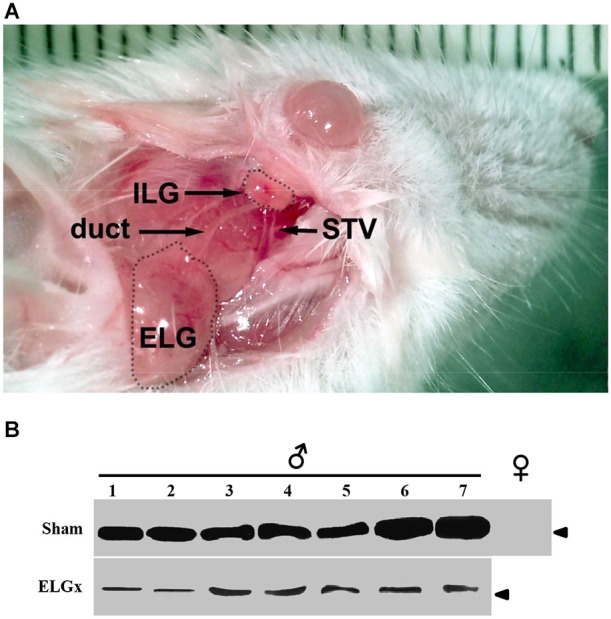
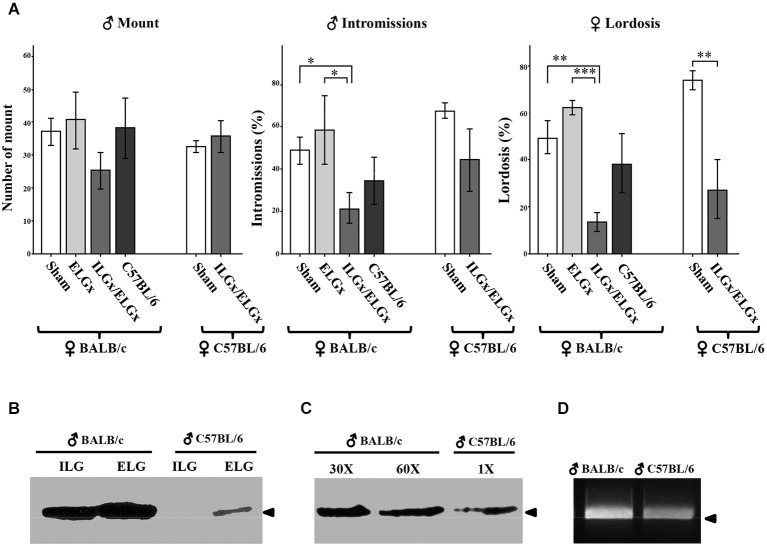
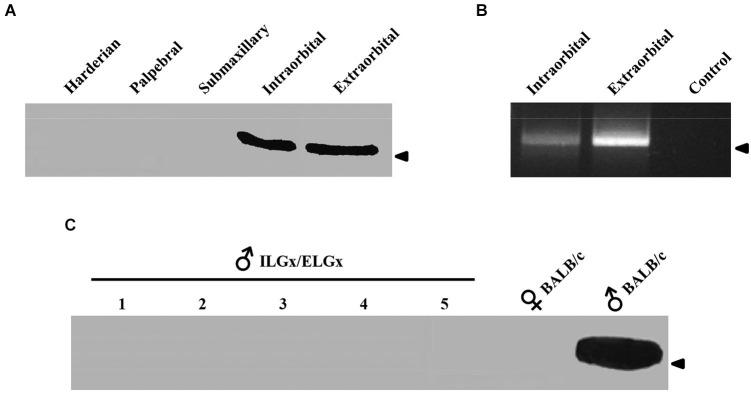
Exocrine gland-secreting peptides (ESPs) are a protein family involved in the pheromonal communication of rodents. ESP1 is a lacrimal peptide synthesized by the extraorbital glands of males of specific mouse strains that modulates the sexual behavior in females. Reportedly, BALB/c males, that produce high level of ESP1 in the tear fluid, were shown to enhance the lordosis behavior in C57BL/6 females during mating. In contrast, C57BL/6 and ICR males, both unable to express ESP1, failed to modulate this sexual behavior. Nonetheless, ICR males did become competent to enhance lordosis behavior in C57BL/6 females providing these were pre-exposed to ESP1. To exclude any strain differences, here, we investigated the pheromonal role of the extraorbital glands and indirectly of ESP1 in animals of the same strain. This was performed by applying the lordosis experimental paradigm in BALB/c mice before and after the surgical removal of these glands in males. The excision of the extraorbital glands reduced but did not abolish the production of ESP1 in the lacrimal fluid of BALB/c mice. An immunological analysis on soluble extracts of the glands that drain into the conjunctival sac revealed that the intraorbital glands (ILGs) are also responsible for the production of ESP1. The removal of both the extra and ILGs completely eliminated the tear secretion of ESP1. Extraorbital gland-deficient BALB/c mice were still able to induce lordosis behavior in sexually receptive females. In contrast, males with the removal of both the extra and ILGs failed to enhance lordosis behavior in females. Unexpectedly, C57BL/6 males did improve this sexual performance in BALB/c females. However, an analysis of the tear fluid of C57BL/6 males revealed low but detectable levels of ESP1. Overall, our study highlights the relevance of the orbital glands in modulating reproductive behavior and the sensitivity of the vomeronasal system to detect trace amount of ESP1.
外分泌腺分泌肽(ESPs)是一个参与啮齿动物信息素交流的蛋白质家族。ESP1是一种由特定小鼠品系雄性眶外腺合成的泪液肽,可调节雌性的性行为。据报道,泪液中产生高水平ESP1的BALB/c雄性小鼠在交配过程中可增强C57BL/6雌性小鼠的脊柱前凸行为。相比之下,无法表达ESP1的C57BL/6和ICR雄性小鼠则无法调节这种性行为。然而,如果C57BL/6雌性小鼠预先接触过ESP1,ICR雄性小鼠确实能够增强其脊柱前凸行为。为了排除任何品系差异,我们在此研究了同一品系动物中眶外腺以及间接ESP1的信息素作用。这是通过在雄性BALB/c小鼠手术切除这些腺体前后应用脊柱前凸实验范式来进行的。眶外腺的切除减少了但并未消除BALB/c小鼠泪液中ESP1的产生。对排入结膜囊的腺体可溶性提取物的免疫分析表明,眶内腺(ILGs)也负责ESP1的产生。切除眶外腺和眶内腺完全消除了泪液中ESP1的分泌。缺乏眶外腺的BALB/c雄性小鼠仍然能够在性接受的雌性小鼠中诱导脊柱前凸行为。相比之下,切除了眶外腺和眶内腺的雄性小鼠无法增强雌性小鼠的脊柱前凸行为。出乎意料的是,C57BL/6雄性小鼠确实改善了BALB/c雌性小鼠的这种性行为表现。然而,对C57BL/6雄性小鼠泪液的分析显示ESP1水平较低但可检测到。总体而言,我们的研究强调了眶腺在调节生殖行为中的相关性以及犁鼻系统检测痕量ESP1的敏感性。