Kraakman Michael James, Murphy Andrew James, Jandeleit-Dahm Karin, Kammoun Hélène L
Cellular and Molecular Metabolism Laboratory, Baker IDI Heart and Diabetes Institute , Melbourne, VIC , Australia ; Haematopoiesis and Leukocyte Biology Laboratory, Baker IDI Heart and Diabetes Institute , Melbourne, VIC , Australia.
Haematopoiesis and Leukocyte Biology Laboratory, Baker IDI Heart and Diabetes Institute , Melbourne, VIC , Australia ; Department of Immunology, Monash University , Melbourne, VIC , Australia.
Front Immunol. 2014 Sep 26;5:470. doi: 10.3389/fimmu.2014.00470. eCollection 2014.
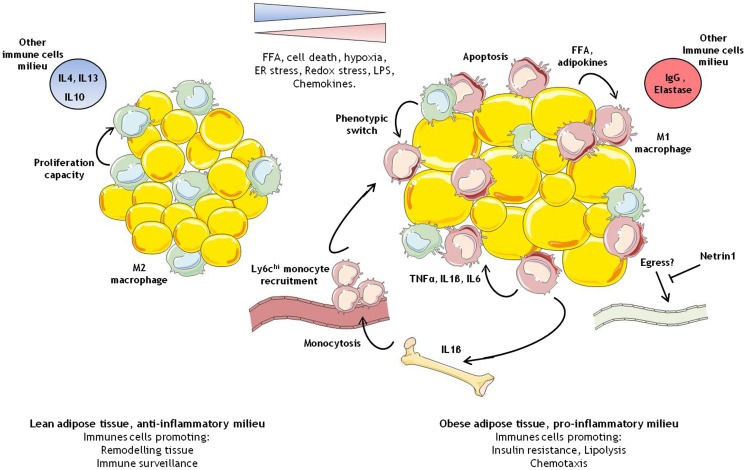
Obesity and type 2 diabetes are now recognized as chronic pro-inflammatory diseases. In the last decade, the role of the macrophage in particular has become increasingly implicated in their pathogenesis. Abundant literature now establishes that monocytes get recruited to peripheral tissues (i.e., pancreas, liver, and adipose tissue) to become resident macrophages and contribute to local inflammation, development of insulin resistance, or even pancreatic dysfunction. Furthermore, an accumulation of evidence has established an important role for macrophage polarization in the development of metabolic diseases. The general view in obesity is that there is an imbalance in the ratio of M1/M2 macrophages, with M1 "pro-inflammatory" macrophages being enhanced compared with M2 "anti-inflammatory" macrophages being down-regulated, leading to chronic inflammation and the propagation of metabolic dysfunction. However, there is emerging evidence revealing a more complex scenario with the spectrum of macrophage states exceeding well beyond the M1/M2 binary classification and confused further by human and animal models exhibiting different macrophage profiles. In this review, we will discuss the recent findings regarding macrophage polarization in obesity and type 2 diabetes.
肥胖症和2型糖尿病如今被公认为慢性促炎性疾病。在过去十年中,巨噬细胞在其发病机制中的作用尤其受到越来越多的关注。现在有大量文献表明,单核细胞被招募到外周组织(即胰腺、肝脏和脂肪组织)中成为驻留巨噬细胞,并导致局部炎症、胰岛素抵抗的发展,甚至胰腺功能障碍。此外,越来越多的证据表明巨噬细胞极化在代谢性疾病的发展中起着重要作用。肥胖症的普遍观点是,M1/M2巨噬细胞的比例失衡,与下调的M2“抗炎”巨噬细胞相比,M1“促炎”巨噬细胞增多,导致慢性炎症和代谢功能障碍的蔓延。然而,新出现的证据揭示了一种更为复杂的情况,巨噬细胞状态的范围远远超出了M1/M2二元分类,并且人类和动物模型表现出不同的巨噬细胞特征,这进一步加剧了这种复杂性。在这篇综述中,我们将讨论肥胖症和2型糖尿病中巨噬细胞极化的最新研究结果。