Division of Endocrinology, Department of Internal Medicine, Yonsei University College of Medicine, Seoul, Korea.
Department of Neurosurgery, Yonsei University College of Medicine, Seoul, Korea.
Endocrinol Metab (Seoul). 2014 Sep;29(3):280-92. doi: 10.3803/EnM.2014.29.3.280. Epub 2014 Sep 25.
Cabergoline is typically effective for treating prolactinomas; however, some patients display cabergoline resistance, and the early characteristics of these patients remain unclear. We analyzed early indicators predicting long-term response to cabergoline.
We retrospectively reviewed the cases of 44 patients with macroprolactinomas who received cabergoline as first-line treatment; the patients were followed for a median of 16 months. The influence of various clinical parameters on outcomes was evaluated.
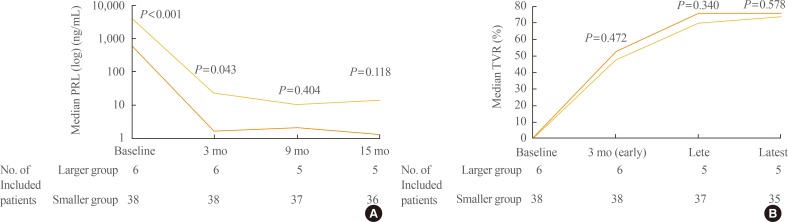
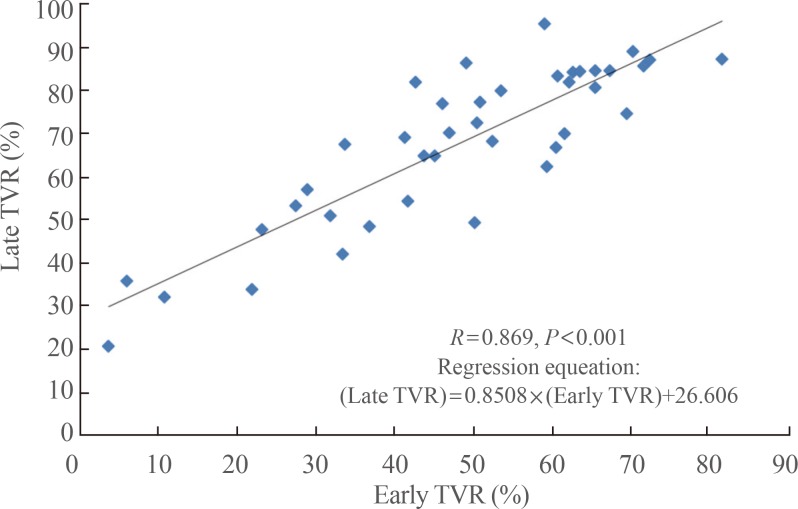
Forty patients (90.9%) were treated medically and displayed tumor volume reduction (TVR) of 74.7%, a prolactin normalization (NP) rate of 81.8%, and a complete response (CR; TVR >50% with NP, without surgery) rate of 70.5%. Most patients (93.1%) with TVR ≥25% and NP at 3 months eventually achieved CR, whereas only 50% of patients with TVR ≥25% without NP and no patients with TVR <25% achieved CR. TVR at 3 months was strongly correlated with final TVR (R=0.785). Patients with large macroadenomas exhibited a low NP rate at 3 months, but eventually achieved TVR and NP rates similar to those of patients with smaller tumors. Surgery independently reduced the final dose of cabergoline (β=-1.181 mg/week), and two of four patients who underwent surgery were able to discontinue cabergoline.
Determining cabergoline response using TVR and NP 3 months after treatment is useful for predicting later outcomes. However, further cabergoline administration should be considered for patients with TVR >25% at 3 months without NP, particularly those with huge prolactinomas, because a delayed response may be achieved. As surgery can reduce the cabergoline dose necessary for successful disease control, it should be considered for cabergoline-resistant patients.
卡麦角林通常对治疗催乳素瘤有效;然而,一些患者表现出卡麦角林耐药性,这些患者的早期特征仍不清楚。我们分析了预测长期对卡麦角林反应的早期指标。
我们回顾性分析了 44 例接受卡麦角林作为一线治疗的大催乳素瘤患者的病例;患者的中位随访时间为 16 个月。评估了各种临床参数对结局的影响。
40 例(90.9%)患者接受药物治疗,肿瘤体积减少(TVR)为 74.7%,催乳素正常化(NP)率为 81.8%,完全缓解(CR;TVR>50%,NP,无需手术)率为 70.5%。大多数(93.1%)TVR≥25%且 3 个月时 NP 的患者最终达到 CR,而仅 50%的 TVR≥25%而 NP 未达到的患者和没有 TVR<25%的患者达到 CR。3 个月时的 TVR 与最终 TVR 强烈相关(R=0.785)。大腺瘤患者在 3 个月时 NP 率较低,但最终达到的 TVR 和 NP 率与肿瘤较小的患者相似。手术独立降低了最终卡麦角林剂量(β=-1.181mg/周),4 例手术患者中有 2 例能够停止卡麦角林。
使用治疗后 3 个月的 TVR 和 NP 确定卡麦角林的反应有助于预测以后的结局。然而,对于 3 个月时 TVR>25%而无 NP 的患者,应考虑进一步给予卡麦角林治疗,特别是对于巨大的催乳素瘤患者,因为可能会出现延迟反应。由于手术可以减少成功控制疾病所需的卡麦角林剂量,因此对于卡麦角林耐药的患者应考虑手术。