Leng Pengfei, Zhang Zhiming, Li Qian, Zhao Maojun, Pan Guangtang
Maize Research Institute, Sichuan Agricultural University, Ya'an, PR China.
Chongqing College of Humanities, Science and Technology, School of Foreign Languages, Hechuan District, Chongqing, PR China.
PLoS One. 2014 Oct 13;9(10):e109580. doi: 10.1371/journal.pone.0109580. eCollection 2014.
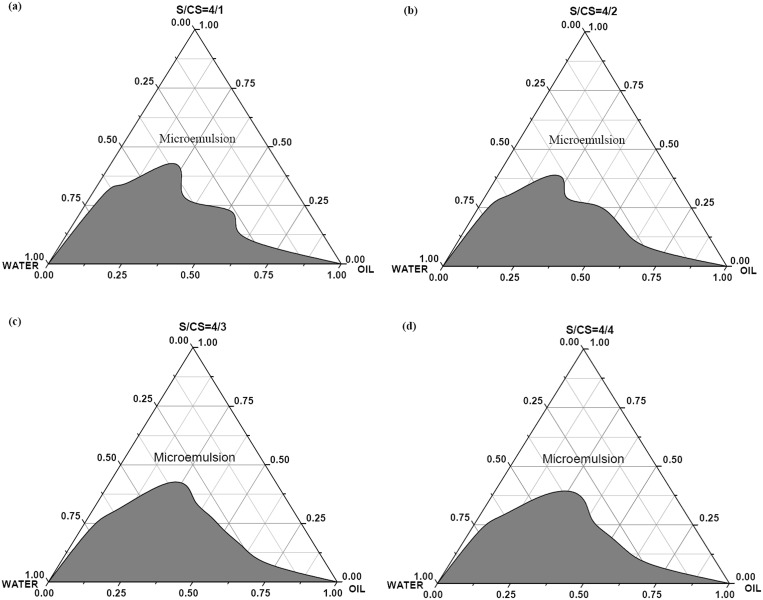
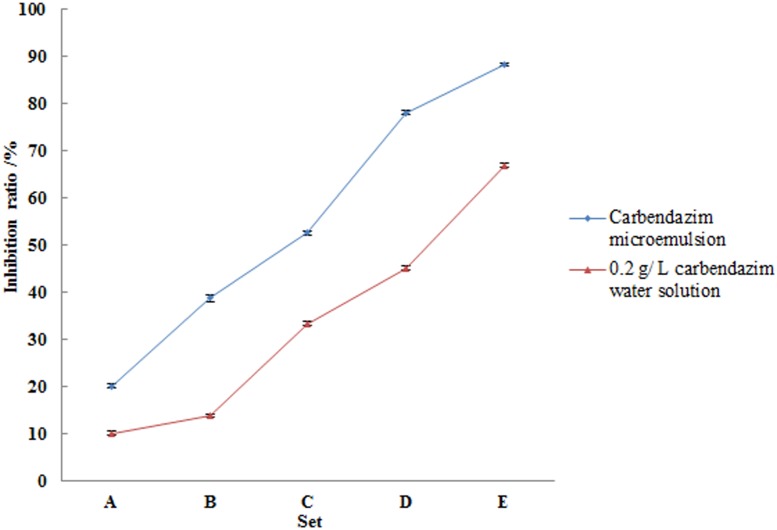
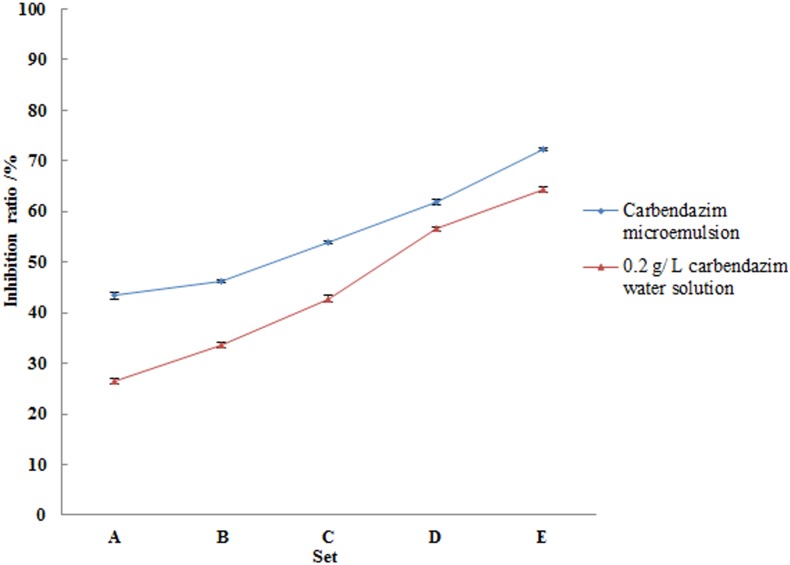
The fungus Rhizoctonia solani Kuhn is a widespread and destructive plant pathogen with a very broad host range. Although various pathogens, including R. solani, have been traditionally controlled using chemical pesticides, their use faces drawbacks such as environmental pollution, development of pesticide resistance, and other negative effects. Carbendazim is a well-known antifungal agent capable of controlling a broad range of plant diseases, but its use is hampered by its poor aqueous solubility. In this study, we describe an environmentally friendly pharmaceutical microemulsion system using carbendazim as the active ingredient, chloroform and acetic acid as solvents, and the surfactants HSH and 0204 as emulsifiers. This system increased the solubility of carbendazim to 30 g/L. The optimal microemulsion formulation was determined based on a pseudo-ternary phase diagram; its physicochemical characteristics were also tested. The cloud point was greater than 90°C and it was resistant to freezing down to -18°C, both of which are improvements over the temperature range in which pure carbendazim can be used. This microemulsion meets the standard for pesticide microemulsions and demonstrated better activity against R. solani AG1-IA, relative to an aqueous solution of pure carbendazim (0.2 g/L). The mechanism of activity was reflected in the inhibition of against R. solani AG1-IA including mycelium growth, and sclerotia formation and germination were significantly better than that of 0.2 g/L carbendazim water solution according to the results of t-test done by SPSS 19.
立枯丝核菌是一种广泛分布且具有破坏性的植物病原菌,寄主范围非常广泛。尽管包括立枯丝核菌在内的各种病原菌传统上一直使用化学农药进行防治,但农药的使用存在环境污染、抗药性发展等缺点以及其他负面影响。多菌灵是一种著名的抗真菌剂,能够防治多种植物病害,但其使用因水溶性差而受到阻碍。在本研究中,我们描述了一种以多菌灵为活性成分、氯仿和乙酸为溶剂、表面活性剂HSH和0204为乳化剂的环境友好型药物微乳体系。该体系将多菌灵的溶解度提高到了30 g/L。基于拟三元相图确定了最佳微乳配方,并对其理化特性进行了测试。浊点大于90°C,抗冻性可达-18°C,这两个温度范围均优于纯多菌灵可使用的温度范围。该微乳符合农药微乳标准,相对于纯多菌灵水溶液(0.2 g/L),对立枯丝核菌AG1-IA表现出更好的活性。根据SPSS 19进行的t检验结果,其活性机制体现在对立枯丝核菌AG1-IA的抑制作用上,包括菌丝生长,菌核形成和萌发均明显优于0.2 g/L多菌灵水溶液。