Li Dong, Chandra Debraj, Saito Kenji, Yui Tatsuto, Yagi Masayuki
Department of Materials Science and Technology, Faculty of Engineering, Niigata University, 8050 Ikarashi-2, Niigata 950-2181, Japan.
Department of Materials Science and Technology, Faculty of Engineering, Niigata University, 8050 Ikarashi-2, Niigata 950-2181, Japan ; Precursory Research for Embryonic Science and Technology (PRESTO), Japan Science and Technology Agency (JST), 4-1-8 Honcho, Kawaguchi, Saitama 332-0012, Japan.
Nanoscale Res Lett. 2014 Oct 2;9(1):542. doi: 10.1186/1556-276X-9-542. eCollection 2014.
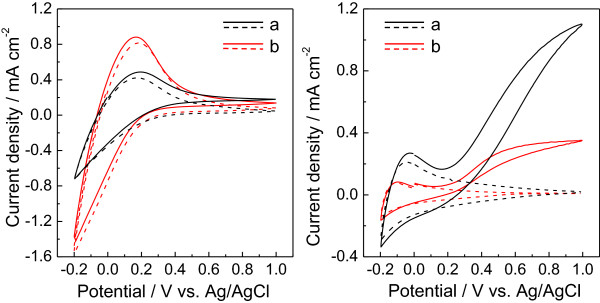
Mesoporous tungsten trioxide (WO3) was prepared from tungstic acid (H2WO4) as a tungsten precursor with dodecylamine (DDA) as a template to guide porosity of the nanostructure by a solvothermal technique. The WO3 sample (denoted as WO3-DDA) prepared with DDA was moulded on an electrode to yield efficient performance for visible-light-driven photoelectrochemical (PEC) water oxidation. Powder X-ray diffraction (XRD) data of the WO3-DDA sample calcined at 400°C indicate a crystalline framework of the mesoporous structure with disordered arrangement of pores. N2 physisorption studies show a Brunauer-Emmett-Teller (BET) surface area up to 57 m(2) g(-1) together with type IV isotherms and uniform distribution of a nanoscale pore size in the mesopore region. Scanning electron microscopy (SEM) images exhibit well-connected tiny spherical WO3 particles with a diameter of ca. 5 to 20 nm composing the mesoporous network. The WO3-DDA electrode generated photoanodic current density of 1.1 mA cm(-2) at 1.0 V versus Ag/AgCl under visible light irradiation, which is about three times higher than that of the untemplated WO3. O2 (1.49 μmol; Faraday efficiency, 65.2%) was evolved during the 1-h photoelectrolysis for the WO3-DDA electrode under the conditions employed. The mesoporous electrode turned out to work more efficiently for visible-light-driven water oxidation relative to the untemplated WO3 electrode.
以钨酸(H₂WO₄)为钨前驱体,十二烷基胺(DDA)为模板,采用溶剂热法制备了介孔三氧化钨(WO₃),以引导纳米结构的孔隙率。用DDA制备的WO₃样品(记为WO₃-DDA)被模制在电极上,以实现可见光驱动的光电化学(PEC)水氧化的高效性能。在400°C下煅烧的WO₃-DDA样品的粉末X射线衍射(XRD)数据表明,介孔结构具有晶体骨架,孔隙排列无序。N₂物理吸附研究表明,其比表面积高达57 m² g⁻¹,具有IV型等温线,纳米级孔径在介孔区域均匀分布。扫描电子显微镜(SEM)图像显示,直径约为5至20 nm的紧密连接的微小球形WO₃颗粒构成了介孔网络。在可见光照射下,WO₃-DDA电极在相对于Ag/AgCl为1.0 V时产生的光阳极电流密度为1.1 mA cm⁻²,约为无模板WO₃的三倍。在所采用的条件下,WO₃-DDA电极在1小时的光电解过程中产生了O₂(1.49 μmol;法拉第效率为65.2%)。相对于无模板的WO₃电极,介孔电极在可见光驱动的水氧化方面表现出更高的效率。