González-López Julio J, Rebolleda Gema, Leal Marina, Oblanca Noelia, Muñoz-Negrete Francisco J, Costa-Frossard Lucienne, Alvarez-Cermeño José C
Department of Ophthalmology, Ramón y Cajal University Hospital, Carretera de Colmenar Km 9, 1, 28034 Madrid, Spain ; Department of Surgery, Alcalá de Henares University, Madrid, Spain ; Medical Retina Department, Moorfields Eye Hospital, London, UK.
Department of Ophthalmology, Ramón y Cajal University Hospital, Carretera de Colmenar Km 9, 1, 28034 Madrid, Spain ; Department of Surgery, Alcalá de Henares University, Madrid, Spain.
Biomed Res Int. 2014;2014:128517. doi: 10.1155/2014/128517. Epub 2014 Sep 18.
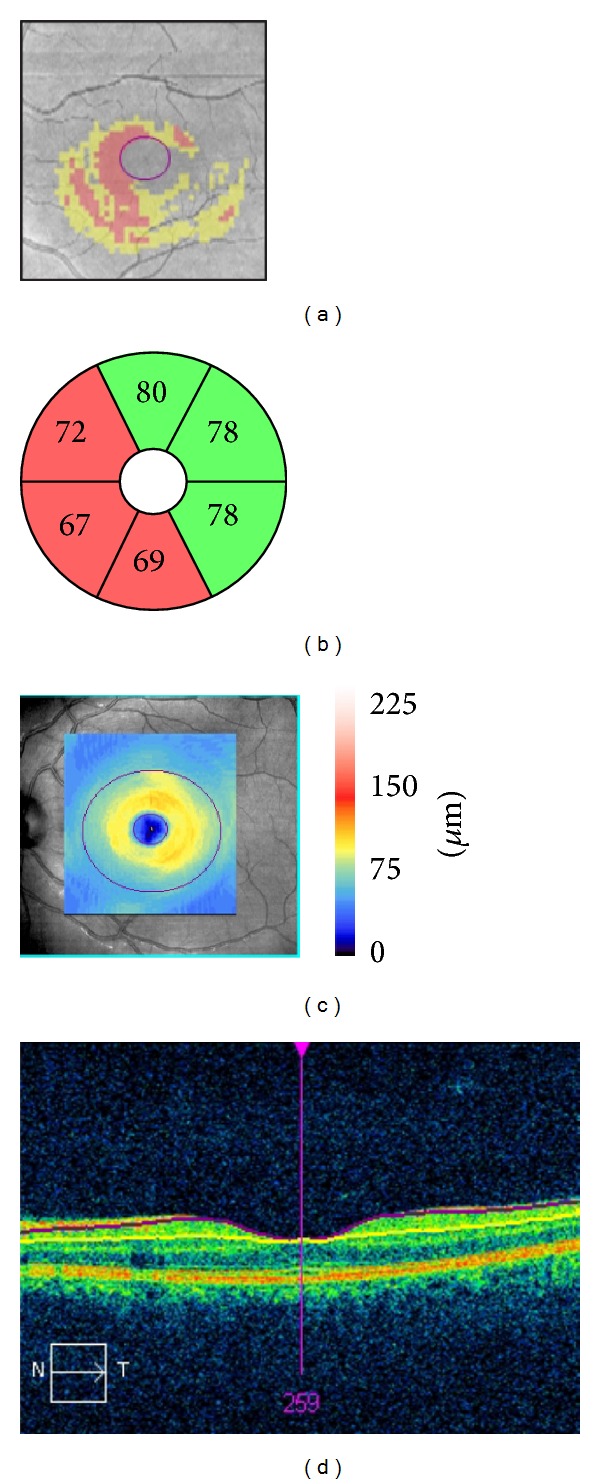
To estimate sensitivity and specificity of several optical coherence tomography (OCT) measurements for detecting retinal thickness changes in patients with relapsing-remitting multiple sclerosis (RRMS), such as macular ganglion cell-inner plexiform layer (GCIPL) thickness measured with Cirrus (OCT) and peripapillary retinal nerve fiber layer (pRNFL) thickness measured with Cirrus and Spectralis OCT.
Seventy patients (140 eyes) with RRMS and seventy matched healthy subjects underwent pRNFL and GCIPL thickness analysis using Cirrus OCT and pRNFL using Spectralis OCT. A prospective, cross-sectional evaluation of sensitivities and specificities was performed using latent class analysis due to the absence of a gold standard.
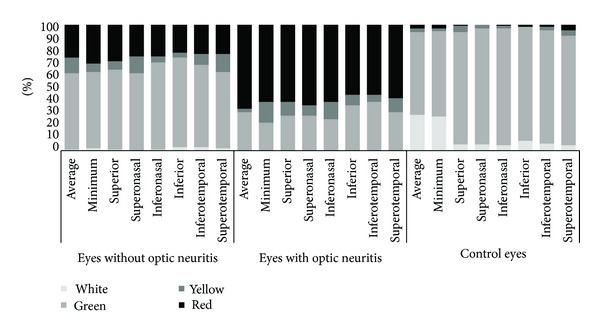
GCIPL measures had higher sensitivity and specificity than temporal pRNFL measures obtained with both OCT devices. Average GCIPL thickness was significantly more sensitive than temporal pRNFL by Cirrus (96.34% versus 58.41%) and minimum GCIPL thickness was significantly more sensitive than temporal pRNFL by Spectralis (96.41% versus 69.69%). Generalised estimating equation analysis revealed that age (P = 0.030), optic neuritis antecedent (P = 0.001), and disease duration (P = 0.002) were significantly associated with abnormal results in average GCIPL thickness.
Average and minimum GCIPL measurements had significantly better sensitivity to detect retinal thickness changes in RRMS than temporal pRNFL thickness measured by Cirrus and Spectralis OCT, respectively.
评估几种光学相干断层扫描(OCT)测量方法在检测复发缓解型多发性硬化症(RRMS)患者视网膜厚度变化方面的敏感性和特异性,例如使用Cirrus(OCT)测量黄斑神经节细胞 - 内丛状层(GCIPL)厚度,以及使用Cirrus和Spectralis OCT测量视乳头周围视网膜神经纤维层(pRNFL)厚度。
70例RRMS患者(140只眼)和70名匹配的健康受试者接受了使用Cirrus OCT进行的pRNFL和GCIPL厚度分析,以及使用Spectralis OCT进行的pRNFL厚度分析。由于缺乏金标准,采用潜在类别分析进行敏感性和特异性的前瞻性横断面评估。
GCIPL测量的敏感性和特异性高于两种OCT设备获得的颞侧pRNFL测量结果。Cirrus测量的平均GCIPL厚度比颞侧pRNFL明显更敏感(96.34%对58.41%),Spectralis测量的最小GCIPL厚度比颞侧pRNFL明显更敏感(96.41%对69.69%)。广义估计方程分析显示,年龄(P = 0.030)、既往视神经炎(P = 0.001)和病程(P = 0.002)与平均GCIPL厚度异常结果显著相关。
平均和最小GCIPL测量在检测RRMS患者视网膜厚度变化方面的敏感性分别明显优于Cirrus和Spectralis OCT测量的颞侧pRNFL厚度。