Mangham-Jefferies Lindsay, Mathewos Bereket, Russell Jeanne, Bekele Abeba
Department of Global Health and Development, London School of Hygiene and Tropical Medicine, 15-17 Tavistock Place, London WC1H 9SH, UK.
Hum Resour Health. 2014 Oct 14;12:61. doi: 10.1186/1478-4491-12-61.
Governments are increasingly reliant on community health workers to undertake health promotion and provide essential curative care. In 2003, the Government of Ethiopia launched the Health Extension Programme and introduced a new cadre, health extension workers (HEWs), to improve access to care in rural communities. In 2013, to inform the government's plans for HEWs to take on an enhanced role in community-based newborn care, a time and motion study was conducted to understand the range of HEW responsibilities and how they allocate their time across health and non-health activities.
The study was administered in 69 rural kebeles in the Southern Nations Nationalities and People's Region and Oromia Region that were intervention areas of a trial to evaluate a package of community-based interventions for newborns. Over 4 consecutive weeks, HEWs completed a diary and recorded all activities undertaken during each working day. HEWs were also surveyed to collect data on seasonal activities and details of the health post and kebele in which they work. The average proportion of productive time (excluding breaks) that HEWs spent on an activity, at a location, or with a recipient each week, was calculated.
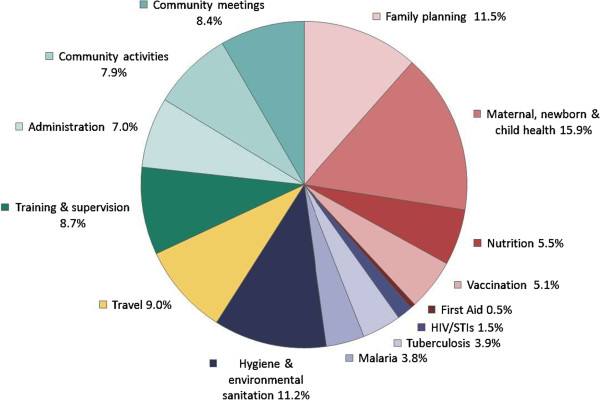
The self-reported diary was completed by 131 HEWs. Over the course of a week, HEWs divided their time between the health post (51%) and the community (37%), with the remaining 11% of their time spent elsewhere. Curative health activities represented 16% of HEWs' time each week and 43% of their time was spent on health promotion and prevention. The remaining time included travel, training and supervision, administration, and community meetings. HEWs spent the majority (70%) of their time with individuals, families, and community members.
HEWs have wide-ranging responsibilities for community-based health promotion and curative care. Their workload is diverse and they spend time on activities relating to family health, disease prevention and control, hygiene and sanitation, as well as other community-based activities. Reproductive, maternal, newborn, and child health activities represent a major component of the HEW's work and, as such, they can have a critically important role in improving the health outcomes of mothers and children in Ethiopia.
各国政府越来越依赖社区卫生工作者来开展健康促进活动并提供基本的治疗护理。2003年,埃塞俄比亚政府启动了卫生推广计划,并引入了一个新的干部队伍,即卫生推广工作者(HEW),以改善农村社区的医疗服务可及性。2013年,为了为政府让卫生推广工作者在社区新生儿护理中发挥更大作用的计划提供信息,开展了一项时间和动作研究,以了解卫生推广工作者的职责范围以及他们如何在健康和非健康活动之间分配时间。
该研究在南方各族州和奥罗米亚州的69个农村凯贝勒(kebeles)进行,这些地区是一项评估新生儿社区综合干预措施试验的干预区域。在连续4周的时间里,卫生推广工作者完成了一本日记,并记录了每个工作日所开展的所有活动。还对卫生推广工作者进行了调查,以收集有关季节性活动以及他们工作的卫生站和凯贝勒的详细信息。计算了卫生推广工作者每周在一项活动、一个地点或与一名接受者相处时所花费的生产性时间(不包括休息时间)的平均比例。
131名卫生推广工作者完成了自我报告日记。在一周的时间里,卫生推广工作者将时间分配在卫生站(51%)和社区(37%)之间,其余11%的时间花在其他地方。治疗性健康活动占卫生推广工作者每周时间的16%,43%的时间用于健康促进和预防。其余时间包括出行、培训与监督、行政工作以及社区会议。卫生推广工作者大部分时间(70%)与个人、家庭和社区成员在一起。
卫生推广工作者在社区健康促进和治疗护理方面承担着广泛的职责。他们的工作量多种多样,他们把时间花在与家庭健康、疾病预防控制、卫生与环境卫生以及其他社区活动相关的事务上。生殖、孕产妇、新生儿和儿童健康活动是卫生推广工作者工作的主要组成部分,因此,他们在改善埃塞俄比亚母婴健康结果方面可以发挥至关重要的作用。