Nadauld Lincoln D, Garcia Sarah, Natsoulis Georges, Bell John M, Miotke Laura, Hopmans Erik S, Xu Hua, Pai Reetesh K, Palm Curt, Regan John F, Chen Hao, Flaherty Patrick, Ootani Akifumi, Zhang Nancy R, Ford James M, Kuo Calvin J, Ji Hanlee P
Genome Biol. 2014 Aug 27;15(8):428. doi: 10.1186/s13059-014-0428-9.
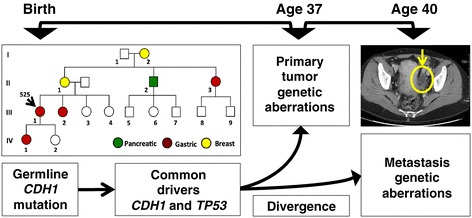
Gastric cancer is the second-leading cause of global cancer deaths, with metastatic disease representing the primary cause of mortality. To identify candidate drivers involved in oncogenesis and tumor evolution, we conduct an extensive genome sequencing analysis of metastatic progression in a diffuse gastric cancer. This involves a comparison between a primary tumor from a hereditary diffuse gastric cancer syndrome proband and its recurrence as an ovarian metastasis.
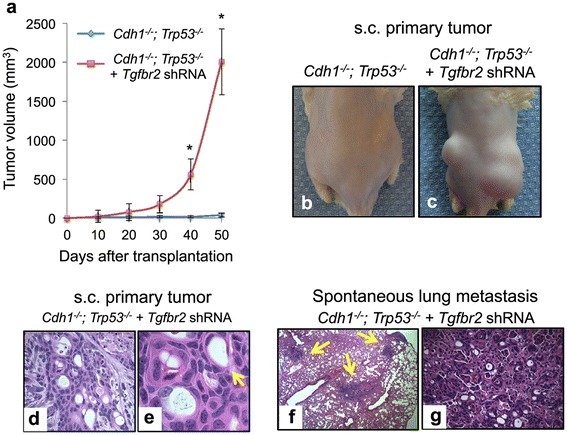
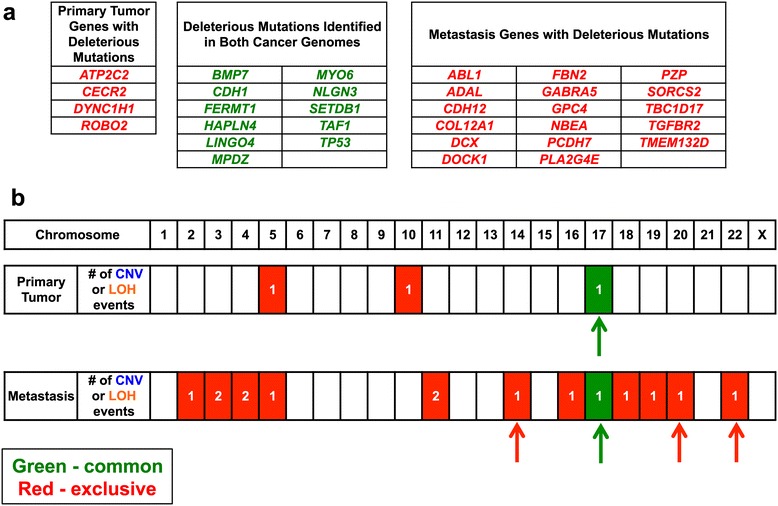
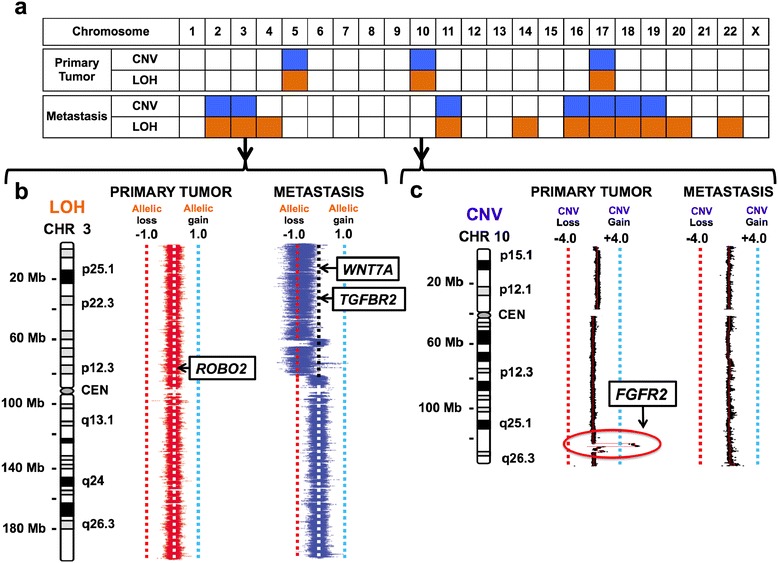
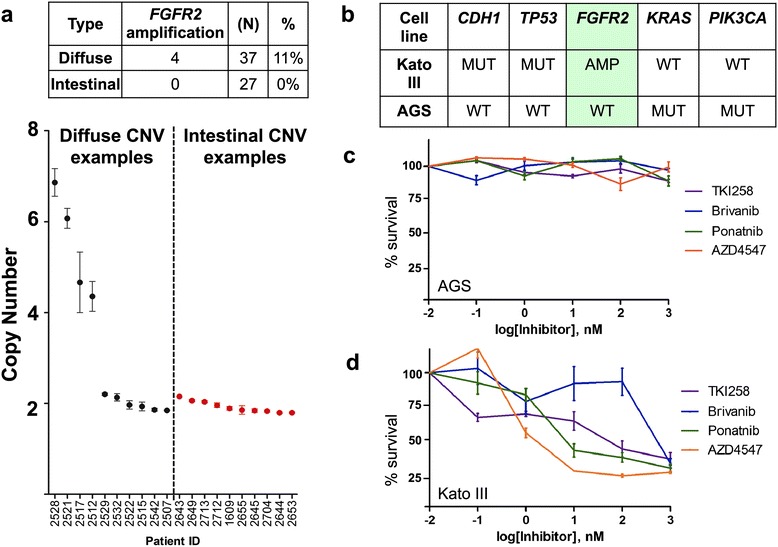
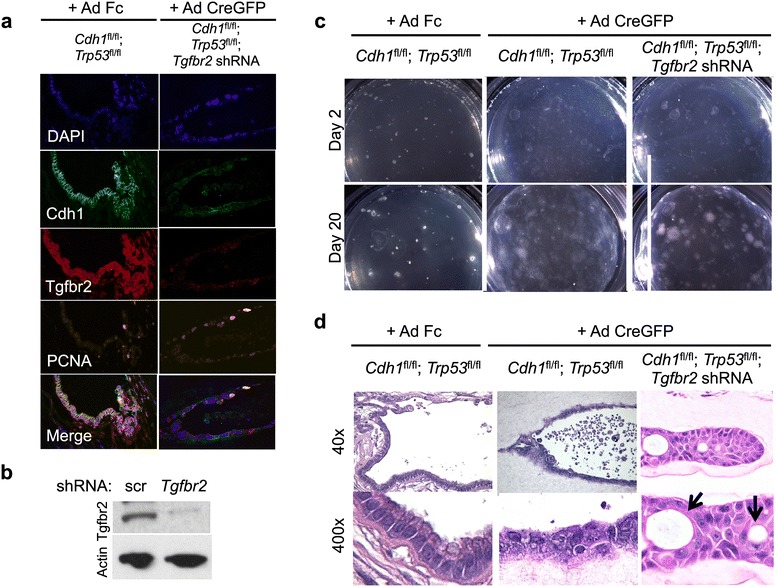
Both the primary tumor and ovarian metastasis have common biallelic loss-of-function of both the CDH1 and TP53 tumor suppressors, indicating a common genetic origin. While the primary tumor exhibits amplification of the Fibroblast growth factor receptor 2 (FGFR2) gene, the metastasis notably lacks FGFR2 amplification but rather possesses unique biallelic alterations of Transforming growth factor-beta receptor 2 (TGFBR2), indicating the divergent in vivo evolution of a TGFBR2-mutant metastatic clonal population in this patient. As TGFBR2 mutations have not previously been functionally validated in gastric cancer, we modeled the metastatic potential of TGFBR2 loss in a murine three-dimensional primary gastric organoid culture. The Tgfbr2 shRNA knockdown within Cdh1-/-; Tp53-/- organoids generates invasion in vitro and robust metastatic tumorigenicity in vivo, confirming Tgfbr2 metastasis suppressor activity.
We document the metastatic differentiation and genetic heterogeneity of diffuse gastric cancer and reveal the potential metastatic role of TGFBR2 loss-of-function. In support of this study, we apply a murine primary organoid culture method capable of recapitulating in vivo metastatic gastric cancer. Overall, we describe an integrated approach to identify and functionally validate putative cancer drivers involved in metastasis.
胃癌是全球癌症死亡的第二大原因,转移性疾病是主要死因。为了确定参与肿瘤发生和肿瘤演变的候选驱动因素,我们对弥漫性胃癌的转移进展进行了广泛的基因组测序分析。这涉及对一名遗传性弥漫性胃癌综合征先证者的原发性肿瘤及其作为卵巢转移瘤的复发情况进行比较。
原发性肿瘤和卵巢转移瘤均存在CDH1和TP53这两种肿瘤抑制基因的双等位基因功能丧失,表明它们有共同的遗传起源。原发性肿瘤表现出成纤维细胞生长因子受体2(FGFR2)基因的扩增,而转移瘤明显缺乏FGFR2扩增,而是具有转化生长因子-β受体2(TGFBR2)的独特双等位基因改变,表明该患者体内TGFBR2突变的转移克隆群体发生了不同的进化。由于TGFBR2突变此前尚未在胃癌中得到功能验证,我们在小鼠三维原发性胃类器官培养中模拟了TGFBR2缺失的转移潜能。在Cdh1-/-; Tp53-/-类器官中敲低Tgfbr2可在体外产生侵袭,并在体内产生强大的转移致瘤性,证实了Tgfbr2的转移抑制活性。
我们记录了弥漫性胃癌的转移分化和基因异质性,并揭示了TGFBR2功能丧失的潜在转移作用。为支持本研究,我们应用了一种能够重现体内转移性胃癌的小鼠原发性类器官培养方法。总体而言,我们描述了一种综合方法来识别和功能验证参与转移的假定癌症驱动因素。