Tian Yali, Wong Thomas K S, Li Jiping, Jiang Xiaolian
Department of Cardiovascular Surgery, West China Hospital, Sichuan University, 37 Guo Xue Xiang Street, Chengdu, Sichuan Province 610041, China.
BMC Public Health. 2014 Oct 15;14:1073. doi: 10.1186/1471-2458-14-1073.
Serious and long-lasting psychiatric consequences can be found in children and adolescents following earthquake, including the development of posttraumatic stress disorder (PTSD). Although researchers have been focused on PTSD recently, its prevalence and risk factors after a huge natural disaster are still unclear because of limited sample size. The purpose of this study is to explore the prevalence of posttraumatic stress disorder (PTSD) in adolescent survivors three years after the Wenchuan earthquake, describe PTSD symptoms, and to find out risk factors of PTSD.
A total of 4,604 adolescents from three middle schools which located in earthquake-stricken areas were recruited in this study. Instruments included the demographic questionnaire, questionnaire about earthquake exposure, the Social Support Appraisal Scale (SSA), the Posttraumatic stress disorder Checklist-Civilian Version (PCL-C), and the structured clinical interview for DSM-IV Disorders (SCID).
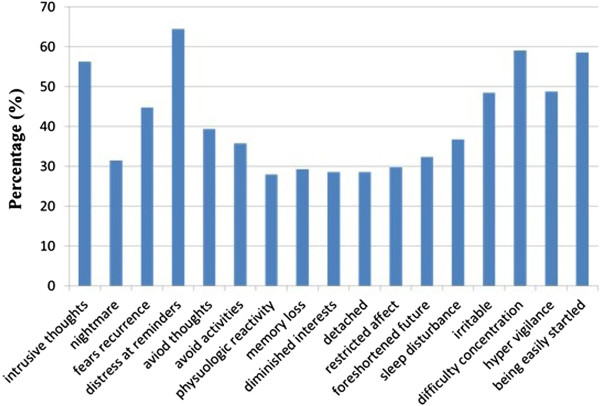
The prevalence rate of PTSD was 5.7% (frequency: n = 261), and the most commonly occurring symptoms of PTSD were distress at reminders (64.5%), difficulty concentration (59.1%), and being easily startled (58.6%). Loss of houses and property, being injured, deaths of family members, and witness of death are positive risk factors of PTSD, and physical exercise and social support are negative risk factors of PTSD.
Professional and effective interventions are needed to reduce the development of PTSD among adolescents after the Wenchuan earthquake, especially for these who lost their houses or property and lost their family members, witnessed death, and lacked of social support in the earthquake. Moreover, injured adolescents and adolescents who lacked of physical exercise also need intervention due to high risk.
地震后儿童和青少年会出现严重且持久的精神后果,包括创伤后应激障碍(PTSD)的发生。尽管研究人员近期一直关注PTSD,但由于样本量有限,在巨大自然灾害后其患病率及危险因素仍不明确。本研究旨在探讨汶川地震三年后青少年幸存者中创伤后应激障碍(PTSD)的患病率,描述PTSD症状,并找出PTSD的危险因素。
本研究招募了来自地震灾区三所中学的4604名青少年。所用工具包括人口统计学调查问卷、地震暴露情况问卷、社会支持评定量表(SSA)、创伤后应激障碍检查表-平民版(PCL-C)以及精神疾病诊断与统计手册第四版(DSM-IV)障碍的结构化临床访谈(SCID)。
PTSD患病率为5.7%(频数:n = 261),PTSD最常出现的症状为触景生情(64.5%)、注意力不集中(59.1%)和易受惊吓(58.6%)。房屋和财产损失、受伤、家庭成员死亡以及目睹死亡是PTSD的阳性危险因素,体育锻炼和社会支持是PTSD的阴性危险因素。
需要专业有效的干预措施来减少汶川地震后青少年中PTSD的发生,尤其是对于那些在地震中失去房屋或财产、失去家庭成员、目睹死亡且缺乏社会支持的青少年。此外,受伤青少年以及缺乏体育锻炼的青少年因风险高也需要干预。