Department of Ophthalmology, Gonabad University of Medical Sciences, Gonabad, Iran.
BMC Complement Altern Med. 2014 Oct 15;14:399. doi: 10.1186/1472-6882-14-399.
The progressive nature of glaucoma and its growing incidence make its therapy an important target for research. The role of oxidative damage in the pathogenesis of glaucoma makes antioxidants such as saffron extract an attractive target for potential clinical use. Herein, we evaluate the effect of aqueous saffron extract on intraocular pressure (IOP) in eyes with primary open-angle glaucoma (POAG).
Thirty-four eyes of 34 clinically stable POAG patients receiving treatment with timolol and dorzolamide eye drops were enrolled in this prospective, comparative, randomized interventional pilot study. Eligible subjects were randomized to receive 30 mg/day aqueous saffron extract orally (17 subjects, 17 eyes) or placebo (17 subjects, 17 eyes) for one month as an adjunct to timolol and dorzolamide. Following treatment, both study groups entered a one-month wash-out period. The main outcome measure was IOP during treatment and after the wash-out period.
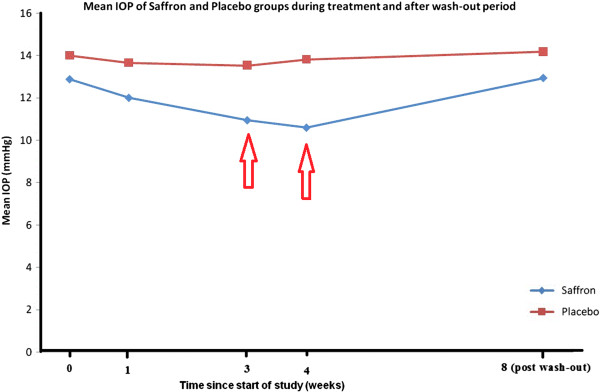
Mean baseline IOP was 12.9 ± 3.7 versus 14.0 ± 2.5 mmHg in the saffron and control groups, respectively (p = 0.31). After three weeks of treatment, IOP was significantly decreased to 10.9 ± 3.3 mmHg in the saffron group as compared to 13.5 ± 2.3 mmHg in the control group (p = 0.013). At four weeks, IOP was still significantly lower in the saffron group (10.6 ± 3.0 versus 13.8 ± 2.2 mmHg, p = 0.001). At the end of the wash-out period, IOP was 12.9 ± 3.0 in the saffron group versus 14.2 ± 2.0 mmHg in the control group (p = 0.175). None of the patients experienced side effects during the study and wash-out period.
Oral aqueous saffron extract seems to exert an ocular hypotensive effect in primary open-angle glaucoma. This effect became evident after three weeks of therapy.The current study was registered at the International Clinical Trials Registry Platform (ICTRP) as IRCT201201278832N1.
青光眼具有进行性且发病率不断增加,因此其治疗成为研究的重要目标。氧化损伤在青光眼发病机制中的作用使藏红花提取物等抗氧化剂成为潜在临床应用的有吸引力的目标。在此,我们评估了水藏红花提取物对原发性开角型青光眼(POAG)眼内压(IOP)的影响。
34 名临床稳定的 POAG 患者的 34 只眼参与了这项前瞻性、对照、随机干预性初步研究。符合条件的受试者随机接受每天 30 毫克口服水藏红花提取物(17 名受试者,17 只眼)或安慰剂(17 名受试者,17 只眼),作为与 timolol 和 dorzolamide 滴眼剂联合治疗的辅助手段。治疗后,两组均进入一个为期一个月的洗脱期。主要观察指标为治疗期间和洗脱期后的 IOP。
藏红花组和对照组的平均基线 IOP 分别为 12.9 ± 3.7mmHg 和 14.0 ± 2.5mmHg(p = 0.31)。治疗 3 周后,藏红花组的 IOP 显著下降至 10.9 ± 3.3mmHg,而对照组则为 13.5 ± 2.3mmHg(p = 0.013)。4 周时,藏红花组的 IOP 仍明显较低(10.6 ± 3.0 与 13.8 ± 2.2mmHg,p = 0.001)。洗脱期结束时,藏红花组的 IOP 为 12.9 ± 3.0mmHg,对照组为 14.2 ± 2.0mmHg(p = 0.175)。在研究和洗脱期间,没有患者出现不良反应。
口服水藏红花提取物似乎对原发性开角型青光眼具有降低眼内压的作用。这种作用在治疗 3 周后变得明显。本研究已在国际临床试验注册平台(ICTRP)注册,注册号为 IRCT201201278832N1。