Campanella Gianluca, Polidoro Silvia, Di Gaetano Cornelia, Fiorito Giovanni, Guarrera Simonetta, Krogh Vittorio, Palli Domenico, Panico Salvatore, Sacerdote Carlotta, Tumino Rosario, Elliott Paul, Matullo Giuseppe, Chadeau-Hyam Marc, Vineis Paolo
Department of Epidemiology and Biostatistics, Imperial College London, London, UK,Human Genetics Foundation (HuGeF), Turin, Italy, Department of Medical Sciences, University of Turin, Turin, Italy, Fondazione IRCCS - Istituto Nazionale dei Tumori, Milan, Italy, Istituto per lo Studio e la Prevenzione Oncologica (ISPO Toscana), Florence, Italy, Department of Clinical Medicine and Surgery, University of Naples Federico II, Naples, Italy, Piedmont Reference Centre for Epidemiology and Cancer Prevention (CPO Piemonte), Turin, Italy Cancer Registry and Histopathology Unit, Azienda Ospedaliera 'Civile - M. P. Arezzo', Ragusa, Italy and MRC-PHE Centre for Environment and Health, Imperial College London, London, UK.
Department of Epidemiology and Biostatistics, Imperial College London, London, UK,Human Genetics Foundation (HuGeF), Turin, Italy, Department of Medical Sciences, University of Turin, Turin, Italy, Fondazione IRCCS - Istituto Nazionale dei Tumori, Milan, Italy, Istituto per lo Studio e la Prevenzione Oncologica (ISPO Toscana), Florence, Italy, Department of Clinical Medicine and Surgery, University of Naples Federico II, Naples, Italy, Piedmont Reference Centre for Epidemiology and Cancer Prevention (CPO Piemonte), Turin, Italy Cancer Registry and Histopathology Unit, Azienda Ospedaliera 'Civile - M. P. Arezzo', Ragusa, Italy and MRC-PHE Centre for Environment and Health, Imperial College London, London, UK Department of Epidemiology and Biostatistics, Imperial College London, London, UK,Human Genetics Foundation (HuGeF), Turin, Italy, Department of Medical Sciences, University of Turin, Turin, Italy, Fondazione IRCCS - Istituto Nazionale dei Tumori, Milan, Italy, Istituto per lo Studio e la Prevenzione Oncologica (ISPO Toscana), Florence, Italy, Department of Clinical Medicine and Surgery, University of Naples Federico II, Naples, Italy, Piedmont Reference Centre for Epidemiology and Cancer Prevention (CPO Piemonte), Turin, Italy Cancer Registry and Histopathology Unit, Azienda Ospedaliera 'Civile - M. P. Arezzo', Ragusa, Italy and MRC-PHE Centre for Environment and Health, Imperial College London, London, UK.
Int J Epidemiol. 2015 Aug 1;44(4):1442-1449. doi: 10.1093/ije/dyu198. Epub 2014 Oct 15.
Observational studies have suggested that the risks of non-communicable diseases in voluntary migrants become similar to those in the host population after one or more generations, supporting the hypothesis that these diseases have a predominantly environmental (rather than inherited) origin. However, no study has been conducted thus far to identify alterations at the molecular level that might mediate these changes in disease risk after migration.
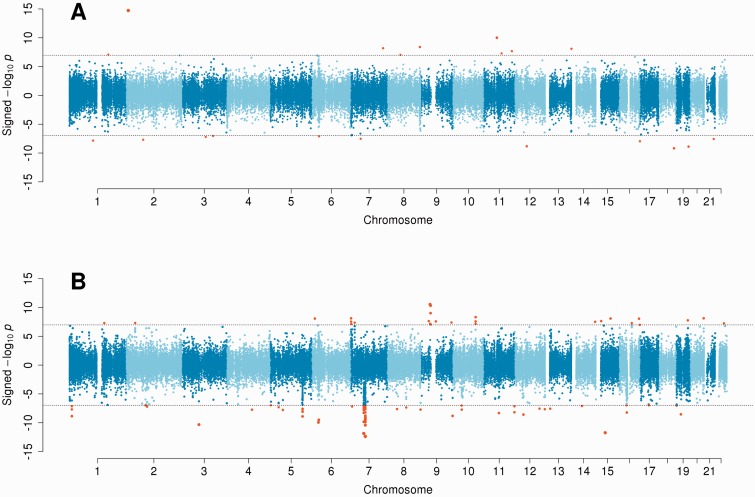
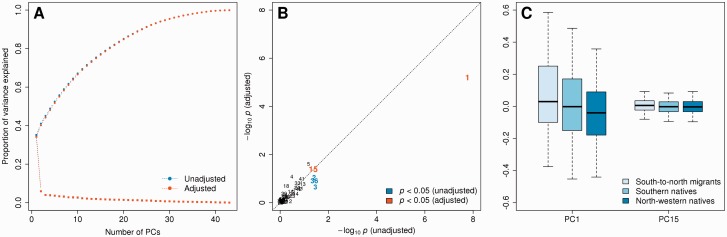
Using genome-wide DNA methylation profiles from more than 1000 Italian participants, we conducted an epigenome-wide association study (EWAS) to identify differences between south-to-north migrants and their origin (southern natives) and host (north-western natives) populations.
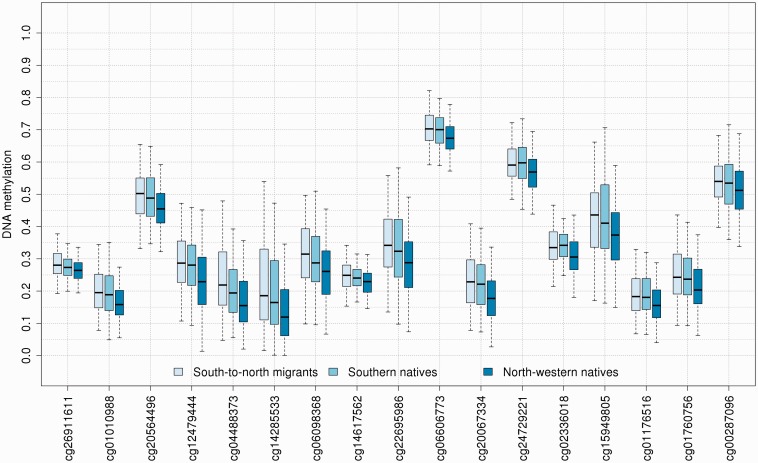
We identified several differentially methylated CpG loci, in particular when comparing south-to-north migrants with north-western natives. We hypothesise that these alterations may underlie an adaptive response to exposure differentials that exist between origin and host populations.
Our study is the first large agnostic investigation of DNA methylation changes linked to migratory processes, and shows the potential of EWAS to investigate their biological effects.
观察性研究表明,自愿移民中非传染性疾病的风险在一代或多代之后会变得与宿主人群相似,这支持了这些疾病主要源于环境(而非遗传)的假说。然而,迄今为止尚未进行研究来确定在分子水平上可能介导移民后疾病风险这些变化的改变。
我们利用来自1000多名意大利参与者的全基因组DNA甲基化谱,开展了一项全表观基因组关联研究(EWAS),以确定从意大利南部向北部移民者与其原籍(南部本地人)和宿主(西北部本地人)人群之间的差异。
我们确定了几个差异甲基化的CpG位点,特别是在比较从南部向北部移民者与西北部本地人时。我们推测,这些改变可能是对原籍和宿主人群之间存在的暴露差异的适应性反应的基础。
我们的研究是首次对与移民过程相关的DNA甲基化变化进行的大规模无假设调查,并显示了EWAS在研究其生物学效应方面的潜力。