Lie Arve, Skogstad Marit, Johnsen Torstein Seip, Engdahl Bo, Tambs Kristian
Department of Occupational Medicine and Epidemiology, National Institute of Occupational Health, Oslo, Norway.
Norwegian State Railways (NSB) Occupational Health Service, Oslo, Norway.
BMJ Open. 2014 Oct 16;4(10):e005529. doi: 10.1136/bmjopen-2014-005529.
Railway workers performing maintenance work of trains and tracks could be at risk of developing noise-induced hearing loss, since they are exposed to noise levels of 75-90 dB(A) with peak exposures of 130-140 dB(C). The objective was to make a risk assessment by comparing the hearing thresholds among train and track maintenance workers with a reference group not exposed to noise and reference values from the ISO 1999.
Cross-sectional.
A major Norwegian railway company.
1897 and 2730 male train and track maintenance workers, respectively, all exposed to noise, and 2872 male railway traffic controllers and office workers not exposed to noise.
The primary outcome was the hearing threshold (pure tone audiometry, frequencies from 0.5 to 8 kHz), and the secondary outcome was the prevalence of audiometric notches (Coles notch) of the most recent audiogram.
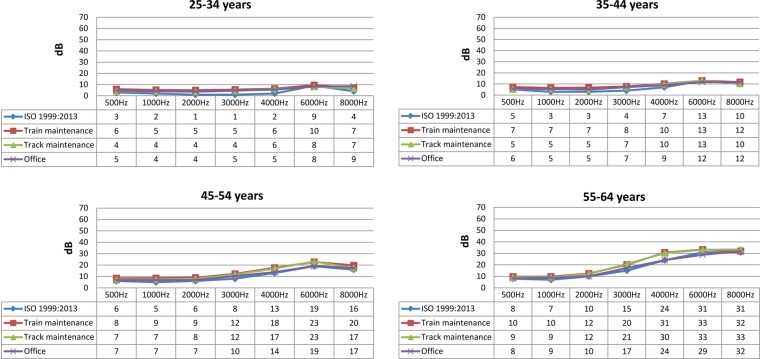
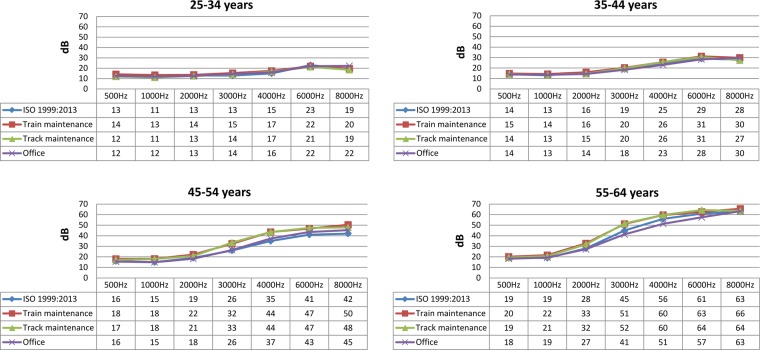
Train and track maintenance workers aged 45 years or older had a small mean hearing loss in the 3-6 kHz area of 3-5 dB. The hearing loss was less among workers younger than 45 years. Audiometric notches were slightly more prevalent among the noise exposed (59-64%) group compared with controls (49%) for all age groups. They may therefore be a sensitive measure in disclosing an early hearing loss at a group level.
Train and track maintenance workers aged 45 years or older, on average, have a slightly greater hearing loss and more audiometric notches compared with reference groups not exposed to noise. Younger (<45 years) workers have hearing thresholds comparable to the controls.
从事列车和轨道维护工作的铁路工人可能面临噪声性听力损失的风险,因为他们暴露于75 - 90 dB(A)的噪声水平,峰值暴露为130 - 140 dB(C)。目的是通过比较列车和轨道维护工人与未暴露于噪声的参照组的听力阈值以及ISO 1999的参考值来进行风险评估。
横断面研究。
挪威一家大型铁路公司。
分别有1897名和2730名男性列车和轨道维护工人,均暴露于噪声环境,以及2872名未暴露于噪声的男性铁路交通管制员和办公室工作人员。
主要观察指标是听力阈值(纯音听力测定,频率范围为0.5至8 kHz),次要观察指标是最近听力图上听力测听切迹(科尔斯切迹)的患病率。
45岁及以上的列车和轨道维护工人在3 - 6 kHz区域平均有3 - 5 dB的轻度听力损失。45岁以下工人的听力损失较小。在所有年龄组中,暴露于噪声的组(59 - 64%)听力测听切迹的患病率略高于对照组(49%)。因此,它们可能是在群体水平上揭示早期听力损失的敏感指标。
与未暴露于噪声的参照组相比,45岁及以上的列车和轨道维护工人平均听力损失略大,听力测听切迹更多。较年轻(<45岁)的工人听力阈值与对照组相当。