Health Economics and Health Technology Assessment, Institute of Health & Wellbeing, University of Glasgow, Glasgow, UK.
Robertson Centre for Biostatistics, Institute of Health & Wellbeing, University of Glasgow, Glasgow, UK.
Heart. 2015 Feb;101(3):201-8. doi: 10.1136/heartjnl-2014-305637. Epub 2014 Oct 16.
A policy model is a model that can evaluate the effectiveness and cost-effectiveness of interventions and inform policy decisions. In this study, we introduce a cardiovascular disease (CVD) policy model which can be used to model remaining life expectancy including a measure of socioeconomic deprivation as an independent risk factor for CVD.
A state transition model was developed using the Scottish Heart Health Extended Cohort (SHHEC) linked to Scottish morbidity and death records. Individuals start in a CVD-free state and can transit to three CVD event states plus a non-CVD death state. Individuals who have a non-fatal first event are then followed up until death. Taking a competing risk approach, the cause-specific hazards of a first event are modelled using parametric survival analysis. Survival following a first non-fatal event is also modelled parametrically. We assessed discrimination, validation and calibration of our model.
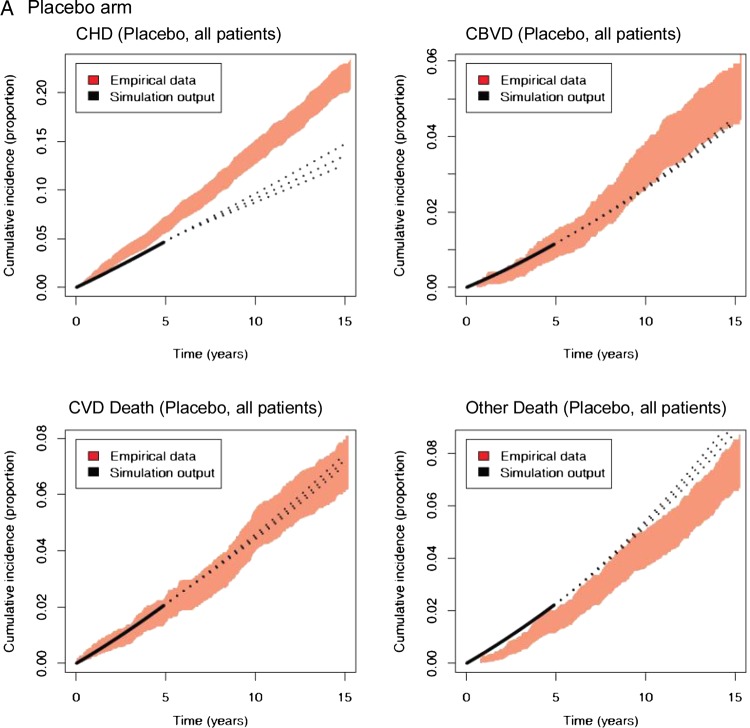
Our model achieved a good level of discrimination in each component (c-statistics for men (women)-non-fatal coronary heart disease (CHD): 0.70 (0.74), non-fatal cerebrovascular disease (CBVD): 0.73 (0.76), fatal CVD: 0.77 (0.80), fatal non-CVD: 0.74 (0.72), survival after non-fatal CHD: 0.68 (0.67) and survival after non-fatal CBVD: 0.65 (0.66)). In general, our model predictions were comparable with observed event rates for a Scottish randomised statin trial population which has an overlapping follow-up period with SHHEC. After applying a calibration factor, our predictions of life expectancy closely match those published in recent national life tables.
Our model can be used to estimate the impact of primary prevention interventions on life expectancy and can assess the impact of interventions on inequalities.
政策模型是一种可以评估干预措施的有效性和成本效益,并为政策决策提供信息的模型。本研究引入了一种心血管疾病(CVD)政策模型,该模型可以用于模拟剩余预期寿命,包括将社会经济剥夺作为 CVD 的一个独立风险因素进行衡量。
使用苏格兰心脏健康扩展队列(SHHEC)构建状态转移模型,并与苏格兰发病率和死亡率记录相关联。个体从 CVD 无事件状态开始,可以转移到三个 CVD 事件状态和一个非 CVD 死亡状态。首次发生非致命事件的个体随后会被跟踪直至死亡。采用竞争风险方法,使用参数生存分析对首次事件的特定原因风险进行建模。首次非致命事件后的生存情况也采用参数化模型进行建模。我们评估了我们模型的区分度、验证和校准。
我们的模型在每个组成部分都达到了较好的区分度(男性(女性)-非致命性冠心病(CHD)的 C 统计量:0.70(0.74),非致命性脑血管疾病(CBVD):0.73(0.76),致命性 CVD:0.77(0.80),致命性非 CVD:0.74(0.72),非致命性 CHD 后生存:0.68(0.67),非致命性 CBVD 后生存:0.65(0.66))。一般来说,我们的模型预测与 SHHEC 重叠的苏格兰随机他汀类药物试验人群的观察性事件发生率相当。在应用校准因子后,我们对预期寿命的预测与最近的国家生命表发布的数据非常接近。
我们的模型可用于估计初级预防干预措施对预期寿命的影响,并评估干预措施对不平等的影响。