Kim Jung-Hee, Kim Min-Joong, Sim Woo-Young, Lew Bark-Lynn
Department of Dermatology, Kyung Hee University College of Medicine, Seoul, Korea.
Ann Dermatol. 2014 Oct;26(5):624-7. doi: 10.5021/ad.2014.26.5.624. Epub 2014 Sep 26.
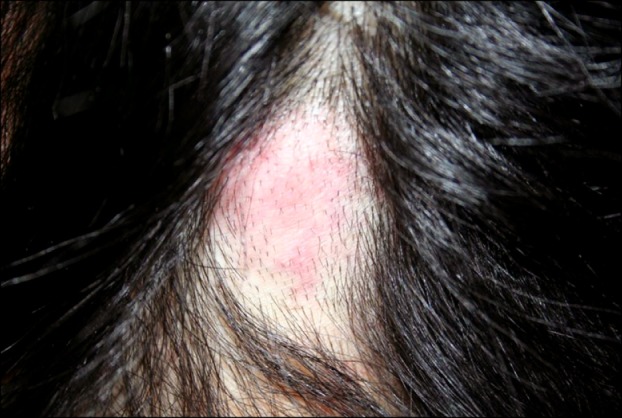
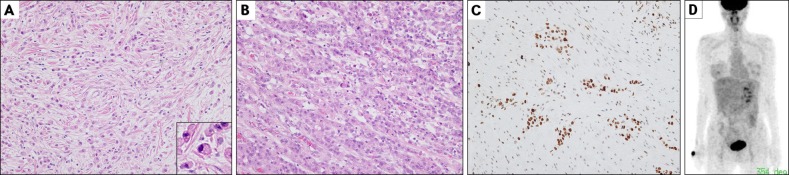
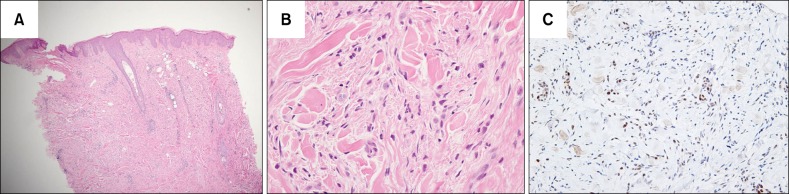
Alopecia neoplastica is defined as hair loss secondary to a visceral malignancy that has metastasized to the scalp. The scalp is a relatively common site of cutaneous metastasis, usually presenting as a single or multiple firm scalp nodules. Alopecia neoplastica is a well-recognized but rare presentation, and its pathogenesis is incompletely understood. Atrophy of the hair follicles due to tumor invasion of the scalp plays a role in the development of alopecia. Herein, we describe a 33-year-old woman with gastric adenocarcinoma who developed alopecia neoplastica while receiving cancer chemotherapy. Scalp biopsy revealed metastatic adenocarcinoma cells interspersed between collagen bundles and around hair follicles. Immunohistochemical analysis indicated that the tumor cells originated from the primary gastric adenocarcinoma. Therefore, she was diagnosed with alopecia neoplastica due to gastric adenocarcinoma. The findings from this report may be helpful for understanding the mechanism of alopecia neoplastica.
肿瘤性脱发被定义为继发于已转移至头皮的内脏恶性肿瘤的脱发。头皮是皮肤转移相对常见的部位,通常表现为单个或多个质地坚硬的头皮结节。肿瘤性脱发是一种广为人知但罕见的表现形式,其发病机制尚未完全明确。肿瘤侵袭头皮导致毛囊萎缩在脱发的发生中起作用。在此,我们描述一名33岁患有胃腺癌的女性,她在接受癌症化疗时出现了肿瘤性脱发。头皮活检显示转移性腺癌细胞散布于胶原束之间及毛囊周围。免疫组织化学分析表明肿瘤细胞起源于原发性胃腺癌。因此,她被诊断为因胃腺癌导致的肿瘤性脱发。本报告的研究结果可能有助于理解肿瘤性脱发的机制。