Department of Biology, Emory University Atlanta, GA, USA.
Front Integr Neurosci. 2014 Sep 29;8:75. doi: 10.3389/fnint.2014.00075. eCollection 2014.
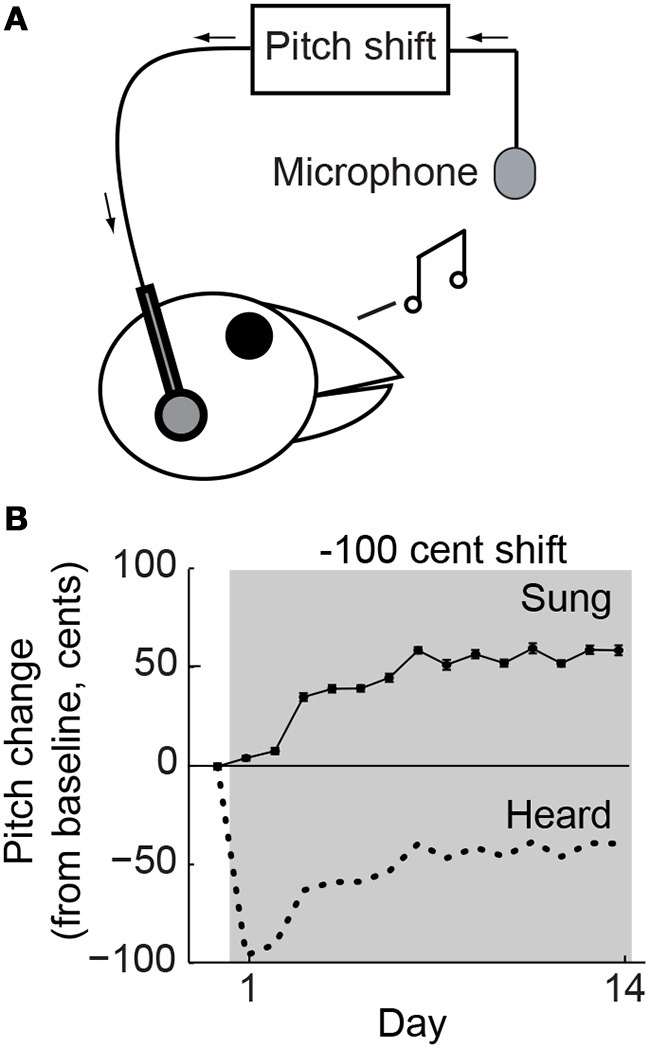
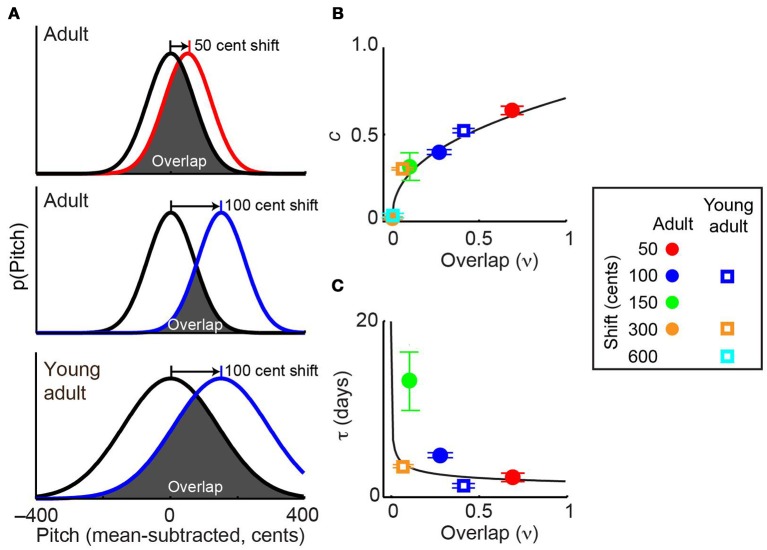
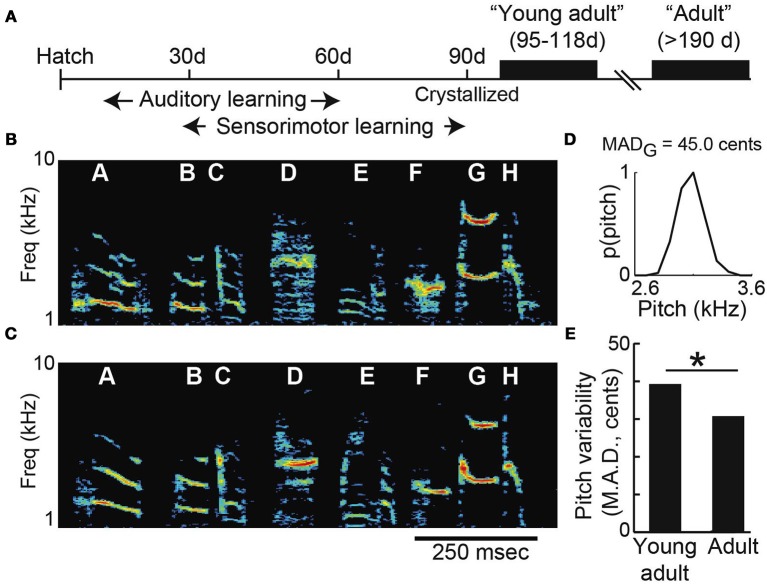
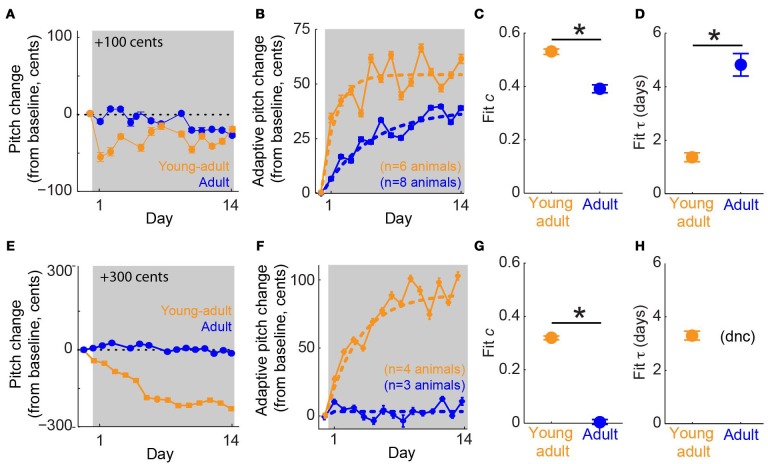
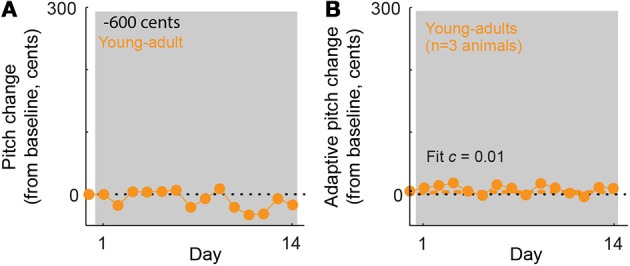
The brain uses sensory feedback to correct errors in behavior. Songbirds and humans acquire vocal behaviors by imitating the sounds produced by adults and rely on auditory feedback to correct vocal errors throughout their lifetimes. In both birds and humans, acoustic variability decreases steadily with age following the acquisition of vocal behavior. Prior studies in adults have shown that while sensory errors that fall within the limits of vocal variability evoke robust motor corrections, larger errors do not induce learning. Although such results suggest that younger animals, which have greater vocal variability, might correct large errors more readily than older individuals, it is unknown whether age-dependent changes in variability are accompanied by changes in the speed or magnitude of vocal error correction. We tested the hypothesis that auditory errors evoke greater vocal changes in younger animals and that a common computation determines how sensory information drives motor learning across different ages and error sizes. Consistent with our hypothesis, we found that in songbirds the speed and extent of error correction changes dramatically with age and that age-dependent differences in learning were predicted by a model in which the overlap between sensory errors and the distribution of prior sensory feedback determines the dynamics of adaptation. Our results suggest that the brain employs a simple and robust computational principle to calibrate the rate and magnitude of vocal adaptation across age-dependent changes in behavioral performance and in response to different sensory errors.
大脑利用感官反馈来纠正行为中的错误。鸣禽和人类通过模仿成年个体发出的声音来获得发声行为,并依靠听觉反馈来纠正其一生中的发声错误。在鸟类和人类中,随着发声行为的获得,声学可变性会随着年龄的增长而稳步下降。先前在成人中的研究表明,虽然落在发声可变性范围内的感官错误会引起强烈的运动校正,但较大的错误不会引起学习。尽管这些结果表明,具有更大发声可变性的年幼动物可能比年长个体更容易纠正大错误,但尚不清楚可变性的年龄依赖性变化是否伴随着发声错误校正的速度或幅度的变化。我们检验了这样一个假设,即听觉错误会在年幼动物中引起更大的发声变化,并且一个共同的计算会决定感官信息如何在不同年龄和错误大小下驱动运动学习。与我们的假设一致,我们发现,在鸣禽中,错误校正的速度和程度随着年龄的变化而急剧变化,并且学习中的年龄依赖性差异可以通过一个模型来预测,该模型中,感官错误和先前感官反馈分布之间的重叠决定了适应的动态。我们的研究结果表明,大脑采用了一种简单而强大的计算原理,根据行为表现的年龄依赖性变化以及对不同感官错误的反应,来校准发声适应的速度和幅度。