Department of Movement, Human and Health Sciences, University of Rome Foro Italico Rome, Italy ; Clinical Laboratory of Experimental Neurorehabilitation, IRCCS Fondazione Santa Lucia Rome, Italy.
Clinical Laboratory of Experimental Neurorehabilitation, IRCCS Fondazione Santa Lucia Rome, Italy.
Front Hum Neurosci. 2014 Oct 2;8:760. doi: 10.3389/fnhum.2014.00760. eCollection 2014.
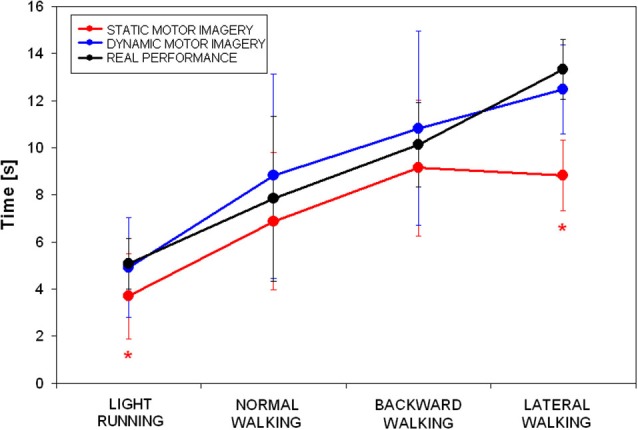
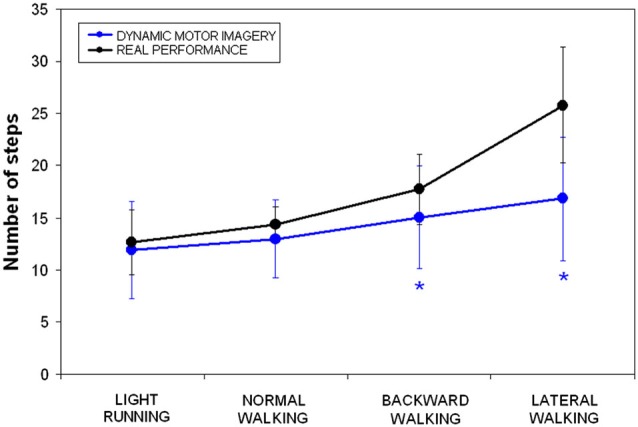
Motor imagery (MI) is a mental representation of an action without its physical execution. Recently, the simultaneous movement of the body has been added to the mental simulation. This refers to dynamic motor imagery (dMI). This study was aimed at analyzing the temporal features for static and dMI in different locomotor conditions (natural walking, NW, light running, LR, lateral walking, LW, backward walking, BW), and whether these performances were more related to all the given conditions or present only in walking. We have been also evaluated the steps performed in the dMI in comparison with the ones performed by real locomotion. 20 healthy participants (29.3 ± 5.1 years old) were asked to move towards a visualized target located at 10 mt. In dMI, no significant temporal differences respect the actual locomotion were found for all the given tasks (NW: p = 0.058, LR: p = 0.636, BW: p = 0.096; LW: p = 0,487). Significant temporal differences between static imagery and actual movements were found for LR (p < 0.001) and LW (p < 0.001), due to an underestimation of time needed to achieve the target in imagined locomotion. Significant differences in terms of number of steps among tasks were found for LW (p < 0.001) and BW (p = 0.036), whereas neither in NW (p = 0.124) nor LR (p = 0.391) between dMI and real locomotion. Our results confirmed that motor imagery is a task-dependent process, with walking being temporally closer than other locomotor conditions. Moreover, the time records of dMI are nearer to the ones of actual locomotion respect than the ones of static motor imagery.
运动想象(MI)是一种无需实际执行的动作的心理表现。最近,身体的同步运动已被添加到心理模拟中。这指的是动态运动想象(dMI)。本研究旨在分析不同运动条件(自然行走、NW、轻跑、LR、侧向行走、LW、后退行走、BW)下静态和 dMI 的时间特征,以及这些表现是否与所有给定条件更相关,还是仅存在于行走中。我们还评估了 dMI 中的步骤与实际运动中的步骤相比。20 名健康参与者(29.3±5.1 岁)被要求向位于 10 米远处的可视化目标移动。在 dMI 中,对于所有给定任务,与实际运动相比,时间上没有发现显著差异(NW:p=0.058,LR:p=0.636,BW:p=0.096;LW:p=0.487)。在 LR(p<0.001)和 LW(p<0.001)中,由于在想象的运动中低估了达到目标所需的时间,因此在静态想象和实际运动之间发现了显著的时间差异。在任务之间的步数方面发现了显著差异,对于 LW(p<0.001)和 BW(p=0.036),而在 NW(p=0.124)和 LR(p=0.391)之间,dMI 和实际运动之间没有差异。我们的结果证实运动想象是一种任务相关的过程,行走在时间上比其他运动条件更接近。此外,与静态运动想象相比,dMI 的时间记录更接近实际运动的时间记录。