NeuroArts Lab, Department of Psychology, Neuroscience & Behaviour, McMaster University Hamilton, ON, Canada.
Front Hum Neurosci. 2014 Sep 30;8:776. doi: 10.3389/fnhum.2014.00776. eCollection 2014.
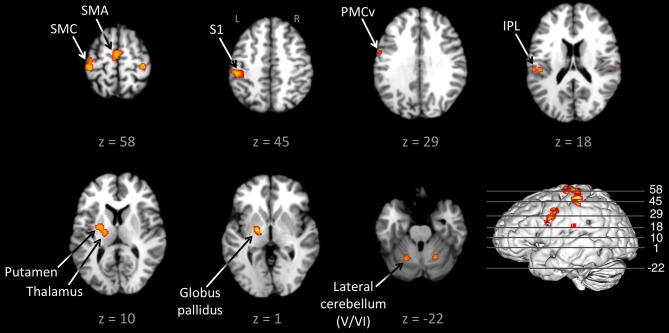
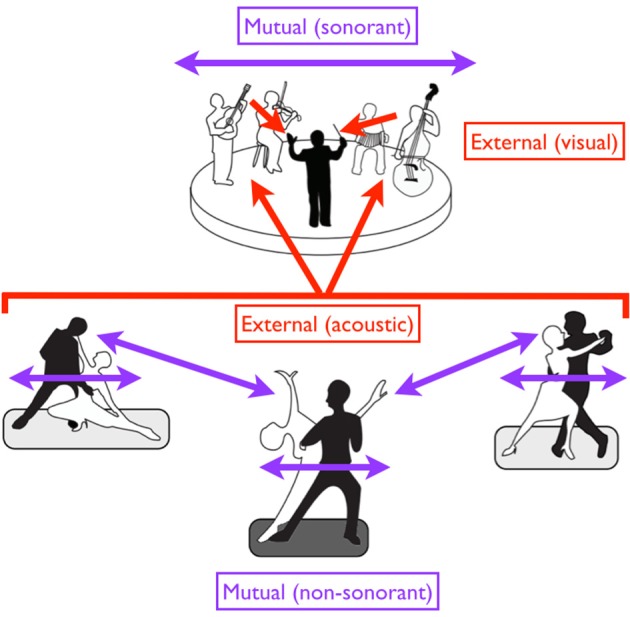
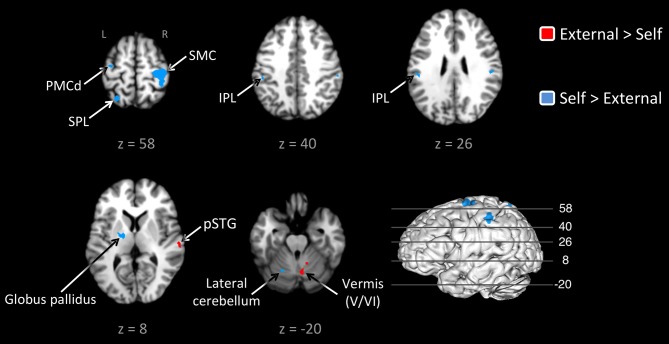
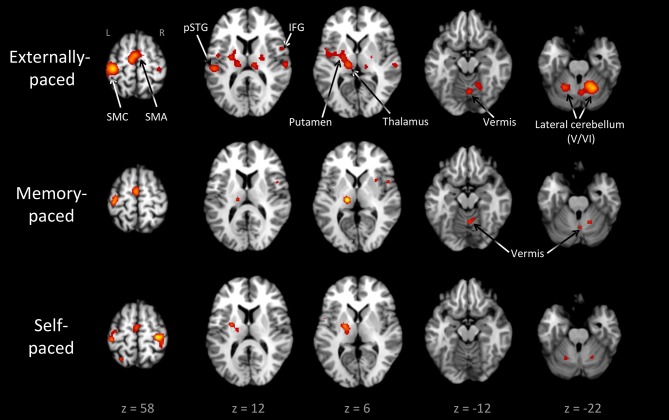
Synchronization of body movement to an acoustic rhythm is a major form of entrainment, such as occurs in dance. This is exemplified in experimental studies of finger tapping. Entrainment to a beat is contrasted with movement that is internally driven and is therefore self-paced. In order to examine brain areas important for entrainment to an acoustic beat, we meta-analyzed the functional neuroimaging literature on finger tapping (43 studies) using activation likelihood estimation (ALE) meta-analysis with a focus on the contrast between externally-paced and self-paced tapping. The results demonstrated a dissociation between two subcortical systems involved in timing, namely the cerebellum and the basal ganglia. Externally-paced tapping highlighted the importance of the spinocerebellum, most especially the vermis, which was not activated at all by self-paced tapping. In contrast, the basal ganglia, including the putamen and globus pallidus, were active during both types of tapping, but preferentially during self-paced tapping. These results suggest a central role for the spinocerebellum in audiomotor entrainment. We conclude with a theoretical discussion about the various forms of entrainment in humans and other animals.
身体运动与声学节奏同步是一种主要的顺应形式,例如在舞蹈中发生。这在手指敲击的实验研究中得到了例证。顺应节拍与内部驱动的运动形成对比,因此是自我调节的。为了研究对声学节拍进行顺应的大脑区域,我们使用激活可能性估计(ALE)元分析对手指敲击的功能神经影像学文献进行了元分析(43 项研究),重点是对外节拍和自我节拍敲击之间的对比。结果表明,涉及计时的两个皮质下系统(小脑和基底神经节)存在分离。外部节拍敲击突出了小脑的重要性,尤其是蚓部,自我节拍敲击根本不会激活它。相比之下,基底神经节,包括壳核和苍白球,在两种类型的敲击中都活跃,但在自我节拍敲击中更活跃。这些结果表明,小脑在听觉运动顺应中起着核心作用。我们以关于人类和其他动物各种顺应形式的理论讨论结束。