Matthews Tomas E, Lumaca Massimo, Witek Maria A G, Penhune Virginia B, Vuust Peter
Center for Music in the Brain, Department of Clinical Medicine, Aarhus University Hospital, Nørrebrogade 44, Building 1A, Aarhus C, 8000, Denmark.
Department of Music School of Languages, Art History and Music, University of Birmingham, Cultures, Birmingham, B15 2TT, UK.
Brain Struct Funct. 2024 Dec;229(9):2299-2313. doi: 10.1007/s00429-024-02836-x. Epub 2024 Jul 25.
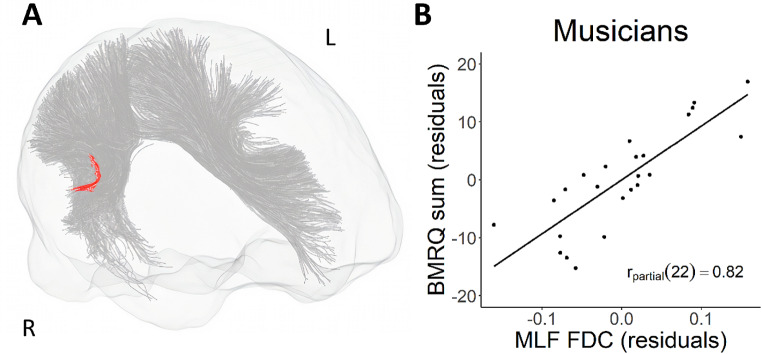
There are pronounced differences in the degree to which individuals experience music-induced pleasure which are linked to variations in structural connectivity between auditory and reward areas. However, previous studies exploring the link between white matter structure and music reward sensitivity (MRS) have relied on standard diffusion tensor imaging methods, which present challenges in terms of anatomical accuracy and interpretability. Further, the link between MRS and connectivity in regions outside of auditory-reward networks, as well as the role of musical training, have yet to be investigated. Therefore, we investigated the relation between MRS and structural connectivity in a large number of directly segmented and anatomically verified white matter tracts in musicians (n = 24) and non-musicians (n = 23) using state-of-the-art tract reconstruction and fixel-based analysis. Using a manual tract-of-interest approach, we additionally tested MRS-white matter associations in auditory-reward networks seen in previous studies. Within the musician group, there was a significant positive relation between MRS and fiber density and cross section in the right middle longitudinal fascicle connecting auditory and inferior parietal cortices. There were also positive relations between MRS and fiber-bundle cross-section in tracts connecting the left thalamus to the ventral precentral gyrus and connecting the right thalamus to the right supplementary motor area, however, these did not survive FDR correction. These results suggest that, within musicians, dorsal auditory and motor networks are crucial to MRS, possibly via their roles in top-down predictive processing and auditory-motor transformations.
个体体验音乐带来的愉悦程度存在显著差异,这与听觉和奖赏区域之间的结构连通性变化有关。然而,以往探索白质结构与音乐奖赏敏感性(MRS)之间联系的研究依赖于标准扩散张量成像方法,这些方法在解剖学准确性和可解释性方面存在挑战。此外,MRS与听觉 - 奖赏网络之外区域的连通性之间的联系,以及音乐训练的作用,尚未得到研究。因此,我们使用先进的纤维束重建和基于固定点的分析方法,研究了音乐家(n = 24)和非音乐家(n = 23)中大量直接分割且经过解剖学验证的白质束中MRS与结构连通性之间的关系。使用手动感兴趣纤维束方法,我们还测试了先前研究中在听觉 - 奖赏网络中观察到的MRS与白质的关联。在音乐家组中,连接听觉和顶下小叶皮质的右侧中间纵束中的MRS与纤维密度和横截面积之间存在显著正相关。在连接左丘脑与腹侧中央前回以及连接右丘脑与右辅助运动区的纤维束横截面积与MRS之间也存在正相关,然而,这些在错误发现率(FDR)校正后并不显著。这些结果表明,在音乐家中,背侧听觉和运动网络对MRS至关重要,可能是通过它们在自上而下的预测处理和听觉 - 运动转换中的作用。